

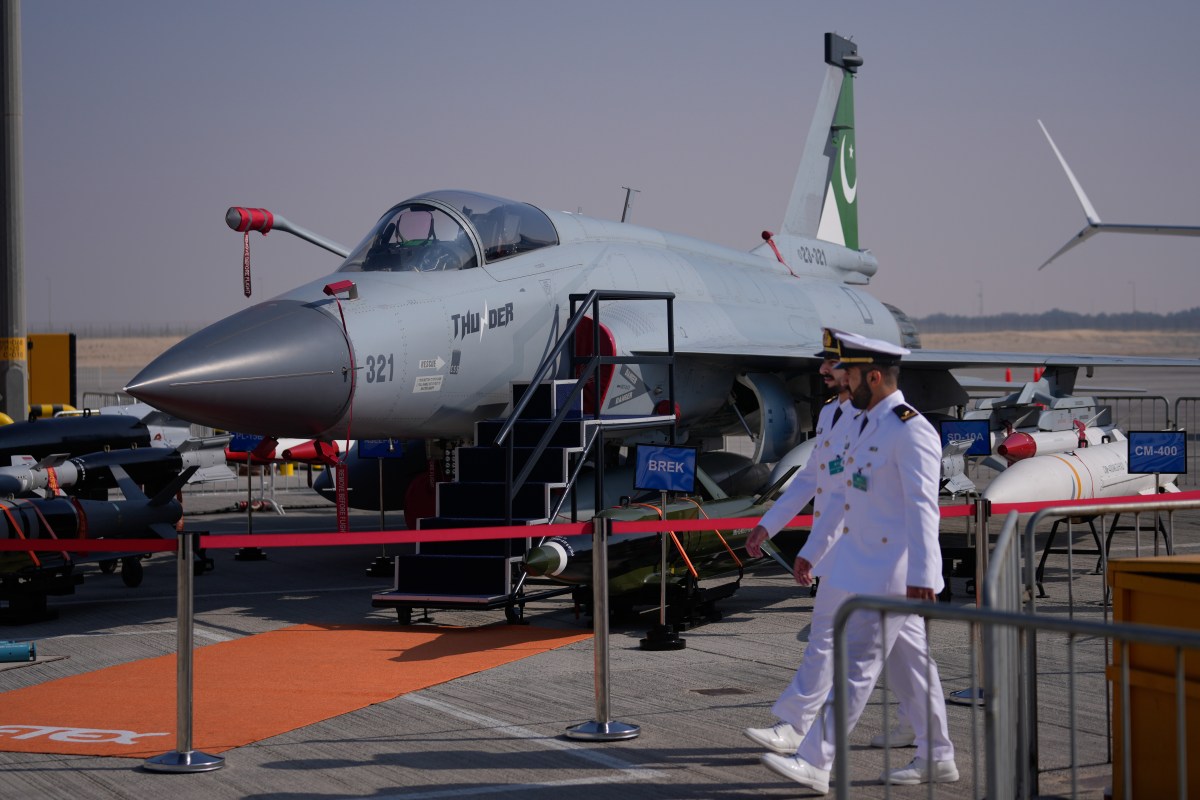
China’s advanced JF‑17 Thunder fighter is expanding its global appeal, achieving another potential export milestone this year after debuting in static and flying displays at two major international airshows.
Pakistan markets the Chinese co-developed JF-17 as a lower-cost multi-role fighter and has positioned itself as a supplier able to offer aircraft, training and maintenance outside Western supply chains.
Why It Matters
China has used its fast-growing defense industry to become the world’s fourth-largest arms exporter, supplying drones, fighter jets, and missiles to almost 48 countries, according to the Stockholm International Peace Research Institute.
The country’s rapid rise as a major arms exporter is reshaping global defense markets, particularly in Asia, Africa, and the Middle East, as affordable, modern platforms enable alternatives to Western suppliers to acquire capable systems, challenging U.S. influence.
What To Know
Pakistan has reached a $4 billion military export deal with the Libyan National Army in Benghazi, expected to include more than a dozen of the Chinese co-developed JF-17, Reuters reported earlier this week, despite a United Nations weapons embargo on the North African country.
In November, Pakistan announced that an unspecified friendly country had signed a memorandum of understanding (MOU) to acquire the JF-17 Thunder fighter jet at the Dubai Airshow.
Myanmar became the first foreign customer, ordering 16 Block‑2 jets around 2015. Nigeria followed with three Block‑2s, delivered and formally inducted in May 2021. Azerbaijan signed an $1.6 billion agreement for Block‑III aircraft in 2024, followed by a broader package announced in June for 40 jets valued at roughly $4.6 billion, according to the Army Recognition Group defense website.
Jointly developed by Pakistan Aeronautical Complex (PAC) and China’s Chengdu Aircraft Corporation, the JF‑17 Thunder is a fourth-generation, lightweight, multirole fighter jointly developed by Pakistan and China, now fielded in its export-oriented Block III variant with upgraded avionics and sensors.
Pakistan and China formally agreed to develop and produce the JF‑17 Thunder in 1999, which was formally inducted into the Pakistan Air Force (PAF) in 2010. Pakistan operates an estimated 156 JF‑17s and reportedly deployed them, alongside J‑10C fighters, during a recent conflict with India.
What People Are Saying
Pakistan’s Inter‑Services Public Relations (ISPR) said in a press release on November 20: “Demonstrating increasing international confidence in Pakistan’s aviation industry, several countries expressed interest in acquiring the JF-17 Thunder. In a noteworthy development, an MoU was signed with a friendly country for the procurement of the JF-17 Thunder, marking another significant milestone in Pakistan’s expanding defence and industrial partnerships.”
Douglas Barrie, Senior Fellow for Military Aerospace at the International Institute for Strategic Studies (IISS), wrote in an analysis in January 2024: “The Block III replaces the JF-17’s mechanically scanned radar with an active electronically scanned array (AESA) to improve targeting capabilities…The PAF is also adopting a twin-rack-launcher option for the J-10C and JF-17 Block III to increase the number of active radar-guided AAMs each aircraft can carry. Increasing the number of missiles provides, all things being equal, an aircraft with greater combat persistence.”
What Happens Next
Other countries, including Iraq and Bangladesh, have reportedly signaled interest, as Pakistan seeks to expand the JF‑17’s global footprint and advance its own defense export ambitions.
Read the full article here
