

Super quantum dots might be the next big (ok, little) thing in TVs. At least, that’s what companies such as TCL want you to believe. While “regular” quantum dots have greatly improved the performance of LCD and OLED TVs, many of our picks for best TV use them to create bright, vibrant images, for instance. Will SQDs offer any improvement or is this just marketing fluff?
As with most things tech, the answer is a bit of both. While the name “super quantum dots” is a little hyperbolic, there are potential improvements in performance. Behind the scenes there are also some impressive, if you’re a nerd like me, advancements in manufacturing that allow them to exist at all. First though…
What’s a quantum dot?
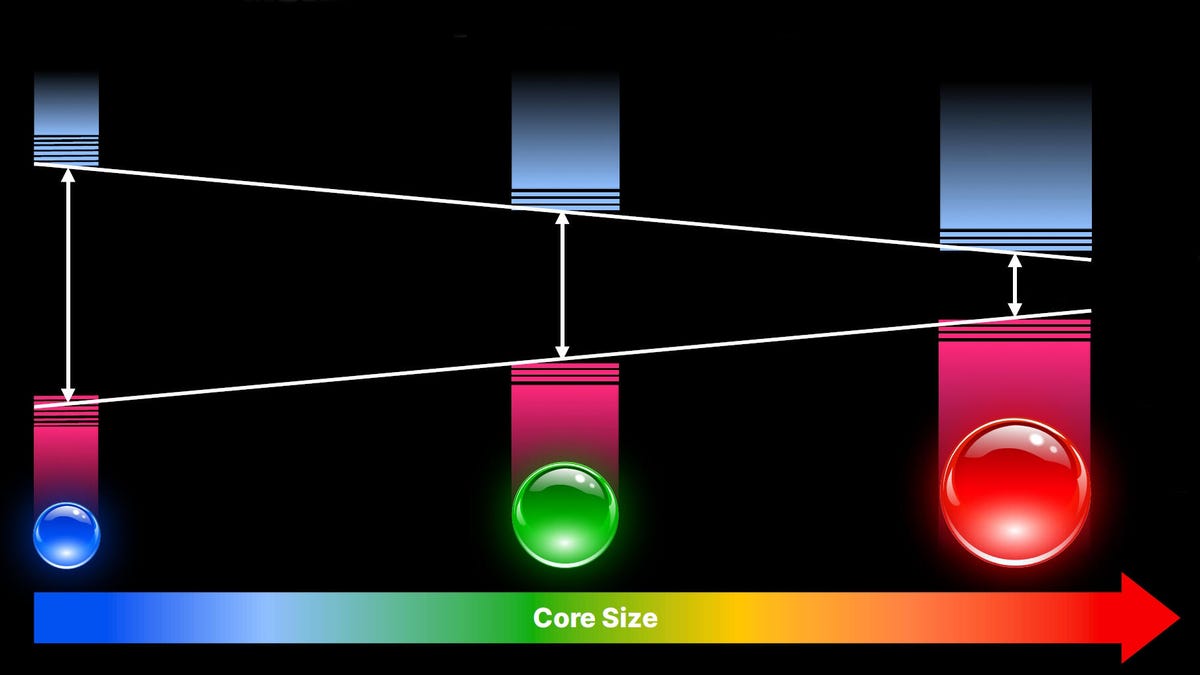
The size of the quantum dot determines what color it emits when supplied with energy. Currently that energy is supplied by blue LEDs or blue OLEDs.
A quick recap. Quantum dots are microscopic particles with a fascinating ability: They can turn one color of light into another color of light with near-perfect efficiency. Right now, the most common use for quantum dots is for converting the blue light of a blue LED or OLED into red and green.
While this is how the majority of TVs with quantum dots work today, in the future there are versions of QD that will convert electricity to light directly (no LEDs required) as well as using ultraviolet light to create visible light.
Two vials of red and green quantum dots, lit with a blue/violet flashlight.
For more detail, check out How quantum dots could challenge OLED for best TV picture, QD-OLED TV: Samsung, Sony Take on LG With Quantum Dot Special Sauce and Putting the ‘Q’ in QLEDs: Where Quantum Dots Are Made.
To understand the next part, the main thing you need to know is that the size of the quantum dot determines what color it emits. The smallest quantum dots emit blue light, medium-sized quantum dots emit green, and the chonkiest (but still microscopic) QDs emit red.
Super quantum dots
Advancements in manufacturing have allowed quantum dot manufacturer Nanosys to be able to offer QDs in batches that create light down to a specific nanometer. This kind of precision allows TV manufacturers to better tune their color filters and overall TV design to create the color gamut and overall performance they want. While the color difference in this photo, compressed for the web, isn’t super obvious, in person you could make out the subtle differences between the different vials. It was most noticeable between the vials with the biggest difference (521nm vs. 537nm for example), but as you looked at them for a moment, the differences between closer vials became noticeable as well.
In essence, a super quantum dot is a refined version of the existing quantum dots, and requires a lot of specialized equipment. The QD manufacturing plant I saw looks like a brewery and involves many stages to get the size required. If the molecule is too big or too small it might not work at all to convert light. Depending on the intended performance of the end product, slight variations in size might be acceptable. Which is to say, as long as the QDs are roughly the same size, some might be a deeper red or a lighter red for example, they’ll average out to be “red” to the person watching TV.
That average might not be good enough, however, for TVs designed for higher-performance. Super Quantum dots are designed to fill this need for better efficiency from the individual elements, with the aim being deeper, more realistic color. The problem is, deeper colors don’t seem as bright, and brightness is pretty much always the main concern for any TV manufacturer. So, the colors need to be quite pure and exact — red is just red, green is only green, and so on. If they’re not, energy is wasted creating color which isn’t as bright or as colorful compared with a competing technology like RGB mini-LED, for instance.
TCL’s representation of the super quantum dot design they’re using.
For example, say you had green quantum dots which were also a little yellowish, that “wasted” yellowish light could have an effect on other colors, including on how deep the red looks. Furthermore, if some red QDs are a little yellowish, that might limit how green the green can be, while also limiting the performance of the red. With budget TVs this isn’t a big deal because the average, as I mentioned earlier, is still “red” or “green.” To get that highest level of performance, though, you need the purest ingredients. Ingredients, in this case, being specific color reproduction.
Are they really “super” though?
Are TVs that use super quantum dots going to look massively better than TVs with boring old regular quantum dots or other technologies? Probably not. Like with most TV advancements these days, it’s an incremental step. TCL is leaning into the name, combining “better” quantum dots with a new color filter design. They’re claiming a 33% increase in color gamut, though we’ll have to see how that stacks up in our lab. You can expect other manufacturers who use or make quantum dots to move in the same direction. They might not call their tech “SQD” but the goal of every TV manufacturer is for brighter, more vibrant TVs, and better-performing QDs is the next way some of them are doing that.
In addition to covering audio and display tech, Geoff does photo tours of cool museums and locations around the world, including nuclear submarines, aircraft carriers, medieval castles, epic 10,000-mile road trips and more.
Also, check out his books Budget Travel for Dummies and the bestselling sci-fi novel about city-size submarines. You can follow him on Instagram and YouTube.
Read the full article here
