

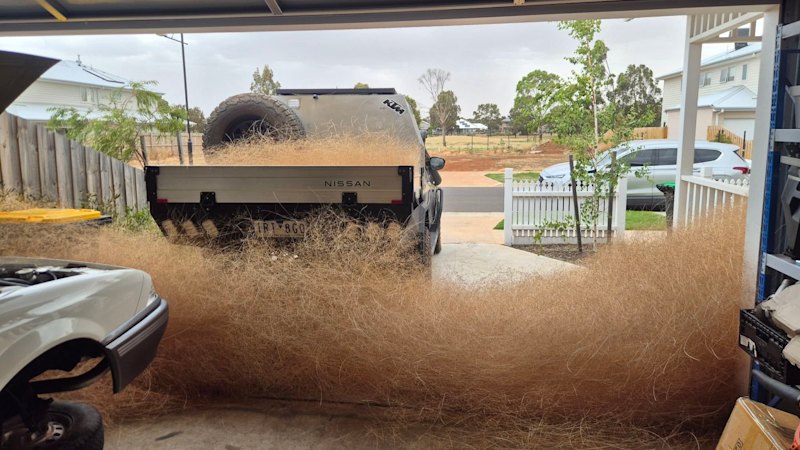
Tumbleweeds blown from overgrown paddocks are increasingly inundating homes in Melbourne’s outer west, creating a messy and potentially dangerous fire hazard for locals.
The City of Melton has received 44 requests to help clean up tumbleweeds this financial year – more than double the next-highest annual figure since the council started collating such data four years ago.
Suburbs such as Hillside, Aintree, Eynesbury and Kurunjang have previously experienced tumbleweed events and could endure more soon, the council has warned, as increased rainfall in spring caused rapid grass growth that dried out in recent heat.
Fraser Rise resident Tony Cox said strong winds had recently blown tumbleweeds across Western Plains into his property, encasing his home in metres of a tinder-dry fuel that wedges itself between his fence and house.
“I’ve been nervous as hell during the hot weather, with the potential of fire breaking out there,” he said.
“They’ve been pretty ferocious. You can clean them up now and they’ll be back within the hour.”
Sharon Apap, a resident of Fraser Rise for 12 years whose property also faces an open reserve, said the tumbleweed problem had worsened this summer.
“I would have them in the past, absolutely, but not to the extent that I had it this year,” she said.
An estate in Hillside was buried beneath an even larger torrent of tumbleweed in December 2020, when gale-force winds drove the spread of dry grass, colloquially known as “hairy panic”.
A hairy panic invasion also led to global headlines for Wangaratta in 2016, when some homes were covered by tumbleweeds that climbed two metres high.
Professor Leslie Weston, a plant biologist at Charles Sturt University, said the term “hairy panic” was often broadly used to refer to several different species of Panicum grass.
However, she suspected the recent tumbleweed outbreak in western Melbourne was the result of Hillman’s panic – a grass from Texas introduced to South Australia in the early 1900s that has become dominant.
The windswept invasive grass can be toxic for livestock, Weston said, and had spread all the way to Bathurst, about 200 kilometres west of Sydney, moving up to 100 kilometres each year.
“It’s a real problem,” Weston said, “because if people aren’t mowing their paddocks in the appropriate time, the plant will set seed, and once it sets seed and produces these seed heads, it can disperse and repopulate and essentially invade areas where it hasn’t been previously.”
Weston said this tumbleweed was different to those typically depicted in American films, which were often spikier shrubs.
A spokesperson for the City of Melton said the frequency of tumbleweed events on Melbourne’s fringe varied from year to year and was highly dependent on the right dry and windy weather following rapid grass growth.
“Tumbleweeds typically come from large privately owned properties with areas of overgrowth,” they said.
“Council takes a proactive approach to reducing their impact on the community by implementing its fire prevention program and undertaking roadside slashing to reduce tumbleweed and fire risk.”
After the tumbleweed event on January 9, council workers had identified and helped clean up tumbleweed from the majority of affected homes within two days, the spokesperson said.
Cox said his tumbleweed problem had escalated in the last five years as maintenance of the paddock across the road from his house had slackened.
“It’s just atrocious,” he said. “We’ve had them like a metre high at the front door and two metres deep. It’s hard yakka cleaning them up, I can tell you, because they are such little things, they’re very hard to pick up.”
Cox appreciated the efforts of council this summer to try and get private landowners to cut their grass, having pestered the municipality in previous years.
However, he believed the tumbleweed problem could worsen as residential development continued to expand into previously rural areas.
Apap said the grass near her home was recently cut, but she was still cleaning up tumbleweeds from earlier this month.
“You’re constantly fighting to get through them to get into the house,” she said. “This is ongoing every year. We just need to be proactive and prevent this from taking place.”
Get to the heart of what’s happening with climate change and the environment. Sign up for our fortnightly Environment newsletter.
From our partners
Read the full article here
