

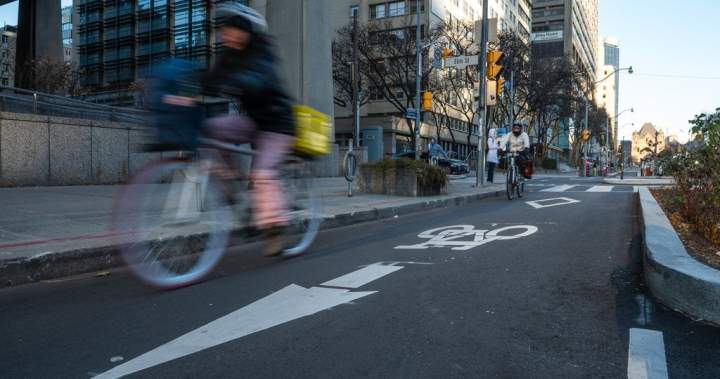
A group of Toronto cyclists are in Ontario’s highest court on Wednesday to defend their successful challenge of the province’s plan to rip up three stretches of the city’s bike lanes.
The cyclists, including a bike courier and a university student, have so far successfully argued the unproven plan to improve traffic by taking out protected bike lanes is an unconstitutional risk to their safety. The Court of Appeal for Ontario will hear the provincial government’s appeal of the case on Wednesday.
The province argued the lower-court decision would effectively create a right to bike lanes, a position dismissed by the Superior Court justice last July.
Justice Paul Schabas found the government pursued the plan though its own advisers and external experts broadly agreed it would not accomplish its stated goal to reduce traffic congestion — and could possibly make it worse. Even if the claim was taken at face value, the judge found the harm caused to cyclists would be way out of step with the law’s intent to save some drivers “a few minutes of travel time.”
He found removing the bike lanes, or reconfiguring them so they’re no longer separated, would lead to more accidents, injuries and death. The government recognized as much when it added an immunity clause to the legislation shielding it from liability, his ruling said.
Premier Doug Ford’s government passed a 2024 law to remove 19 kilometres of protected bike lanes in Toronto along Bloor Street, Yonge Street and University Avenue.
The risk of cyclist injury on a major street with parked cars and no cycling infrastructure is about nine times greater than on a protected bike lane, a 2024 Toronto city staff report suggested, citing research.

Get daily National news
Get the day’s top news, political, economic, and current affairs headlines, delivered to your inbox once a day.
The report noted 28 people have been killed and 380 seriously injured while cycling in Toronto over the past decade. About two-thirds of those crashes took place on streets without safe bike lanes, the report said.
Schabas ruled the province’s move to amend the legislation while the case was being decided — under the government’s new wording, bike lanes would be “reconfigured” rather than removed — was effectively a distinction without a difference that could be seen as an attempt to evade his judgment. So long as the province was trying to remove separated bike lanes to restore vehicle traffic, the issue was the same, Schabas said.
As part of its appeal, the province is arguing that Schabas erred in finding that bike lane removals would violate the right to life, liberty and security of a person as that section of the Charter “was never intended to subject legislation that has any impact on safety to judicial scrutiny.”
Ford has called out the lower-court decision as ridiculous and ideological, once using it as fodder to rant about the idea of elected judges.
The premier has said he doesn’t oppose bike lanes but wants them off arterial roads and onto secondary streets. But the judge heard evidence from the city and others who suggested that for many sections of the targeted bike lanes there were no feasible alternatives on secondary roads without creating disconnected, and more dangerous, stretches for cyclists.
A spokesperson for Toronto Mayor Olivia Chow says she has been working with the province toward “win-win” solutions that keep both car lanes and protected bike lanes.
The city has previously suggested it could cost about $48 million to take out the bike lanes. The province’s transportation minister initially said he didn’t believe the estimate but failed to provide one of his own.
In October, minister Prabmeet Sarkaria said the government would move ahead with plans to restore lanes of vehicle traffic but keep bike lanes on a short stretch of Bloor Street at a cost of $750,000. He said the bike lanes would include barrier curbs and bollards.
Chow called it a good compromise. Michael Longfield with Cycle Toronto, the advocacy group spearheading the court challenge, also welcomed the change but questioned whether it was a workable solution on all the bike lanes targeted by the province.
Ahead of Wednesday’s hearing, Longfield said the case was about ensuring the government respected the rule of law.
“The Ford government is wasting time and public money on a bad-faith culture war, against the advice of its own experts, at a moment when Ontarians need leadership focused on real solutions for real challenges,” he said in a statement.
Read the full article here
