

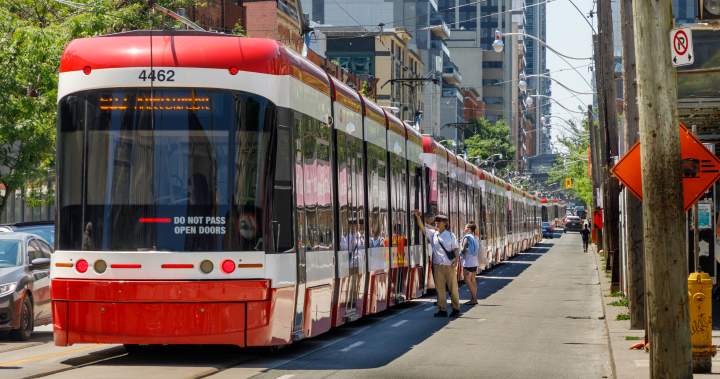
When hundreds of thousands of soccer fans descend on Toronto this summer, the city’s plan to get them to and from World Cup matches depends on its least reliable form of transit.
Exhibition Place, where matches involving countries like Germany, Senegal and Panama will be played in June and July, isn’t located on any of Toronto’s subway lines and is instead served by streetcar.
The streetcar on Bathurst Street feeds into the area beside BMO Field Stadium and is at the centre of Toronto’s plan to move thousands around. To do so, officials are looking to massively ramp up service along the line.
The route was designated as a RapidTO project, along with the Dufferin Street bus, last year to create red-painted priority lanes where transit can run without being interrupted by cars. Headways will also be increased so streetcars run roughly every five minutes during the FIFA celebrations.
The TTC, however, is in a race against time to ensure the overhead electrical cables and other core infrastructure can handle the increased service before fans begin to arrive in June.
An internal TTC presentation, obtained by Global News using freedom of information laws, shows assessments are underway to see how the line would cope with increased service — and new upgrades are likely needed.
Get breaking National news
For news impacting Canada and around the world, sign up for breaking news alerts delivered directly to you when they happen.
“Network simulations indicate potential vulnerabilities; operational adjustments may be needed,” part of the presentation warned. “Limited time and infrastructure prevent capacity increases at all critical sites.”
The same document suggests implementing “subway-style scheduling” on the line and says engineers are “evaluating capacity limits” along Bathurst Street.
Josh Colle, the TTC’s chief strategy and customer experience officer, told Global News the transit agency has the drivers and vehicles to run significantly enhanced service, with only the infrastructure left to check.
“The question kind of turned to the other side, which is to say we need to make sure the power grid and all of that infrastructure can accommodate that level of service,” he explained.
“We’ve got to run it in a way that is smooth and spaced well — you can’t have four of those massive streetcars dwelling in one power block.”
Colle said work was currently underway to test the capacity of the network and look for ways to ensure that Bathurst Street can handle increased streetcars.
The move is not without its risks. Streetcars are consistently Toronto’s least reliable and least popular form of transit.
A February update from the new CEO of the TTC shows streetcars have an on-time performance of just 55 per cent, compared to 73 per cent for buses and 82 per cent for subways.
Customer satisfaction is lower, too, with only 58 per cent of streetcar riders satisfied. That’s substantially lower than the 70 per cent of bus passengers and 74 per cent of subway riders.
The recent opening of the Finch West and Eglinton Crosstown LRTs put further emphasis on the problems, with complaints about riders sitting for long periods at traffic lights waiting for cars to breeze through.
Colle acknowledged putting that network at the centre of the World Cup plan is a risk, which could come with long-term rewards.
“I am always concerned about the service with lots of spotlight on us, so that only becomes heightened with the World Cup,” he said.
“I think the pressure and the call to action is: make this work for the World Cup because if we can, it’s proof of concept. Can we make Spadina really sing? Can we make St. Clair do what it should?”
Read the full article here
