

Two competing visions for the EU’s economic future are set to collide on Thursday, when the bloc’s leaders gather for an informal retreat to discuss reviving the bloc’s competitiveness.
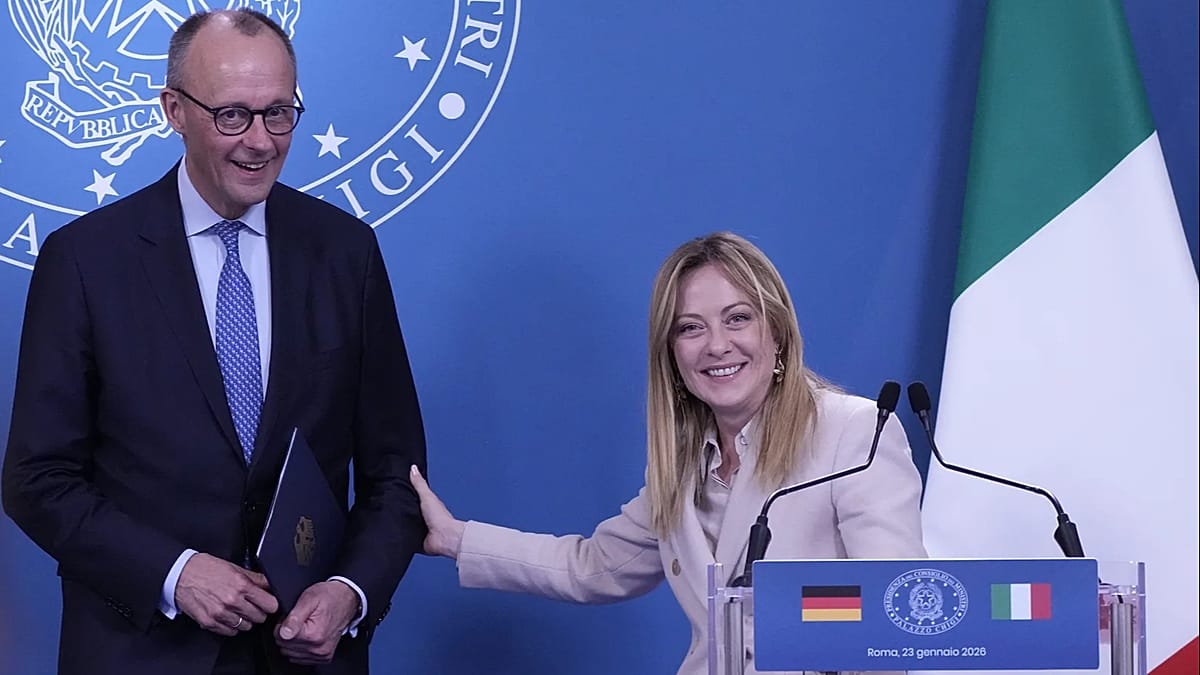
On one side stands France; on the other, a newly aligned Germany and Italy.
Paris made a last-minute move to join an informal pre-summit scheduled by Berlin and Rome ahead of the retreat on Thursday morning in an unusual bid to coordinate their positions before leaders convene.
The French intervention followed remarks on Tuesday from President Emmanuel Macron to several European media outlets, and amounts to an effort to assert Paris’ agenda in response to a document circulated in recent days by Germany and Italy that lays out a sharply different vision for the EU economy.
In doing so, the French president has flipped the script and introduced firmly on the table one of the most divisive matters for EU leaders: pooling debt to prop up the bloc.
The timing is no coincidence either.
Earlier this month, Mario Draghi, called on the EU to work as a true union and urged leaders to implement a “pragmatic” federalist approach to survive in a new, more brutal world.
The retreat in Alden Biesen, Belgium comes a year and a half after a landmark report by Draghi warned of a bleak outlook for Europe’s economy unless decisive steps were taken to boost competitiveness.
Since the report’s publication in 2024, the global geo-economic landscape has shifted dramatically, with the US and China’s aggressive agendas adding pressure on the EU’s 27 countries.
Macron is the most loyal to Draghi’s ambitions but also the weakest leader at home compared to Meloni and Merz.
Divisions expected on eurobonds
During the retreat, leaders will focus “on strengthening the Single Market, reducing barriers to growth and enhancing Europe’s strategic autonomy,” according to the agenda presented by the Cypriot EU presidency.
Draghi, along with another former Italian prime minister, Enrico Letta – who published his own landmark report on the Single Market the same year – will attend parts of the discussions.
Still, a senior EU official said the time for diagnosis was over, and that leaders now need to take “concrete measures” to move the EU’s economic agenda forward.
Reaching consensus, however, will be difficult. The EU’s Franco-German engine appears to be sputtering, with Paris now facing a fresh Berlin-Rome alliance. On 23 January, Germany and Italy agreed to coordinate their push to deregulate industry.
The first flashpoint is expected to be Macron’s call, made Tuesday, for issuing common EU debt – eurobonds – to finance the massive investments needed to lift competitiveness. Draghi’s report in 2024 put those needs at between €750 billion and €800 billion a year.
“We have three battles to fight: in security and defence, in green transition technologies, and in artificial intelligence and quantum technologies. In all of these areas, we invest far less than China and the United States,” Macron said, adding: “If the EU does nothing in the next three to five years, it will be swept out of these sectors.”
Berlin, however, has long resisted repeating the joint borrowing used to fund the €750 billion post-Covid recovery plan.
Instead, Germany and Italy are expected on Thursday to call for expanded venture-capital financing and stronger exit options for investors. The document circulated by Rome and Berlin suggests “the creation of a pan-European stock exchange, a pan European secondary market, and a review of capital requirements for lending without impeding financial stability”.
On eurobonds, Nordic countries have traditionally sided with Germany.
Still, the same senior EU official noted that “when the European Union needs to take those decisions, it has taken so,” adding that joint borrowing remains an option after the bloc again turned to it at the end of 2025 to support Ukraine. “There is no dream of European debt. There is European debt out in the markets and we’ve just increased by 90 billion last December.”
In a letter sent to leaders on Monday, Commission chief Ursula von der Leyen did not mention joint borrowing, doubling down on cutting excessive regulation and integrating the 27-nation single market.
In the run-up to a meeting with European industry leaders, she also appealed to establish the so-called 28th regime to harmonise rules for companies operating across Europe.
Germany’s strict conditions
France is also pressing for a long-standing priority: a European preference, or “Made in Europe,” policy that would favour EU-content products in public procurement.
“It’s defensive, but it’s essential, because we are facing unfair competitors who no longer respect the rules of the World Trade Organization,” Macron said on Tuesday.
While the idea has gained traction in EU capitals and at the European Commission, Nordic and Baltic countries as well as the Netherlands warned in a non-paper circulated ahead of the summit that the European preference “risks wiping out our simplification efforts, hindering companies’ access to world-leading technology, hampering exchange with other markets and pushing investments away from the EU.”
Germany, meanwhile circulated a document seen by Euronews in December as part of discussions among the 27 laying out strict conditions. Berlin wants the European preference to be time-limited, broadly defined, and applied only to a narrow list of products. It also favours a “Made with Europe” approach, open to countries with EU free-trade agreements and other “like-minded” partners.
Italy, the EU’s third-largest economy, has sided with Germany. Both countries say their priority is not only to support European businesses but also “to attract new business from outside the EU,” according to their document to other capitals.
Macron appeared to partially align with that view on Tuesday, saying the European preference should focus on limited sectors such as clean tech, chemicals, steel, automotive or defence. “Otherwise Europeans will be swept away,” he said.
Berlin and Rome want more deregulation
At the retreat, Berlin and Rome are also set to push a deregulatory agenda. As the European Commission rolled out several simplification packages in 2025, the two countries are calling “for further withdrawals and simplifications of EU initiatives across the board”.
They also propose an “emergency brake” allowing intervention if legislation raises “serious concerns regarding additional administrative burden both on enterprises and on national authorities”.
Last but not least, the Mercosur trade agreement looms large. During the retreat, the Commission plans to consult EU countries on its provisional implementation after a judicial review triggered by the European Parliament suspended ratification of the deal, signed with Brazil, Argentina, Paraguay and Uruguay.
France remains firmly opposed to the Mercosur agreement, citing farmers’ fears of unfair competition from Latin American imports. But the deal nonetheless won backing from a majority of member states in January after Italy gave its support.
Berlin and Rome leave little room for doubt in their document: “We call for an ambitious EU trade policy taking full account of the potentials and needs of all economic sectors, including agriculture. The finalisation of the EU-Mercosur Agreement was an important step in that direction.”
Read the full article here
