

As the Winter Olympics are underway in Milan, fake videos, AI-generated content and disinformation are flooding social media about the Games.
The Cube, Euronews’ fact-checking team, found examples of this video of JD Vance looking concerned as loud boos are heard in the background being shared on X and Telegram.
One version of the clip reached more than 4 million views on X.
However, the video is not authentic.
Clip misrepresents Olympic Ceremony
The viral video appears to show Vance standing in the crowd and frowning as loud boos are heard. But comparisons with verified images of the actual opening ceremony show clear inconsistencies.
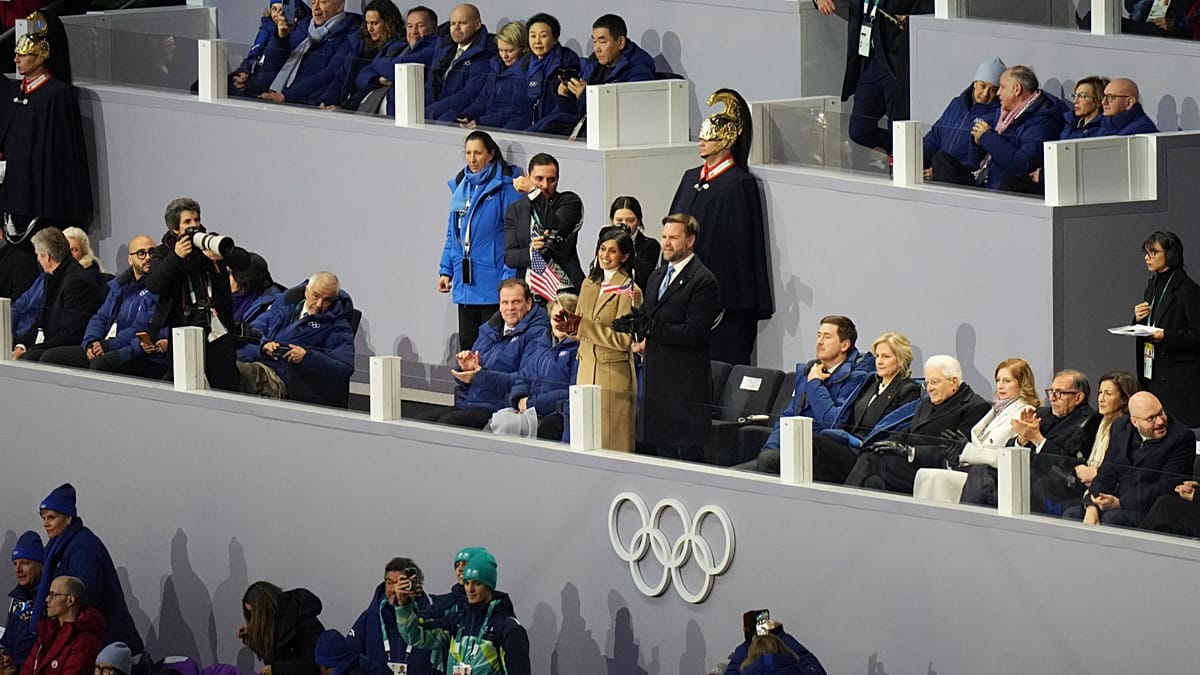
During the ceremony, Vance and his wife Usha were pictured standing in the crowd as the athlete’s passed by in a procession. In official photographs, Vance is clearly pictured wearing a formal suit, not the windbreaker seen in the video.
Vance did later wear a windbreaker, but this was during a preliminary round of women’s ice hockey, not the opening ceremony.
Reports from the event show that Vance was indeed booed by the crowd when images of him and his wife appeared on screen after athletes from team USA walked past.
One presenter on Canada’s CBC News can be heard saying “those are alot of boos for him” as the cameras cut to the vice president. Journalists attending the ceremony also reported hearing boos as they sat in the stalls at the event.
However, the viral clip is not from the event, and there are further signs it is AI-generated. At one point in the video, Vance’s eye movement appears unnatural.
Sensity AI, which finds and monitors AI-generated synthetic videos, told The Cube that there are there strong indicators the clip was created using AI from a still photograph of Vance.
Sensity found that midway through the clip, the video briefly plays in reverse, while the audio continues uninterrupted — suggesting the video and sound do not come from the original recording.
Vance’s body movements and the clip’s background details are also consistent with deepfake manipulation. At one point, his pupils briefly disappear.
The Amsterdam-based company animated the still photograph of Vance — taken whilst he attended a preliminary round of women’s ice hockey — using a commercially available AI tool. For around €12, they were able to produce a similar deepfake.
Russian disinformation targets Ukrainian refugees
Elsewhere, a large-scale campaign propagated by Russian Telegram channels used the Games as a means to spread disinformation about Ukrainian refugees.
One video, posted on Telegram, falsely claims to show Ukrainian refugees protesting outside Italian embassies demanding the Olympic Games be cancelled.
A voiceover claims that Ukrainian protesters are calling the event an “extravagant expense” and evidence that Italy is “ignoring the needs of Ukraine.”
There are no credible media reports of Ukrainians protesting against the Olympics in Italy.
Protests did occur, but reports say that these consisted of anti-ICE protesters, groups demonstrating against the Olympics’ financial and environmental impact and pro-Palestinian groups.
Another video shows a doctored CBC report using stock footage and an AI-voiceover claiming Ukrainian athletes at the Games are segregated from other athletes due to aggressive behaviour.
A look at the real report, by CBC’s Adrienne Arsenault, takes a look at the Olympic village which houses athletes. It makes no mention of Ukrainian refugees.
There are also no credible reports that suggest Ukrainian athletes are housed separately from other athletes during the Games.
The Centre for Countering Disinformation, a body affiliated with the National Security and Defence Council of Ukraine, reported further outlandish claims levelled towards Ukrainian refugees during the Games which are not backed up by official reporting.
These include posts that the World Anti-Doping Agency “eased doping controls” for the Ukrainian team and that translators for the team had “fled” delegations.
The Centre called these “coordinated” attempts from Russian networks to discredit Ukrainian athletes ahead of the Games, from which Russia is banned.
Sweden’s “Princess Frida”?
Another false claim that gained traction on X alleged that Sweden’s “Princess Frida” criticised US President Donald Trump and invited Canada to join the European Union.
The Cube found examples of this theory spreading on X, with combined posts reaching thousands of views and sparking debate over whether Canada should join the EU.
In reality, there is no Swedish princess called Frida, as corroborated by the official list of members of Sweden’s royal family.
The image shared alongside the claim actually shows Swedish cross-country skier Frida Karlsson, who is not a member of the royal family.
Karlsson, who won gold in the women’s 10km + 10km skiathlon on Saturday, has made no such comments.
Read the full article here
