

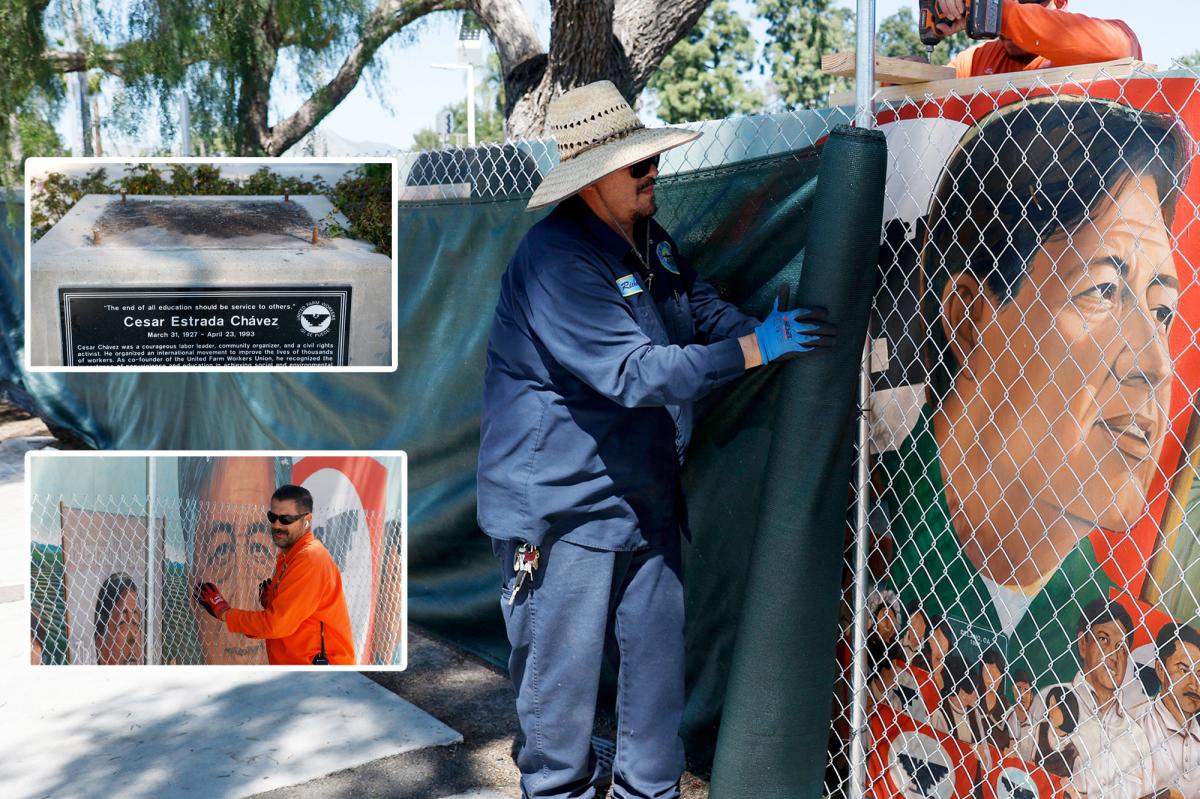
California taxpayers are staring down a multi-million dollar bill to wipe the legacy of union leader Cesar Chavez from the state’s schools, streets and public monuments.
The founder of the United Farm Workers has been accused of sexually assaulting, abusing and grooming woman and girls as young as 12 during the height of his power and influence during the 1960s and 70s.
The allegations have already forced Californian authorities to change the name of Cesar Chavez Day, a state holiday marked on his birthday of March 31.
Chavez, who spent most of his life in California, died on April 21, 1993 has had almost 50 schools at least partially named after him, as well as roads, monuments and murals.
But now the statues are coming down, street names being stripped, and murals are being covered up in a rapid-fire backlash against the once-revered labor leader.
In San Fernando, a statue of Chavez was removed, while at Santa Ana College, murals and other campus imagery bearing his likeness have been covered.
The Post contacted California State Controller Malia Cohen, the Department of Finance and the United Farm Workers union about who would be picking up the tab for the Chavez wipe out operation.
The California Department of Finance spokeswoman Danamona Andrianarimanana explained that whether the city or state pays to remove statues or update street signs depends on who owns the property.
She said no Cesar Chavez statues or signs are known to be on state property, so the city would likely be responsible.
She also noted that school boards control naming decisions and that any costs for renaming schools are covered by the school districts.
Herb Morgan, a candidate for state controller, confirmed the burden would mostly fall on taxpayers for all state and locally-owned assets, with a cost far in excess of $10 million.
Morgan, an investment professional with nearly four decades in financial markets, said: “It’s going to be local governments, cities, counties, school districts. The state would have to cover the removal on any state assets. It’s going to go through existing local budgets and general funds.”
“Fresno recently renamed a 10 mile stretch, which they spent $142,000 on for signs and installation,” he said.
“They’ll have to spend that again to put the old signs back in.”
Fresno City Council voted unanimously Tuesday night to begin restoring the original names, California Avenue, Ventura Street and Kings Canyon Road.
The streets were only changed to Cesar Chavez Boulevard in 2024.
Unexpected blowouts are likely to follow, too. In 1995, San Francisco budgeted $20,000 to rename Army Street to Cesar Chavez Street. But the cost jumped to nearly $900,000 because the new name was so long that the existing highway signs on Highway 101 and Interstate 280 had to be completely replaced.
In Bakersfield, City staff estimate it will cost about $30,000 for each city street sign replacement, and about $200,000 for freeway signs on H Street.
Renaming schools across California will not come cheap, either, based on previous California experience.
In 2021, the San Francisco Unified School District moved to rename 44 schools, but the plan was blocked due to a lawsuit and public backlash. While the renaming itself was estimated to cost at least $400,000 to $1 million, the district was also facing a $155 million budget deficit.
Meanwhile, replacing statues is likely to prove expensive. In Carlsbad, removing a controversial sculpture by Andrea Blum cost about $140,000 in 1999, or about $300,000 today when factoring in inflation and other costs.
Even restoring or repairing vandalized monuments like San Francisco’s Columbus during the Black Lives Matter protests cost tens of thousands of dollars.
Gov. Gavin Newsom has signaled interest in elevating the broader farmworker and labor movement over individual legacies. In Los Angeles, Mayor Karen Bass has already renamed Cesar Chavez Day to Farm Workers Day and floated the idea that changes could extend to holidays, buildings, streets, all of that.
Taken together, the numbers paint a stark picture. Renaming schools, swapping street signs and dismantling monuments come with a very real financial consequence.
Read the full article here
