

Though rooted firmly in science, nervous system regulation has, over the past two years, been talked about in every way, on every platform. It has been woven into trendy meditation courses and yoga flows, wellness retreats and self‑help books, podcasts, live shows, calm apps and even conversations about manifestation.
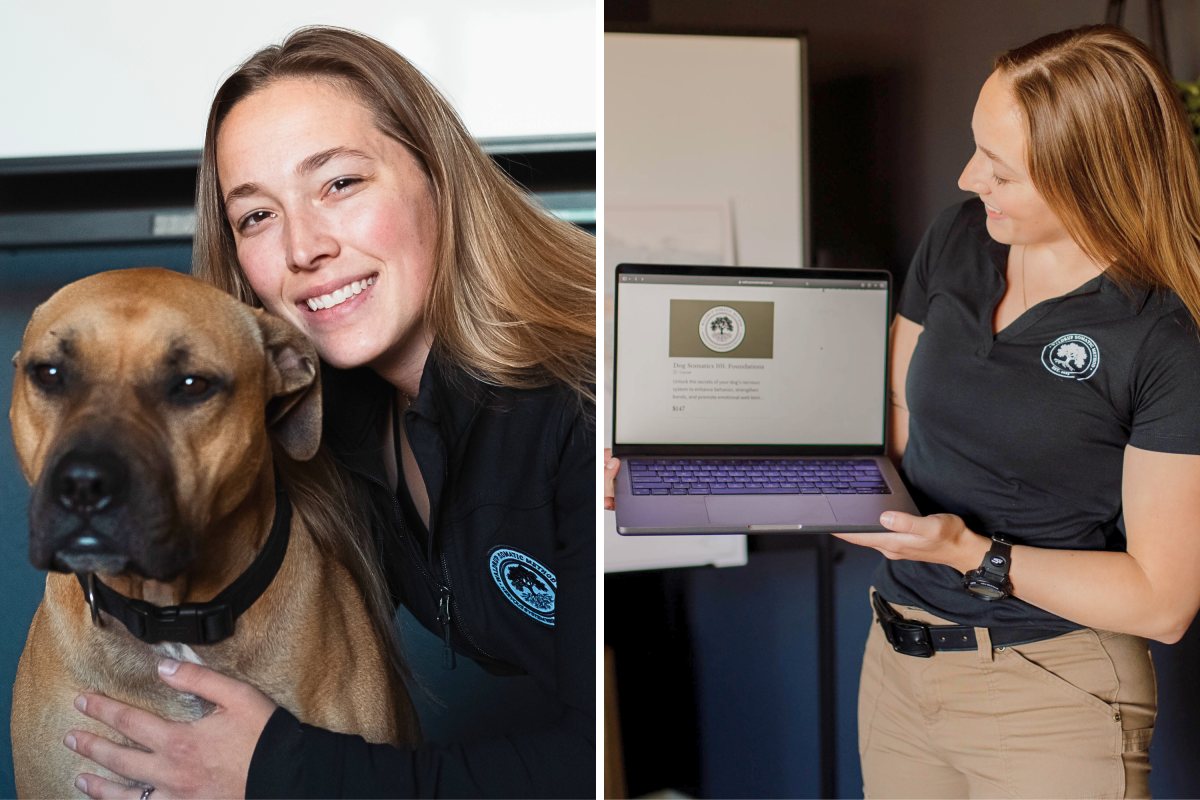
Now, it is time for dogs to get the same treatment and soothe their fight-flight responses. At the center of that shift is Rose Waldrup, the founder of the Waldrup Somatic Method, a canine nervous-system education methodology that integrates trauma‑informed care and somatic regulation.
“I’m formally trained as a psychosomatic practitioner working with humans, and my background spans years of studying how the body processes stress, trauma, and experience through the nervous system—long before I specialized in dogs,” Waldrup, 28, told Newsweek.
Over time, she said, the parallels became impossible to ignore—particularly when seeing rescue and shelter canines.
“I noticed how directly this applies to dogs, especially in rescues and shelters, who are often living in chronic states of survival,” Waldrup said. “That realization led me to develop an approach that bridges somatic principles, nervous system science, and canine behavior in a practical, real‑world way.”
Waldrup’s work reflects a broader cultural moment. As humans have become increasingly attuned to how stress, trauma and overstimulation live in the nervous system, a similar re‑evaluation is beginning to unfold in the way people understand animal behavior—especially in anxious dogs whose past experiences are often devastating, or even unknown.
“What’s important to understand is this: this isn’t just another training method—it’s the foundation underneath all behavior,” Waldrup said. “When you understand the nervous system, behavior stops being confusing.
“It starts to make sense,” she added.
At the heart of Waldrup’s approach is a distinction she returns to again and again.
“This is not training—this is regulation,” she said. “Most people try to change behavior from the outside in.
“We work from the inside out—starting with the dog’s nervous system.”
In practical terms, that means reframing behaviors that are often labeled as stubborn, reactive or defiant.
“A dysregulated dog isn’t being difficult—it’s being biological,” Waldrup said. “We’re not asking the dog to perform or comply, we’re working with its body, its patterns, its lived experience.”
From that perspective, the work becomes less about commands and corrections and more about safety. Waldrup’s method is built around a set of core principles she applies across cases, particularly with dogs who have experienced instability or trauma. Choice is a key component.
“Safety comes from choice,” she said. “When a dog feels it has control, the nervous system begins to settle.”
Equally important is observation before intervention.
“We don’t rush in, we watch,” Waldrup said. “Every dog is constantly communicating through subtle shifts in posture, breath, movement and engagement.”
Another guiding idea is that behavior always has a history.
“What we see on the surface is an adaptation to what the dog has experienced,” Waldrup said.
Rather than focusing on managing symptoms, Waldrup emphasizes nervous-system literacy—teaching people how to actually read their canine, rather than simply control it, until they allow their bodies to feel safer.
“If the nervous system isn’t stable, learning doesn’t stick,” Waldrup said. “Once regulation is in place, everything else becomes easier—and more lasting.
“This work is about helping the dog feel safe in its own body again,” she added. “From that place, behavior changes naturally.”
The Nervous System Tour
That philosophy has traveled well beyond individual sessions. Waldrup is on what she calls the U.S. Nervous System Tour, a project that has taken on a life of its own.
“At its core, it’s about shifting how people understand dogs,” she said.
The tour involves traveling across the country to work directly with rescue dogs, shelter teams and owners, demonstrating what happens when people stop trying to control behavior and start working with the nervous system instead.
“What we’re seeing over and over again is this: People don’t need more training techniques,” Waldrup said. “They need a new lens.”
The second phase of the tour is building toward a larger goal: a dedicated K9 Nervous System Sanctuary and Training Center. The space is envisioned as a place specifically designed for regulating highly stressed dogs, rehabilitating nervous systems rather than managing behavior, and teaching people how to work with canines at a deeper, biological level.
For dog owners curious about applying these ideas at home, Waldrup said the most-important step is also the simplest: slow down.
“Instead of asking, ‘How do I fix this behavior?’ ask: ‘What is my dog’s nervous system communicating right now?’” she added.
Small shifts, Waldrup said, can make a significant difference—giving canines more choice in interactions, reducing constant stimulation and pressure, paying attention to subtle signals such as breathing, posture and pacing, and focusing on creating safety before expecting change.
In a culture increasingly fluent in the language of regulation and healing, Waldrup said this nervous‑system‑first approach offers a more humane, and ultimately more effective, way to understand anxious dogs.
Read the full article here
