

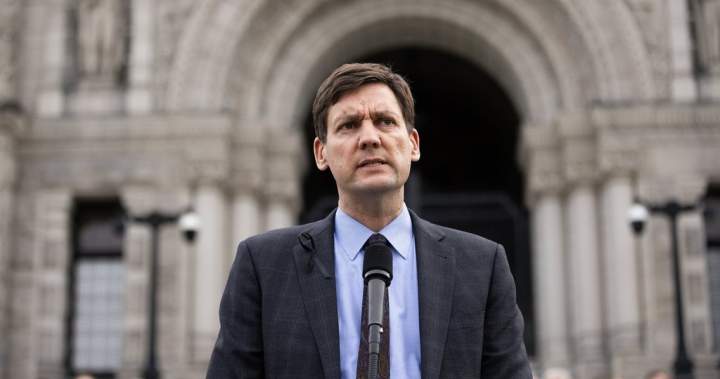
British Columbia’s government has proposed suspending sections of its Declaration on the Rights of Indigenous Peoples Act (DRIPA).
At a press conference on Thursday, B.C. Premier David Eby said that when the Act was introduced, it was to set out a framework by which the government could work with First Nations partners on addressing key concerns on issues including treaties, language preservation, care for Indigenous children and youth and unequal health outcomes and poverty.
“This act created an action plan that allowed us to prioritize work when developed in partnership with First Nations and it has been working,” Eby said.
“We have aligned 20 different laws in British Columbia, including laws that prohibited First Nations from owning property in the nation’s own name, laws that should have been addressed a long time ago.”
Eby said the Act has created massive job initiatives, such as the Eskay Creek Mine and Red Chris Mine in Tahltan Territory, as well as partnerships on clean energy across B.C.
“Recently, we had a decision from the Court of Appeal that, instead of the step-by-step incremental approach of the action plan, that the UN declaration was incorporated into British Columbia law overnight, and as I described it to Indigenous leadership today, instead of taking, eating the elephant one bite at a time, the court has invited us to do it all at once, and that is just not possible,” Eby said.
Get daily National news
Get daily Canada news delivered to your inbox so you’ll never miss the day’s top stories.
“So we’ve been presenting this challenge to our First Nations partners. How do we preserve what’s been working about the Declaration Act while at the same time addressing the very serious litigation risk that is present for the province of British Columbia as a result of the Court of Appeal decision?”
Eby was referring to a December 2025 decision from the provincial appeals court. In its ruling, the court agreed with the Gitxaała and the Ehattesaht First Nations, which argued that the government’s obligations under the Declaration Act are legally enforceable.
Days after the ruling, Eby told attendees at a BC Chamber of Commerce event that his government would look at amending the Declaration Act. Now, he’s saying the changes are “non-negotiable” from his government’s perspective.
Eby said on Thursday that during the first round of meetings with Indigenous leaders, they heard “loud and clear” that any proposed amendments to the act were “totally unacceptable.”
“They felt the process was rushed and that the entirety of that approach was wrong,” Eby said.
“So we took that feedback back and we withdrew that proposal. Today, I presented another proposal to Indigenous leadership that responds to government’s concern about legal liability, but also seeks to respond to the Indigenous leadership’s concern about preserving the act and ensuring that we take the time to be able to respond to what the actual court instructions are to us on this.”
Eby said the specific proposal put forward on Thursday would put a temporary pause on some sections of the act for up to three years.
“It could be less,” he said, “but whatever is required in order for us to get final instructions from the Supreme Court of Canada for the Gitxaała matter to be fully determined, and to take that information and sit down together and work out what the best path forward is. That was the proposal that we brought forward.”
He added that the temporary pause relates directly to the Gitxaała decision.
More to come.
-with files from The Canadian Press
Read the full article here
