

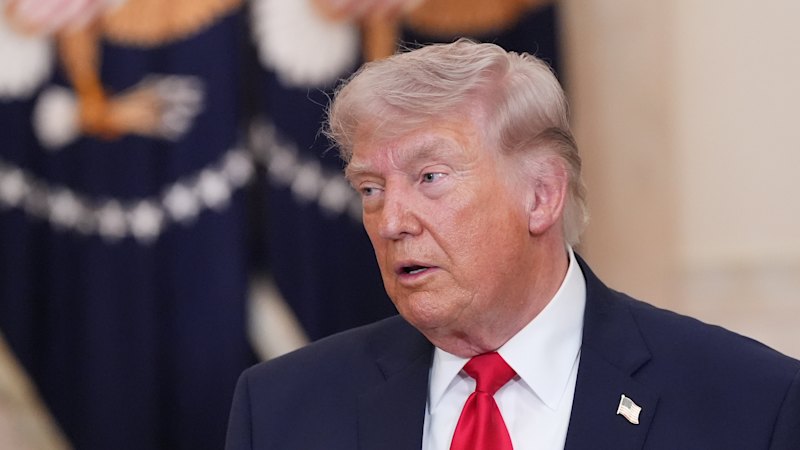
The US president’s recent remarks about bombing the Iranian people back to the Stone Ages (“Trump blast sees hopes for quick end to war dim”, April 3) was clearly based on the same comments that I remember well, made by the US Air Force general Curtis LeMay in the 1960s. He was referring to the planned carpet bombing in the Vietnam War. Like many comments made by the current US president, there is a most unfortunate lack of knowledge and respect for history. Does he have no gatekeepers? The Vietnamese people rose beautifully and quickly out of the Stone Age to comprehensively defeat the US armed forces. I wonder if the Iranians will do the same but in a different manner for a different period. The Vietnam War marked the start of the modern era of guerilla warfare and led to the toppling of Manhattan’s World Trade Centres and the inglorious defeat of the US and its hapless allies, such as Australia, in Afghanistan. It’s one thing to not know about history, but it’s clearly another to clumsily cherry-pick quotes from its barbarism, particularly when it’s from one of your own. Stephen Bargwanna, Coogee
It was nauseating to hear Donald Trump threatening to attack Iran so violently that “it would bring them back to the Stone Ages where they belong”. The callousness, sadism and denigration is beyond belief. One can’t help but think of those ordinary Iranians who a month ago held Trump up as their saviour when he promised them freedom and hope. Toni Lorentzen, Fennell Bay
When not playing cowboys and Indians, the artful draft-dodger has a hankering for mid-20th century times. Disparagingly and blandly referring to how he wants the US to bomb Iran “back to the Stone Ages, where they belong”, Donald Trump seems encouraged by the populist 1960s US vision of bombing North Vietnam “back to the Stone Age”. That played out well for the US and its allied others over many grinding years, didn’t it, Mr President? Sue Dyer, Downer (ACT)
Trump talks of bombing the people of Iran “back to the Stone Ages”. The region of Mesopotamia, between the Euphrates and Tigris rivers, has a history dating back many thousands of years and includes part of present-day Iran. The civilisations that succeeded one another there developed urbanisation, writing, mathematics (including algebra), law-making, astronomy, medicine … the list goes on. No wonder it’s regarded as the cradle of civilisation. One example: the reason we have 360 degrees in a revolution, 60 seconds in a minute and so on is that, over 5000 years ago, the Sumerians reckoned that a year was close to 360 days’ long, just one living legacy of Mesopotamian civilisations. How does the Stone Age fit in there? Bill Forbes, Medowie
It is clear that Donal Trump is running out of ideas. His main aim in life is to be the centre of attention, and what is more attention-drawing than starting a war? If the world promises, and that includes the media, to pay no attention to him for a whole month (a sort of belated Lent), might he just evaporate or explode in a tantrum and save us all a lot of lives and money? It’s worth a try. Nola Tucker, Kiama
The war with Iran should publicly be referred to in the media as “Trump’s War”. That naming will ensure history always couples Trump with war, as opposed to his demand that “Trump’s peace” be his legacy. Dorothy Kamaker, Whale Beach
Excise excuses
Waleed Aly (“The road beyond populist politics”, April 3) is right that the fuel excise cut is less economic policy than political signalling. It shows government empathy and seeks public co-operation ahead of possible sacrifices. But it remains economically questionable. Lower prices weaken the incentive to conserve. Or, to borrow the familiar line, high prices are the cure for high prices. As fuel costs flow through to groceries and essentials, consumers adapt. In periods of scarcity, that adjustment is part of how the system is supposed to work. Cutting excise may make political sense, but it comes at a cost that will need to be recovered. With higher petrol prices already nudging consumers towards electric vehicles, a distance-based road-user charge seems increasingly likely, and the tax breaks now sweetening EV purchases may not last much longer either. John Kempler, Rose Bay
Waleed Aly writes that “By forgoing tax dollars, the government signals a sacrifice of its own.” So Aly inadvertently explains the reason that ordinary, hard-working Australians resent big government. It’s because politicians think the tax that workers pay to the government belongs to the government. Riley Brown, Bondi Beach
Revving up revenue
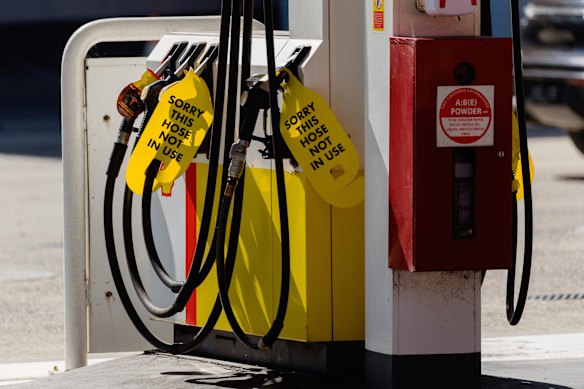
It amazes me how politicians think (“Petrol prices to fall further after states agree on GST”, April 3). We have a petrol shortage and prices are going up because demand exceeds supply. So what do we do? Cut the petrol excise tax and talk of putting a cap on the price, doing nothing to reduce demand and in fact inducing a further shortage. As politically unpalatable as it is, the real solution is not price control. The government must keep out of it (it did not cause the problem) and leave the fuel price to sort itself out. Higher prices will reduce demand, and the users of fuel such as tradesmen and taxis will increase their charges. Domestic users will have to decide just how much petrol they use. That will be difficult for some, but artificially reducing petrol prices when there is a shortage is economic madness and will do nothing to solve the fuel shortage problem. As mentioned, politicians think differently. Miles Harvey, Newtown
Recently, I have read article after article blithely stating that the federal government’s reduction in the fuel excise will be inflationary. A product that costs $1 suddenly jumps to $2 and the government removes excise to make the product only $1.50. The consumer does not have an extra 50¢ in their wallet to spend, they have 50¢ less. How is that inflationary? Sounds like neoliberal anti-government propaganda to me. Graeme Finn, Campsie
Is the government serious about addressing the fuel crisis? A good way to save fuel would be to lower speed limits on motorways from 110km/h to 100km/h for the duration of the crisis. Katriona Herborn, Blackheath
Taylor tilts
Angus Taylor seems to be repeating himself almost daily (“Taylor barely laid a glove on PM in his ’reply‴, April 3). He would be well advised to prepare his budget reply presentation, which will prove if he has any credentials to become a prime minister. Peng Ee, Castle Cove
Can’t confirm
I disagree with your correspondent’s generalisation (Letters, April 3) that “the Australian public respects firm responses from its leaders rather than timid caution”. Many of us respect wise (not timid) caution over “firm” responses that can turn out to be hasty, ill-considered and unwise. Barry Lamb, Eastwood
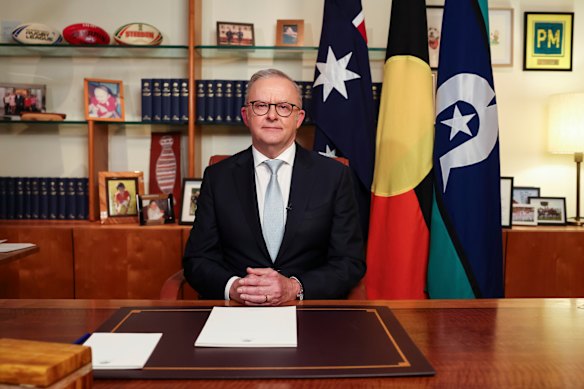
The prime minister did not set the world on fire with his speech. But isn’t that a good thing, given the causes of the current situation? Across the media nit-picking, questioning trust and a desire to read less or more into the speech are a political populist’s dream. Albo’s speech was appropriate for this time. Will more be required? Who knows? Appropriate responses will probably happen as real, not imagined, scenarios unfold. Christopher Hill, Kensington
Punt gambling ads altogether
Gambling drives sports advertising, allowing TV stations to pay more for broadcast rights, which in turn drives up the salaries of elite players (“TV companies demand help filling $90m gambling hole”, April 3). It does little for grassroots sport or for participation numbers. Would the standard of top sporting events be noticeably different if the players were paid less? I think not. The only beneficiaries are the TV corporations and elite players. The losers are gamblers, grassroots players and their clubs, and viewers bombarded with ads. Just ban all gambling ads. Neville Turbit, Russell Lea
It will be interesting to see how Albanese handles horse racing under these proposed reforms. Horse racing on TV, including the Melbourne Cup, is basically hours-long advertising. Signs everywhere for the sponsoring gambling company, races named after gambling companies, and odds and form displayed and discussed, which surely is advertising for gambling. When tobacco ads were banned, all types of sponsorship ceased as they were considered ads. I have a feeling that horse racing will somehow be exempt because nothing says big end of town like the spring carnival. Mark Kilminster, Castle Hill
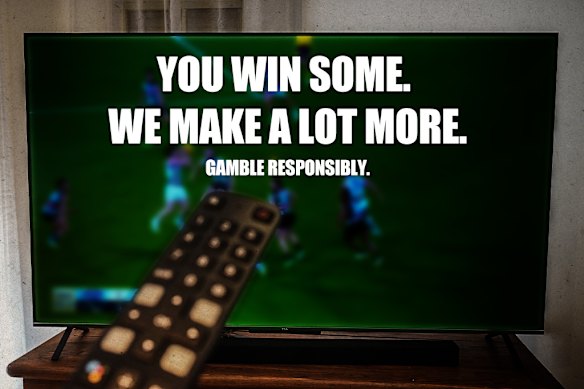
Given what we know about gambling’s damage to families and communities, it beggars belief that media companies want to be compensated for losing the ill-gotten gains they’ve made part of their business model. Colin Stokes, Camperdown
I don’t believe anyone is saying that people don’t “have the right to have a punt”. If you are an adult and aware that the only way gambling entities can exist is if you lose, then go for it. If Albanese can minimise young eyeballs’ exposure to online gambling promotion, break the nexus between gambling and sport, and curtail the options that make up ways a person can gamble, then I’m happy for him and the Labor mob to have another three years. Bill Young, Killcare Heights
Albanese’s “gambling reforms” are tokenistic and little better than the Minns government’s poker machine “trial”. He should show real leadership and stare down all the vested interests. Tony Simons, Balmain
It says it all when numerous big “sports” have a business model that relies on their major income from gambling. If these sports cannot exist without this income, there is something seriously wrong with their business model. Terry Cook, Ermington
I am an advocate for a total ban on gambling advertising. The government’s announcement on advertising reforms is a good start. Graham Hansen, Denistone
May I suggest that television broadcasters try to make up the revenue shortfall, supposedly resulting from the government’s crackdown on gambling advertising, by placing a few bets themselves. As the ads would have us believe, a Same Game Multi, or a Trifecta in the third race at Randwick is a really great way to make some easy money. Ross Duncan, Potts Point
How disappointing that the government thinks reducing the number of gambling advertisements to three per hour is honouring the late Peta Murphy, who worked to the time of her death to have gambling advertising outlawed. We know the harm to young and old done by gambling, the same as the harm from tobacco. We didn’t decide that three cigarettes a day was acceptable and instigated a complete ban. So why such a pathetic response to gambling? There is no point protecting our children from social media and still exposing them to gambling ads. Carole Hayes, Newtown
As a lover of horses going back to my childhood in Croatia, where they pulled the carriage or the plough and I rode them in the river after a hard day working, I was disappointed that in Australia they are mostly bred for show or gambling. During the war, they carted my family via Hungary to Austria, where the Russian Army then confiscated them for their use, despite my tears and father’s pleading. We needed them to return us to our farm in Croatia, then a state within Yugoslavia. On reflection, I am grateful for those events, which led to refugee camps in Austria (1944-1949) and a journey via a ship called Nelly to Australia. This nation gave me opportunities that I could only dream about, but I still regard horse racing as cruelty towards a majestic animal. Ferdo Mathews, Robina (Qld)
Lunar tricks
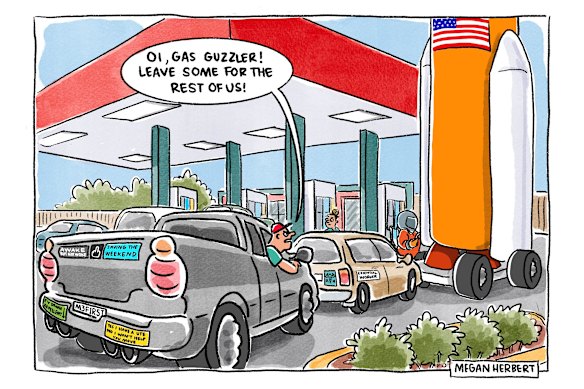
As the moon voyage was launched, was it my imagination or was there a giant spray can emerging from the side of Artemis II (“NASA’s first crewed moon mission in 50 years lifts off”, April 3)? Do I now detect some gold glittering on the moon looking something like “Donal …” ? Margaret Grove, Concord
I’m surprised that during his address to the nation the US president did not declare that the rocky body known as “The Moon” will from this day forth be referred to as “The Rump of Trump”. Alicia Dawson, Balmain
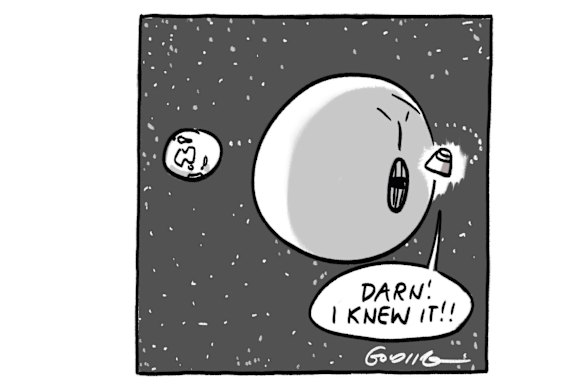
In contrast with England’s spurious claim in relation to Australia, Trump could claim that the moon was terra nullius. Jock Brodie, Port Macquarie
The weather hasn’t been the same since we first landed on the moon. Sean Kelly, Cremorne
Perhaps for the success of the Artemis moon expedition, and to draw more focus on this event, President Trump could be made OIC of the mission and shot into space with enough fuel to arrive at the proposed destination, but no more. Steve Shields, Port Macquarie
On my train to Cronulla on Thursday evening, I was soaking up the glorious full moon climbing into the night sky. Then the realisation, that for all the US’s faults, their spacecraft was on its way to loop around the moon before returning to Earth. Amazing. Chris Downs, Stanwell Park
When much of the world remembers the crucifixion of an extraordinary man of peace, who warned that if we lived by the sword, we would die by the sword, atrocious wars continue at an ever-increasing pace, destroying this beautiful planet with destructive weapons of apocalyptic intensity. Is exploitation the main reason behind this ardent search to return man to the lunar surface? Wouldn’t it be better to do what is within our present capacities, to manage more responsibly, more conscientiously and more lovingly, our own planet first? Bernard Moylan, Bronte
EVs’ range of options
Never mind the suburbs of Sydney without EV chargers (“Revealed: suburbs with zero EV chargers”, April 3), it remains mind-boggling to my wife and me that the twin servos on the M1 Pacific motorway remain EV free. Anyone coming from the north would find this the perfect spot to “recharge” before hitting the big smoke. Tony Bennett, Broke
Many motoring observations are steering toward a glass-half-empty perspective. About two-thirds of NSW’s EVs are in metropolitan Sydney. Many rarely venture far afield, presenting the EV and/or hybrid as the ideal urban vehicles and the most practical means to reduce the state’s overall fuel consumption. Down the track, the efficacy of EV technology will put the petrol driven “infernal” combustion engine well and truly up on blocks. Supporting the technology of renewables will indeed drive EV motoring pleasure further afield. Steve Dillon, Thirroul
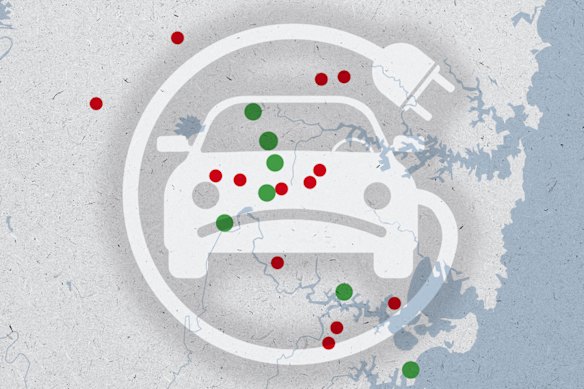
I can reassure your correspondent that it is possible to drive an EV to Broken Hill and not suffer range anxiety. We’ve driven our battery electric vehicle to quite a few places in western NSW, including Cobar, Bourke, Brewarrina, Wilcannia, Menindee Lakes, White Cliffs and, yes, Broken Hill. It takes a little more planning to ensure such a trip goes smoothly. It seems fossil fuel vehicle drivers are now suffering “range anxiety”, cancelling their Easter trips as they are unsure if regional service stations will have fuel. And if there’s no fuel, that’s it. Drivers are stuck without any alternatives. But with an EV, even in the worst case, every standard power point is a potential charger. Brendan Jones, Annandale
The obvious solution for EV charging gaps on country roads is for service stations to install fast and “super” chargers. Servos have toilets, sell food (well, it looks like food) and provide air and water. EV owners understand that accessing power at remote service centres would involve the fuel companies making a profit, as happens with chargers provided by particular EV brands (like Tesla). In a transport future that is increasingly electric, the fuel suppliers could continue to be just that, providing electricity in addition to petrol and diesel. Philip Bell, Bronte
A private matter
I don’t understand why we and the media should know the names and addresses of the Bondi shooters’ family (“Bondi terror accused loses attempt to hide names”, April 3), including the school they attend and their workplace, when they had nothing to do with the attack, yet they have been subjected to abuse, including death threats by phone and in person. Our anger should be focused on the terrorist not other innocent people. Con Vaitsas, Ashbury
- To submit a letter to the Sydney Morning Herald, email [email protected]. Click here for tips on how to submit letters.
- The Opinion newsletter is a weekly wrap of views that will challenge, champion and inform. Sign up here.
Read the full article here
