

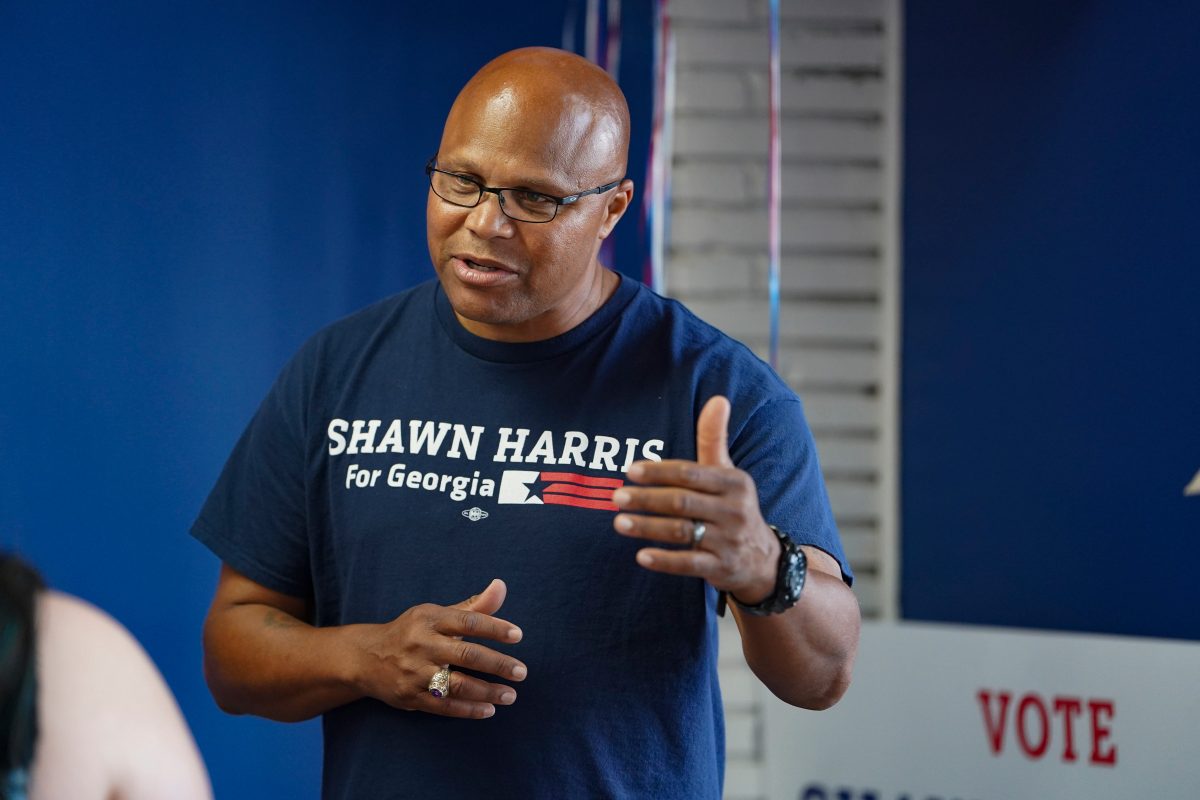
Voters in Georgia’s 14th Congressional District head to the polls Tuesday for a special election runoff that will decide who completes the remainder of former GOP Representative Marjorie Taylor Greene’s term.
While the northwest Georgia district is one of the most Republican‑leaning in the state, prediction markets show traders assigning Democrat Shawn Harris a small—but closely watched—chance of pulling off a major upset.
No publicly released, independent polling of the runoff had surfaced as of Monday, leaving prediction markets, fundraising patterns and the district’s voting history as the main signals ahead of Election Day.
What the Prediction Markets Are Showing
On Kalshi, a U.S.-regulated prediction market, Republican candidate Clay Fuller is trading at roughly a 96–97 percent implied probability of winning the runoff, with Harris priced around 3–4 percent. The market has seen significant trading volume for a House special election, suggesting heightened attention to a race that would normally be considered a foregone conclusion.
Polymarket, an offshore prediction platform, shows nearly identical odds. As of Monday morning, Fuller was priced at about 96 percent, compared with roughly 4 percent for Harris, with more than $200,000 wagered on the outcome. In prediction market terms, those prices indicate strong confidence that Republican voters consolidate behind Fuller after a splintered first round.
While prediction markets are not polls, they are often cited by analysts as a reflection of collective expectations, particularly when conventional polling is absent.
Why There Is a Runoff at All
The runoff was triggered by a crowded, all‑party special election on March 10, called after Greene resigned from Congress in early January following a public and bitter feud with President Donald Trump. Under Georgia law, all candidates appeared on the same ballot, with a runoff required if no one secured more than 50 percent of the vote.
Harris, a retired Army brigadier general and cattle farmer, finished first with about 37 percent of the vote. Fuller, a former district attorney endorsed by Trump, followed closely at just under 35 percent. Republican votes were split among more than a dozen GOP candidates, allowing Harris to top the field without approaching a majority.
That fragmentation is now gone. Tuesday’s contest is a straightforward head‑to‑head, a structure that historically favors Republicans in this district.
How Republicans Normally Perform in Georgia’s 14th
Georgia’s 14th Congressional District is widely considered the most Republican‑leaning district in the state. Trump carried it with 68 percent of the vote in 2024, according to results cited by the Associated Press. Greene herself routinely won by margins exceeding 30 points and never faced a serious general‑election challenge during her tenure.
Harris lost to Greene by roughly that margin in the 2024 general election. Although he modestly improved Democratic performance in several counties during the March special election, his share of the vote—around the high 30s—was still broadly in line with what Democrats typically receive here.
To win outright, Harris would need to do something Democrats have not done in recent cycles: attract a significant share of Republican voters in a district that has shown overwhelming loyalty to Trump and GOP congressional candidates.
Why National Republicans Are Spending Heavily Anyway
One of the more notable dynamics of the race is the level of Republican spending in what should be a safe seat. Punchbowl News has reported that GOP campaign committees and allied outside groups have poured significant resources into the district, despite its deep‑red fundamentals, reflecting broader anxiety over the House’s razor‑thin margin.
With Republicans holding only a narrow majority, even a temporary Democratic flip would matter symbolically and mathematically. The runoff winner will serve only through the end of the current term, but the result could shape narratives heading into the 2026 midterms, especially if Democrats overperform expectations again in a special election.
Democrats have pointed to recent special elections nationwide where their candidates ran ahead of baseline partisan lean, even if they ultimately fell short in red districts. Harris’ campaign has leaned into that argument, framing the race as a test of whether dissatisfaction with Washington Republicans can translate into crossover votes.
What People Are Saying
Shawn Harris, in a post on X April 4: “Parts of our district have hospitals but not the doctors, nurses, or specialists we need, that’s a healthcare desert. At the same time, PFAS contamination is impacting families across Northwest Georgia. People aren’t asking for talking points, they’re asking for help, and I’ve told them to hold me accountable to deliver it.”
Clay Fuller, in a post on X April 2: “Putting America First is simple: Arrest the criminals, deport the illegals, and bring manufacturing jobs back home. President Trump is delivering all three in spades, and our country is coming back stronger than ever.”
President Donald Trump, in a February Truth Social post: “It is my Great Honor to endorse America First Patriot, Clay Fuller, who is running to represent the wonderful people of Georgia’s 14th Congressional District. Clay Fuller has my Complete and Total Endorsement to be the next Representative from Georgia’s 14th Congressional District — HE WILL NOT LET YOU DOWN!”
What Happens Next
The winner of tomorrow’s runoff election will be sworn in shortly thereafter to fill the remainder of Greene’s term. Harris and Fuller are also on the ballot in their respective party primaries later this spring for a full two‑year term, meaning voters could see a rematch regardless of Tuesday’s outcome.
Read the full article here
