

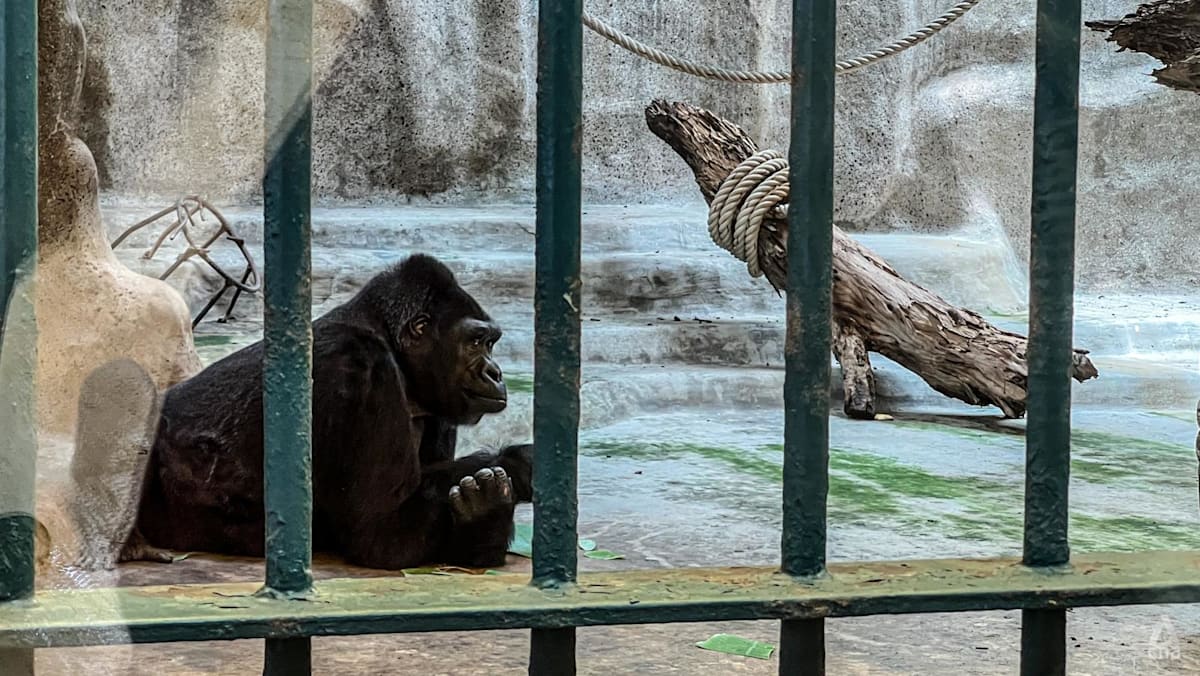
BUA NOI’S CHAMPION
One of the heroes of Sytsma’s film and one of the main champions for Bua Noi’s freedom is a 70-year-old Thai woman named Sinjira Apitan.
Her house in central Bangkok is easy to spot.
Outside in the small front garden is a life-size cardboard cut out of a gorilla. Around one of the trees, she has wrapped a tarpaulin sheet with hung paper cutouts of children’s hands.
Students have drawn pictures and written messages for Bua Noi, like “born to be wild” and “you have my hands”.
They are symbols of the long campaign she has run for decades, originally as a fundraiser for an animal organisation, and later, simply as “an ordinary lady with common sense and a spiritual heart”.
Her life has become quietly and stubbornly tied to this single gorilla.
She recalled a time where Bua Noi was a headline attraction for families in the growing metropolis. She would drive past what was a famous high-rise building at the time, and tell her children that there was a gorilla above the department store.
“In the past, she was very popular. Everybody knew about Bua Noi.”
“And I said to my children, ‘Look, how come there is a gorilla here? For what reason?’ It’s like seeing a human being in jail. It’s not normal. And you have to do something,” she said.
“I’m turning 70 now, but for Bua Noi, I saw her when I was 30-something, and she is still there. The thing that hasn’t changed is the loneliness in her eyes. Her eyes say a lot.”
There are very few people who know Bua Noi well.
Sinjira is no exception. While a long-time advocate for the gorilla, she has spent little time with Bua Noi, especially as relations with Pata’s owner have frayed over the years.
The current owner’s name is Kanit Sermsirimongkol, the brother of the original founder of the zoo, Vinai.
“We have never been enemies from how I feel. I just want to help him to be free from this situation,” Sinjira said.
“The best memory is when I asked permission from the owner to sing her a song. I asked to climb up the ladder, and my voice could go through (the cage). Bua Noi was kind of excited. ‘Who’s there? Who’s trying to help me?’.”
“Then she climbed down and sat and looked at me with her eyes. I think we have some connection. I’m lucky. I don’t think he would allow me to do that again after the campaign.”
Pata Zoo denied a request from CNA for an interview or statement.
But Kanit has previously given interviews to the media, defending his zoo’s captivity and treatment of Bua Noi.
“There are no rules or regulations to say how much space each animal needs. It’s not about space, it’s about the way in which you treat the animals. The space that we provide to the animals is enough for them to freely move around, and to exercise,” he told the Guardian back in 2010.
Ten years later, he spoke to the Bangkok Post, again pushing back against growing efforts to free his solitary gorilla.
“Want to send her back to nature? We should think about the animals’ quality of life in the jungle. They are under threat from diseases like AIDS and Ebola, as well as civil wars and poachers. We can learn something from the bushfires in Australia that have killed around 500 million animals,” he said.
“I won’t send Bua Noi to another country. She’s a treasure of Thais.”
Kanit maintains that she was brought here legally after being born in a German zoo.
But others believe Bua Noi’s journey stretches back through forests, across borders, and is embroiled in a murky global trade that back then, rarely left a reliable paper trail.
Read the full article here
