

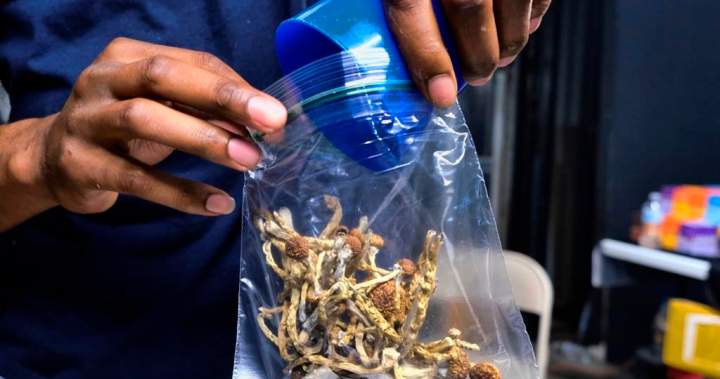
A major international study led by researchers at McGill University suggests psychedelic drugs could become more widely used in treating mental health disorders, including depression and anxiety.
Microdosing mushrooms has gained popularity in recent years, and the new research could further expand acceptance of psychedelic substances in clinical settings.
The study focused on drugs such as LSD and psilocybin, the active compound in so-called magic mushrooms. These substances, known for inducing hallucinations and their association with the 1960s, are now at the centre of renewed scientific interest.
Researchers from McGill University and Mila, Quebec’s artificial intelligence institute, brought together 89 experts from 17 countries for the study.
The findings suggest that psychedelics with different chemical compositions produce similar effects on the brain — a discovery experts say could have significant implications for how the drugs are prescribed therapeutically.
“There are dozens and dozens of clinical trials that are starting to show they work better than any other drug that exists to attack these mental health conditions,” said Danilo Bzdok, a professor of biomedical engineering at McGill.

Get breaking National news
Get breaking Canada news delivered to your inbox as it happens so you won’t miss a trending story.
Dr. Gabriella Gobbi of McGill University’s psychiatry department said the results align with what researchers have observed in animal studies.
“I am very excited about this study because it confirms what we observe in animals,” she said.
Gobbi, who has studied the effects of psychedelics on animal brains for more than a decade, noted that conventional pharmaceuticals are effective for only about 30 per cent of patients with mental health conditions.
“For these people it’s very important to offer something else. Psychedelics can be a new tool to treat this disease,” she said.
Clinical therapist Derek De Braga, who has worked with patients using psychedelics for several years, said the substances can be highly beneficial when used appropriately.
“I think there is no arguing these are incredibly helpful substances,” he said.
De Braga added that proper support is key to effective treatment.
“People have been using these substances for thousands of years. We know the value of these substances. I think it matters how people are supported before, during and after,” he said.
“It’s not just the medicine, it’s the container, the support system, the therapeutic relationship.”
Researchers say they ultimately hope the findings will influence how pharmaceutical companies design drugs and improve access to treatment.
“We hope to help how pharma companies and research do drug design,” Bzdok said.
They say the goal is to make effective treatments more accessible for patients living with mental illness.
Read the full article here
