

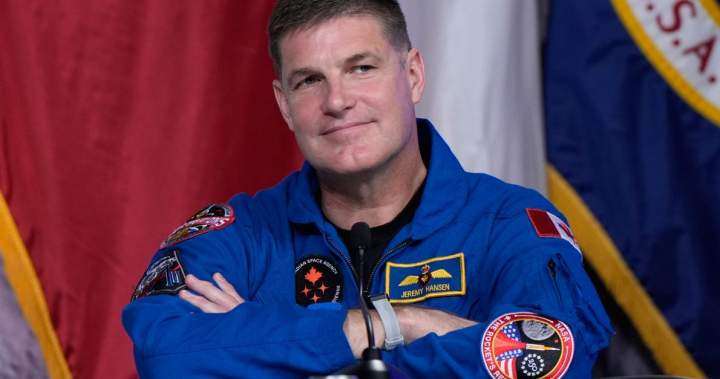
Canadian astronaut Jeremy Hansen says his historic participation in NASA’s Artemis II lunar mission is proof that Canada can “do big things” as a country and hopes it serves as inspiration for the next major achievement.
In an interview with Global News at the Johnson Space Center in Houston nearly a week after returning to Earth, Hansen said becoming the first non-American to travel in low orbit around the moon — and the overwhelming success of the mission — “had very little to do with me,” giving credit to the work of past and present Canadian “visionaries” who made his journey possible.
“What this should do is shine a spotlight on what we’re capable of as a country,” he said.
“I do think we keep ourselves small. And there’s been a rallying cry in the country, but we need to do big things. We need to set big goals. … The fact that a Canadian flew around the moon in 2026 is not because it happened last year. It happened over decades.”
The four-person crew — commander Reid Wiseman, pilot Victor Glover and mission specialists Christina Koch and Hansen — splashed down in the Pacific Ocean near San Diego, Calif., on April 10.
The 10-day flight saw astronauts travel to the moon for the first time in more than 50 years, setting a record for the greatest distance travelled by humans away from Earth. They also captured extraordinary images of parts of the lunar surface never before seen by the human eye.

Get daily National news
Get daily Canada news delivered to your inbox so you’ll never miss the day’s top stories.
Hansen said the enormity of what he experienced has still not sunk in for him.
“Every day I find myself processing a new thing, remembering a new thing from the mission. So it’s going to take some time,” he said.
“We’ve been so busy since we got here. There’s so much science collection to do. Every day we’ve got a full schedule. I barely feel like I’ve fully caught up with my family.”
He added it was difficult for him to choose a single standout moment, eventually listing nearly every milestone of the mission as a highlight.
“I would have gone for any one of the amazing things we saw,” he said.
“I would’ve gone for just the rocket ride. I would go for just that first feeling of floating in space. That first view out the window of the Earth up close, the next view of the Earth far away. Seeing the moon, starting to see a side of the moon I’d never seen before, seeing the moon up close, seeing the solar eclipse behind the moon. I mean they just kept coming.”
He continued: “And then setting your mind on getting back home, and seeing Earth just growing in the window slowly over the first couple of days, and then very quickly in that last day towards splashdown. And then, of course, the ride to the Pacific Ocean was one for the books.”
Hansen is now grateful to be back home and reconnecting with his family — particularly for returning to Earth in time to celebrate his anniversary with his wife.
“That was a close one,” he laughed.
He said the whole experience has “reinforced” his perspective on humanity.
“We’re on this ball in space. It’s this oasis,” he said. “You sit down here and you look up, it looks enormous around you, but you go out there and you look back and you’re like, ‘Oh my gosh, I’ve seen it with my own two eyes.’
“It is incredible, the human experience — the fact that we’re here, we’ve evolved to this point — and it also reinforces for me that we still have some work to do.”
That work is only made possible by working together, he said — whether it be within families, communities or a team as large as NASA.
“You can feel powerless as an individual. You see things like, ‘Gosh, I’d love to see that be better or this be changed, but I don’t know how to do it,’” he said. “But the reality is that you just do the best you can, and you talk openly and you set goals with people and you join teams that are doing something creative.
“I did have this sense when I was in deep space, looking back at the planet that I was very insignificant. But the fact that I was there, that a human was there experiencing it, made me feel very powerful because of the collective unity that it took to push four humans there. We didn’t do that, the four of us. It was this huge team, extraordinary team.”
Hansen said he wants both the next generation of explorers and Canada as a whole to take inspiration from what the Artemis II mission achieved.
“What we should do now is we pat ourselves on the back for this accomplishment, because it’s extraordinary … but we should be like, ‘What’s next? What are we going to do next?’” he said. “Now … we have seen this visual that we can do these extraordinary things.”
He also emphasized that pushing ourselves to achieve those big things should not come at the expense of remaining joyful.
“We had the time of our lives on this mission,” Hansen said. “It was hard, it was challenging, it was dangerous. But it was the time our lives.”
Read the full article here
