

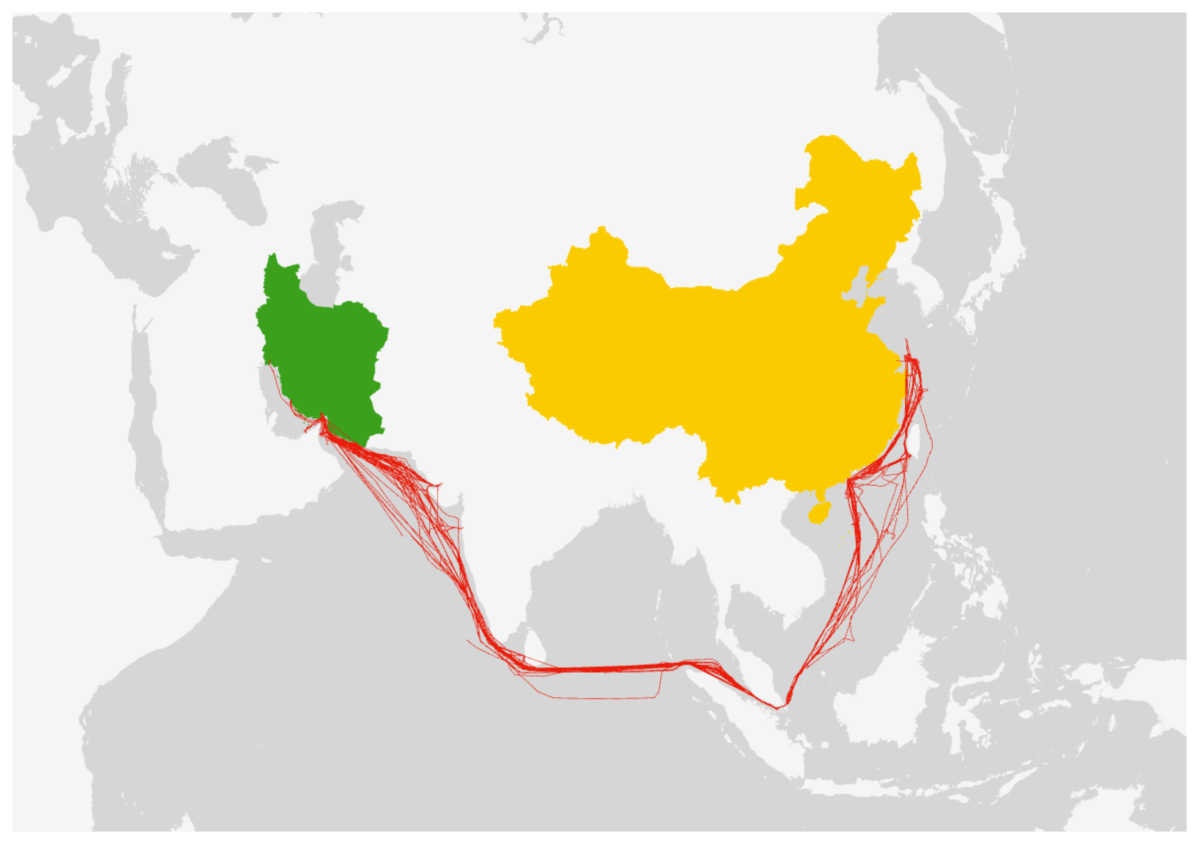
The Iranian ship that President Donald Trump said has been captured by U.S. Marines has made many visits to Chinese ports, according to analysis of shipping data by Newsweek.
China’s Ministry of Foreign Affairs responded on Monday to the seizure of the Iranian-flagged cargo ship the Touska.
“We hope all relevant parties will adopt a responsible attitude, abide by the ceasefire agreement, avoid escalating tensions or intensifying contradictions,” spokesperson Guo Jiakun said.
The action comes days after Trump announced a naval blockade of Iranian ports, which he said would stay in place until there was a deal between the U.S. and Iran over unblocking the Strait of Hormuz.
“Our Navy ship stopped them right in their tracks by blowing a hole in the engine room,” Trump said of the capture of the Touska on Truth Social, adding that U.S. Marines had custody of the vessel, which was under U.S. Treasury sanctions.
Touska’s Links To China
The Touska is owned by Islamic Republic of Iran Shipping Lines, Iran’s national maritime carrier.
The International Maritime Organization, a specialized agency of the United Nations, assigns an IMO number to each vessel, which it retains throughout its service life even as its owners change its name. The Touska’s IMO is 9773301. It was formerly known as the Adalia and the Sahand.
Since its inclusion in 2019 on the U.S. Office of Foreign Assets Control (OFAC), sanctions list, the Touska has made multiple trips to Chinese ports, according to a Newsweek review of historic movement data.
The Touska most recently departed Iranian waters on February 22 via the port of Shahid Rajaee and transited the Strait of Malacca in early March before calling at Zhuhai port in southern China on March 9.
It then sailed north and stayed in Chinese waters off Shanghai for at least 11 days, according to automatic identification system, or AIS, signals captured by the nonprofit group Global Fishing Watch.
The Touska turned off its AIS transponder—a practice in breach of international law known as going “dark”—for two and a half days before remerging for another one-day port call in Zhuhai on March 29.
The Washington Post had previously identified Zhuhai port as a key location where Iran secures precursors for rocket fuel used in its ballistic missiles.
On April 3, the homebound Iranian ship dropped anchor off Port Klang in Malaysia, whose waters are a known transshipment point for Iran’s shadow fleet vessels. It did not depart until nine days later.
It was unclear what cargo the Touska was carrying, but on April 16, while the vessel was in the Arabian Sea off India’s west coast, CENTCOM said it would search and seize “all Iranian vessels, vessels with active OFAC sanctions, and vessels suspected of carrying contraband.”
The list of contraband included military-use equipment, petroleum products and fissile material, according an advisory issued by the U.S.-run Joint Maritime Information Center.
This contraband was “subject to capture at any place beyond neutral territory, if their destination is the territory belonging to, or occupied by, Iran,” CENTCOM said.
Video Shows Capture Touska’s Capture
Video released by CENTCOM showed its Marines depart the amphibious assault ship USS Tripoli by helicopter before heading across the Arabian Sea to board and seize the Touska.
CENTCOM said Marines rappelled onto the Iranian-flagged vessel after guided-missile destroyer USS Spruance had disabled its propulsion when it failed to comply with repeated warnings from U.S. forces.
In the video, a gun can be seen firing in the direction of the cargo ship and a sailor can be heard giving a warning to the crew of the Touska to leave its engine room.
The Spruance fired several rounds from the destroyer’s 5-inch MK gun into the Touska’s engine room after warning the ship’s crew to evacuate it, according to a post on X by CETCOM, which said the crew had failed to comply with repeated warnings over a six-hour period.
Khatam al-Anbiya Central Headquarters, which oversees Iran’s military operation said that its forces did not fight back against the Marines because the ship’s crew had family members aboard.
“They faced constraints in order to protect their lives and ensure their safety, as they were in danger at every moment,” the Iranian military said, according to The Associated Press.
Steve Prest, an associate fellow at U.K. defense think tank the Royal United Services Institute said in analysis shared with Newsweek that each U.S. guided-missile destroyer has a crew over 300 sailors who were highly trained in offensive and defensive maritime operations.
He said a way to interdict a ship would be an operation led by commandos “who would fast-rope down from a helicopter or climb a ladder from a boat.”
In the analysis from last week that preceded Sunday’s operation, Prest, a retired commodore with the U.K.’s Royal Navy, said it would be unclear what might happen to a ship.
“Do you seize the vessel and/or the oil for your own as spoils of war? Impound it until hostilities have ceased and then let it on its way? Or something else? These are questions I have not yet heard discussed,” said Prest.
Trump said on Truth Social that the U.S. Marines have “full custody” of the Touska, “and are seeing what’s on board” without specifying further.
Mark Cancian, a senior adviser with the Center for Strategic and International Studies (CSIS) told Newsweek last week, before the capture of the Touska, that blockades like the one the U.S. is imposing did not have to be 100 percent effective.
“All you have to do is get enough so the rest are discouraged,” Cancian said.
Iran Vows Retaliation
Iran’s top joint military command said the U.S. capture of the vessel had violated the ceasefire and was “an act of maritime piracy.”
The Khatam al-Anbiya headquarters warned that Iran’s armed forces were ready to confront the United States and would soon respond.
The Iranian semiofficial news agency Tasnim reported that Tehran had launched drone strikes on U.S. military vessels in the Gulf of Oman although this was not immediately confirmed by the U.S. and there were no reports of damage.
Read the full article here
