

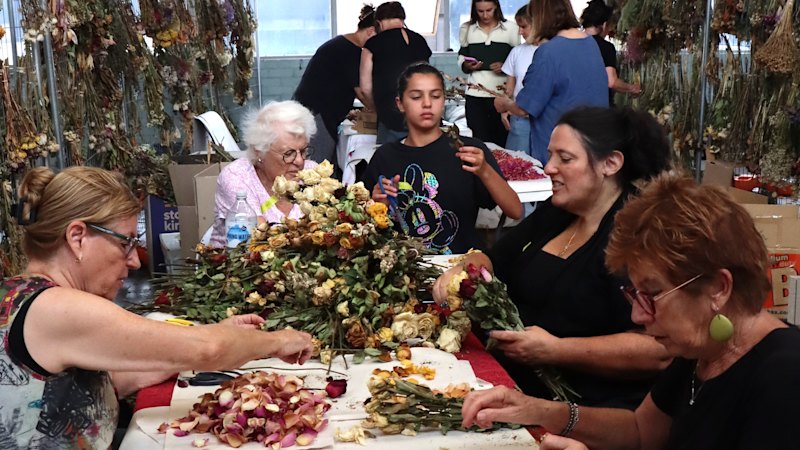
When three tonnes of flowers arrived at the Sydney Jewish Museum, the sheer scale of the grief they represented was almost impossible to comprehend.
For Shannon Biederman, the museum’s senior curator, the sight of wilted bouquets, handwritten notes, and personal mementos gathered from Bondi Beach remains etched in her memory – a powerful symbol of a community grappling with a wound that has not yet closed.
It was late last year, in the aftermath of the Bondi Beach attack – when two gunmen opened fire during a Chanukah by the Sea celebration, killing 15 people and injuring dozens more – that Biederman and a team of volunteers found themselves thrust into the task of documenting history as it was unfolding.
Still processing their own shock, they were charged with preserving thousands of tributes left by mourners outside Bondi Pavilion, transforming this outpouring of public sorrow into the centrepiece of the new Bondi Memorial and National Centre Against Antisemitism, now under construction at the Sydney Jewish Museum in Darlinghurst.
Due to open to the public next year, the development will incorporate tributes, objects and religious items into a permanent space to tell the story of the attack, the lives lost, and the broader rise of antisemitism in Australia.
Ordinarily, a project of this scale would take years of detailed planning and research to develop. This one is being created in months.
“Museums by nature are places of history and reflection on past events,” Biederman says, standing in a construction zone where crews are carving out the future exhibit spaces.
“This has been very different. Capturing something so raw has been incredibly challenging – for many of us, we knew people involved and there’s a real sense of how close it is.
“We feel a deep sense of responsibility because we want to make sure we do justice to the victims, to the story.”
The events of December 14 reshaped a long-planned $18 million upgrade of the Sydney Jewish Museum.
Museum chief executive Kevin Sumption explains that plans were quickly redrawn to repurpose underused parts of the museum including storage and car parking spaces into exhibition rooms and memorial spaces.
Among the most delicate aspects of the project has been preserving what Biederman describes as an “ocean of tributes”. The three tonnes of flowers, collected during the summer heat, had already begun to wither by the time they reached the museum’s doors.
The museum has partnered with artist Nina Sanadze, who is leading a team of more than 100 volunteers to turn the organic matter into a large-scale memorial artwork. Petals are being pressed, pigments extracted, and fragments preserved in resin and bronze.
Alongside flowers are hundreds of other objects collected from Bondi: toys, handwritten letters, menorahs, stones, dreidels and crocheted items. Nine surfboards used by Bondi surf life-saving volunteers as makeshift stretchers on the day of the attack will also form part of the memorial.
“Each item tells a personal story, but together they form a collective narrative of grief and solidarity,” Biederman says. “They’re expressions of hope, of love, of unity. That’s what we’re trying to hold on to.”
For the volunteers, many of whom belong to Sydney’s tight-knit Jewish community, the manual labour of sorting through these objects has provided a deep sense of purpose.
“Everybody knows Bondi. They know that bridge, they sit on the benches at the park,” Biederman said.
“Pressing flowers, sorting through objects – has given people something to hold on to in the face of shock and grief.”
A key challenge lies in how to present such a recent and traumatic event without allowing violence to define or dominate the space.
To navigate this, the museum is employing the “safely in, safely out” principle, developed by Yad Vashem’s International School for Holocaust Studies. Through careful use of lighting, sound and spatial design, visitors will be guided through spaces in a way that allows for emotional processing.
“We don’t want to recreate terror,” Biederman explains. “Our role is to build understanding and offer a space for healing.”
That balance extends to the broader story the museum aims to tell. The Bondi attack did not occur in isolation, Sumption says, and the exhibition will place it within a wider context of rising antisemitism in Australia.
This includes incorporating fragments of a burnt Israeli flag recovered from the 2023 protest on the steps of the Sydney Opera House.
“We want to show the lead-up – the sense of pressure and strain that has been felt within the community,” Sumption said. “It’s a story that, unfortunately, is still ongoing.”
The immediacy of the project also presents challenges. The Bondi story is still unfolding. Investigations are continuing, legal proceedings are pending, and a royal commission into antisemitism and social cohesion begins public hearings on May 4.
The project is expected to evolve with time, incorporating new information and perspectives as they emerge.
“There is an overwhelming amount of material from Bondi – photos, videos, objects, testimonies – and each story is so powerful,” Biederman explains.
At its core, the memorial will draw on a concept from Jewish philosophy: that light will overcome darkness. “In the Bondi story, there are so many people who came and helped,” Biederman says.
“The most important thing we can do is look for the good in people.”
Start the day with a summary of the day’s most important and interesting stories, analysis and insights. Sign up for our Morning Edition newsletter.
 David Barwell is an urban affairs reporter for The Sydney Morning HeraldConnect via email.
From our partners
Read the full article here
