

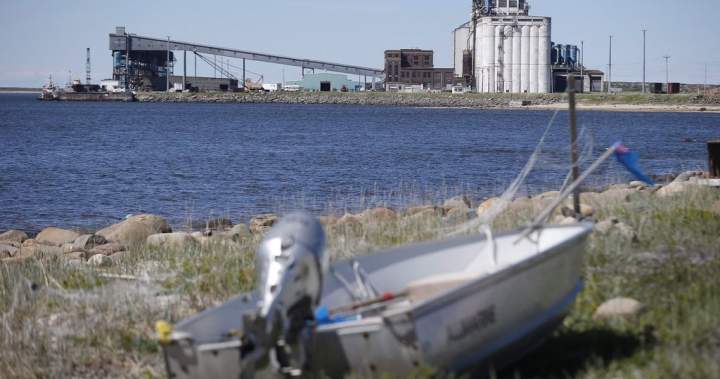
A feasibility study by the University of Manitoba and the Arctic Research Foundation is examining ways to extend the Port of Churchill’s shipping season and potential routes.
“We know with climate change the shipping season throughout the Hudson Bay has become longer and longer, and this time the port has only been opening for about three and a half months a year and we know it can be extended,” said Fei Wang, the director of the Churchill Marine Observatory and a professor at the University of Manitoba.
“This feasibility study is really based on existing data. (Looking) at to keep the Port of Churchill open all year round, to keep the shipping corridor open all year round, what kind of icebreaking capacity do we need?”
The research is being partially done at the University of Manitoba’s sea ice research facility on-campus, and at the Churchill Marine Observatory in Churchill, Man.
“The facility on campus actually allows us to grow sea ice in our own backyard to allow us to follow the growth and the melting of sea ice,” Wang said.
“At the Churchill Marine Observatory we’re doing something similar, but more under natural conditions.”

Get breaking National news
Get breaking Canada news delivered to your inbox as it happens so you won’t miss a trending story.
The study also assesses potential shipping routes and potential impacts on the environment and on northern communities.
“A big part of the route is making sure that we’re not crossing areas or disrupting ice where communities would be using it,” Arctic Research Foundation CEO Tom Henheffer told Global News.
Climate change is playing a major role in the changing ice conditions and the opportunity for extending the shipping season, Wang says.
“The Hudson Bay is on its trajectory to be essentially ice free by all year round,” he said.
“I think it’s being a cliche for me to say that Manitoba is a Maritime province,” Wang added.
“Often we think of Manitoba as a Prairie province, but as a Maritime province the future of Manitoba is going to be, to a large extent, really looking at the sea, the ocean that we have in the north. We’re on the verge of something big that’s really imposed to us by changing climate.”
Project timelines
Last week, Manitoba Premier Wab Kinew said Prime Minister Mark Carney put a tight timeline on the project.
“He shared that he wanted to see LNG shipping out of there by 2030, which is a very, very aggressive timeline. And I took that as a challenge, basically,” Kinew told reporters during an unrelated press conference on Friday.
“That’s the prime minister’s timeline. If we want the Port of Churchill plus project to move forward, it has to move forward it in the next four years.”
It’s an ambitious, but not impossible timeline, according to Barry Prentice, the director of the Transport Institute at the University of Manitoba’s Asper School of Business.
“If you put yourself on a war footing, it is (possible). You can get things done really fast if you want to,” Prentice told Global News. “I mean, we’ve seen these things drag out five, 10 years.”
“But I think if we really want to do it, I don’t think it should take that long,” he added.
Prentice says the Port of Churchill could have major economic benefits for Canada.
“If you look at western Canada, we’re a long way from European markets,” he said.
“At Churchill, you’re already as close to Europe as you are to Montreal. So in terms of distance, and distance matters in trade and costs, so a closer route would be less expensive so that means we get higher prices and maybe more profit.”
Read the full article here
