

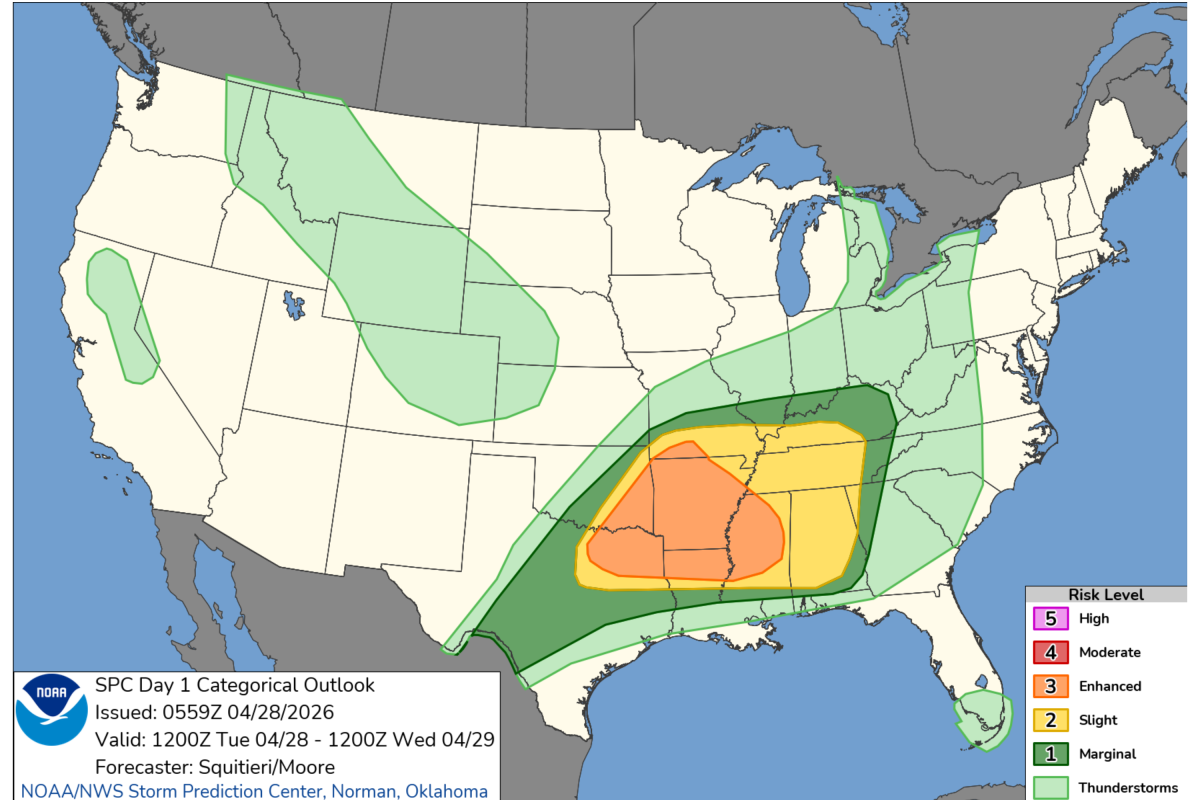
Several parts of the United States have been advised to prepare for either severe thunderstorms or heavy snowfall through Tuesday.
Both types of extreme weather could disrupt travel and cause damage to buildings and infrastructure, according to the National Weather Service (NWS) and the NWS Storm Prediction Center (SPC),
Below are maps showing the two weather systems expected to impact some western, southern, and midwestern parts of the nation.
Severe Thunderstorms and Tornadoes Threaten Parts of the South and Midwest
A broad swath of the south and lower parts of the Midwest face an increased risk of severe thunderstorms and possible tornadoes as a powerful storm system moves east, according to the SPC and multiple local weather offices.
The SPC’s “Day 1 Convective Outlook,” which covers the next 24 hours, places parts of north Texas under an “enhanced risk of severe thunderstorms,” while surrounding areas, including east Texas, Arkansas, southeast Missouri, western Kentucky, Tennessee, and northern Mississippi, are under a Slight Risk for severe storms.
Forecasters warn that through Tuesday afternoon and evening, “multiple rounds of strong to severe thunderstorms” in these areas could produce damaging wind gusts, large hail, and tornadoes, some of which may be strong and fast‑moving.
Regions of Highest Concern
The greatest concentration of severe weather potential is expected from the Lower Mississippi Valley into the Tennessee and Ohio Valleys, where conditions are favorable for storm development.
According to the SPC, much warmer, more humid air near the ground compared with cooler air aloft is creating strong atmospheric instability. This, combined with increasing and erratic winds, could allow storms to quickly intensify, raising the risk of damaging winds and rotating thunderstorms capable of producing tornadoes.
Surrounding areas across the central Plains, Ozarks, and mid‑South face a lower risk of thunderstorms, meaning that although severe storms are still possible, the storm activity is expected to be more scattered and less widespread than in the higher‑risk zones.
Active Warnings Across the Mid‑South
Severe weather has already developed across parts of the mid‑South, prompting multiple “severe thunderstorm warnings” from the NWS offices in Memphis and Nashville.
The warnings covered portions of eastern Arkansas, along with west and middle parts of Tennessee, during the early hours of Tuesday morning.
Storms were capable of producing wind gusts up to 60 mph and hail the size of a quarter or even up to an inch in diameter.
The NWS said damage to trees, roofs, siding, and vehicles was possible, especially given the storms’ rapid movement eastward, at a rate of 50 mph.
Tornado Risk Remains
Although the initial alerts focused on severe thunderstorms, tornado watches remained in effect across large portions of eastern Arkansas and Tennessee into Tuesday morning, with forecasters cautioning that tornadoes could still develop quickly.
What Residents Should Know
Officials urge residents in affected areas to closely monitor weather forecasts and move to an interior room on the lowest floor of a sturdy building if a tornado warning is issued. With additional storm development expected throughout the day, forecasters emphasize that conditions may change quickly as the system progresses eastward.
How To Prepare For Extreme Thunderstorms or Tornadoes
Severe thunderstorms can quickly become dangerous, producing damaging winds, large hail, torrential rain, and tornadoes. Weather officials urge residents in affected areas to take the following precautions:
Before the Storms Arrive
- Ensure weather alerts can be received through more than one source, including mobile devices, weather radios, or local news.
- Identify the safest place in the home or workplace to shelter in—preferably a small interior room on the lowest floor, away from windows.
- Move or secure outdoor items to prevent them from being blown about by strong winds.
During a Severe Thunderstorm
- Stay indoors and away from windows and exterior doors.
- Avoid using corded electronics and plumbing during intense storms.
- If driving, do not shelter under bridges. Pull over safely if visibility drops and avoid flooded roadways.
If a Tornado Warning Is Issued
- Move immediately to a basement or interior room on the lowest floor.
- Use helmets, pillows, or mattresses to protect your head and neck.
- Stay alert for rapidly changing conditions—tornadoes can form quickly within severe thunderstorms.
After the Storms Pass
- Watch for downed power lines, fallen trees, and debris.
- Avoid damaged buildings and report hazards to local authorities.
- Continue monitoring forecasts, as additional storms may follow.
Officials stress that overnight and fast‑moving storms are especially dangerous, as people may have less time to react.
Remaining aware of the weather can significantly reduce the risk of injury during severe storm outbreaks.
Winter Weather Advisories Issued
Winter weather advisories are in place for parts of Wyoming as the NWS warns of accumulating snow, gusty winds, and hazardous travel conditions, particularly in higher‑elevation and mountainous areas, with impacts expected to last through Tuesday.
According to the NWS, snow combined with strong winds is expected to create difficult travel conditions, reduce visibility, impact outdoor recreation, and disrupt commutes in affected areas.
Areas Most Affected by Winter Weather
Winter weather is particularly affecting some of the more mountainous areas across Wyoming through Tuesday, with snow and hazardous travel conditions expected.
In the Sierra Madre and Snowy Ranges, a winter weather advisory remains in effect until Tuesday afternoon. Snow accumulations reaching between 6 and 10 inches are expected, with higher amounts possible at higher elevations.
Snowfall may ease during the morning but is forecast to pick up again later on Tuesday, reducing visibility at times.
Meanwhile, the southern parts of the Laramie Range—including the Interstate 80 Summit between Cheyenne and Laramie—are also under a winter weather advisory. This area could see between 2 and 6 inches of snow by Tuesday morning.
Travel and Safety Concerns
The NWS is warning that roads, bridges, and overpasses in the affected areas may become slick and hazardous. Visibility could drop significantly during periods of heavier snowfall or blowing snow, especially across the mountain passes.
Drivers are urged to slow down, use caution, and check road conditions before heading out.
Outdoor activities could also become dangerous for those who venture out unprepared. Hunters, hikers, and snowmobilers, especially, could lose their bearings and risk exposure to the extreme weather due to low visibility and rapidly changing conditions.
What a Winter Weather Advisory Means
A winter weather advisory is usually issued when weather conditions are expected to cause significant inconveniences and may be hazardous if proper precautions are not taken. When a winter weather advisory is issued, the NWS warns drivers to “be prepared for winter driving conditions and possible travel difficulties.”
While not as severe as a winter storm warning, advisories warn that snow, ice, or blowing snow could still pose safety risks, particularly for travel and outdoor activities, as weather conditions can change rapidly.
The NWS advises residents and travelers in affected areas to slow down, allow extra travel time, and check local road conditions through state 511 services before heading out.
Why Weather Conditions Can Change Quickly
Mountain weather can shift rapidly, even late in the spring season. Strong winds, rising snowfall rates, and changing temperatures can quickly turn manageable conditions into dangerous ones, particularly at elevations.
According to WFY, weather changes especially fast in mountainous areas, such as Wyoming, because the terrain forces air to rise upwards. As air is pushed up over mountains, it cools and condenses, often producing clouds, snow, or rain.
Temperatures also drop with elevation at an average rate of about 6.5°C per 1,000 meters (about 3,200 feet), meaning conditions can be dramatically different between valleys and peaks.
This is why snow, strong winds, and poor visibility can develop quickly in mountain ranges, even when nearby lower elevations remain calmer.
What to Do During a Winter Weather Advisory
What Should Drivers Do When Faced With Winter Weather Conditions?
The NWS advises travellers to check their local road conditions by calling the 511 travel service before heading out. If they decide to make their journey, they should set off early, allow for extra time, and reduce their speed when driving, especially on mountain roads and passes. They should be particularly careful across bridges, overpasses, and shaded roadways, as they may freeze first.
Advice for Those Heading Outdoors
Residents who are planning to go outside into the snow should dress for winter conditions, including colder-than-usual temperatures, wind chills, and sudden temperature drops.
They should also carry extra food, water, and emergency supplies, especially if they’re in remote areas, and be aware that blowing snow can significantly increase the risk of getting lost and becoming stranded in extreme conditions.
Read the full article here
