

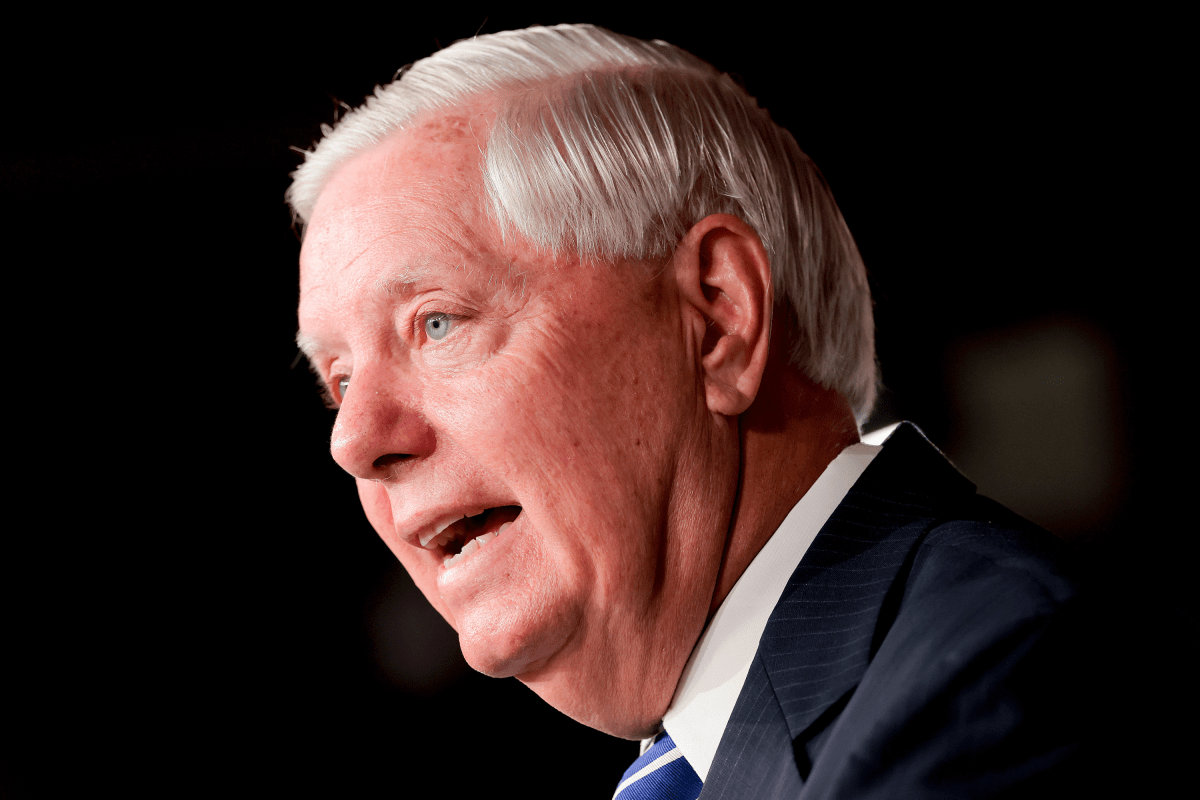
Republican Senator Lindsey Graham enters the 2026 election cycle in a position of strength, with new polling showing him dominating the GOP primary field and prediction markets signaling a broader Republican advantage in November.
A new InsiderAdvantage poll found Lindsey Graham leading the South Carolina Republican Senate primary with 56 percent support, far ahead of a fragmented field of challengers.
The result suggests Graham could avoid a runoff and consolidate Republican support early, reinforcing his path to renomination.
And prediction markets point in the same direction, with traders on platforms such as Kalshi and Polymarket pricing a Republican win in the general election at roughly four in five.
Republican challengers face a steep uphill battle, while Democrats must prepare for a likely matchup against a well-established incumbent.
Why It Matters
Graham’s dominance reflects both incumbency advantages and South Carolina’s strong Republican lean, which has consistently delivered double-digit GOP margins in federal races.
His position has also been reinforced by President Donald Trump’s endorsement, a signal that continues to carry weight among primary voters.
What To Know
The InsiderAdvantage poll provides a fresh snapshot of the Republican primary landscape.
Conducted May 13–14 among 800 likely voters, the survey places Graham at 56 percent, well above the threshold needed to avoid a runoff under South Carolina rules.
His nearest challenger, Mark Lynch, trails at 13 percent, while Calvin Cowen (3 percent), Darius Mitchell (2 percent), Thomas Dismukes (2 percent) and Pat Herrmann (1 percent) remain in low single digits.
A further 23 percent of respondents are undecided. The poll’s plus or minus 3.46-point margin of error and mixed-mode design should be factored into interpretation, though the scale of Graham’s lead places him comfortably ahead.
Pollster Matt Towery described the breadth of Graham’s support as unusual, noting that the senator leads “among every single demographic group,” according to additional survey cross-tabs.
More than 60 percent of respondents also said Trump’s endorsement would help secure Graham’s victory, pointing to the alignment between the senator and the party’s base.
What Other Polls Show
Other polling broadly supports this picture, albeit with some variation over time.
A Pulse Opinion Research survey conducted March 11–17, 2026, among 1,000 likely voters, with a plus or minus 3.1 percentage-point margin of error, found Graham at 41 percent, ahead of Lynch on 21 percent and Dans on 11 percent, with 22 percent undecided.
Earlier polls showed a similar trend of Graham leading but below a majority. A Big Data Poll survey from September 26–29, 2025, of 827 registered voters, with a plus or minus 3.5 percent margin of error, gave Graham 46 percent, while a June 10–13, 2025, Quantus Insights poll of 600 registered voters, with a plus or minus 3.5 percent margin of error, put him at 48 percent.
More recent numbers suggest consolidation. A Quantus Insights survey from October 1–4, 2025, of 600 registered voters, with a plus or minus 4.2 percent margin of error, recorded Graham at 58 percent, indicating his support can exceed the 50 percent mark depending on turnout assumptions and field composition.
What Prediction Markets And Forecasters Say
Beyond traditional polling, prediction markets offer another lens on the race, aggregating trader expectations based on available information.
Platforms such as Kalshi and Polymarket allow participants to buy and sell contracts tied to election outcomes, with prices reflecting the perceived probability of an event.
On Kalshi, contracts tied to the South Carolina Senate race price a Republican victory at 85 percent, with the Democratic Party closer to 15 percent.
Trading volumes remain modest but indicate steady confidence in a GOP hold.
Polymarket shows a similar picture, placing Republican chances at approximately 81 percent compared with 21 percent for Democrats.
These markets draw on a mix of polling data, fundraising figures, historical voting patterns and broader political conditions. Their strength lies in aggregating diverse information quickly and dynamically, often adjusting faster than traditional models.
However, they can also reflect trader biases, low liquidity or herd behavior, particularly in lower-profile races.
Fundraising data underscores Graham’s financial advantage, with the incumbent raising more than $20.6 million and holding over $11.6 million in cash on hand as of March 31, 2026, according to campaign finance reports.
Forecasters broadly align with this assessment. Inside Elections rates the race as “Likely Republican” as of April 23, 2026, while Race to the White House uses the same classification.
The Cook Political Report categorizes it as “Solid Republican,” and Sabato’s Crystal Ball places it in the “Safe Republican” column—positioning the contest at the more secure end of the GOP spectrum nationally.
Taken together, polling, market pricing and expert analysis all point in the same direction.
Graham remains the clear favorite to win his primary and enter the general election with substantial structural advantages, leaving little evidence—at least for now—of a competitive race in November.
What Happens Next
South Carolina Republicans will vote in the primary on June 9, 2026, with a candidate needing more than 50 percent to avoid a June 23 runoff between the top two finishers.
The Republican nominee will then face the Democratic candidate in the November 3 general election, where a simple plurality is enough to win.
Read the full article here
