

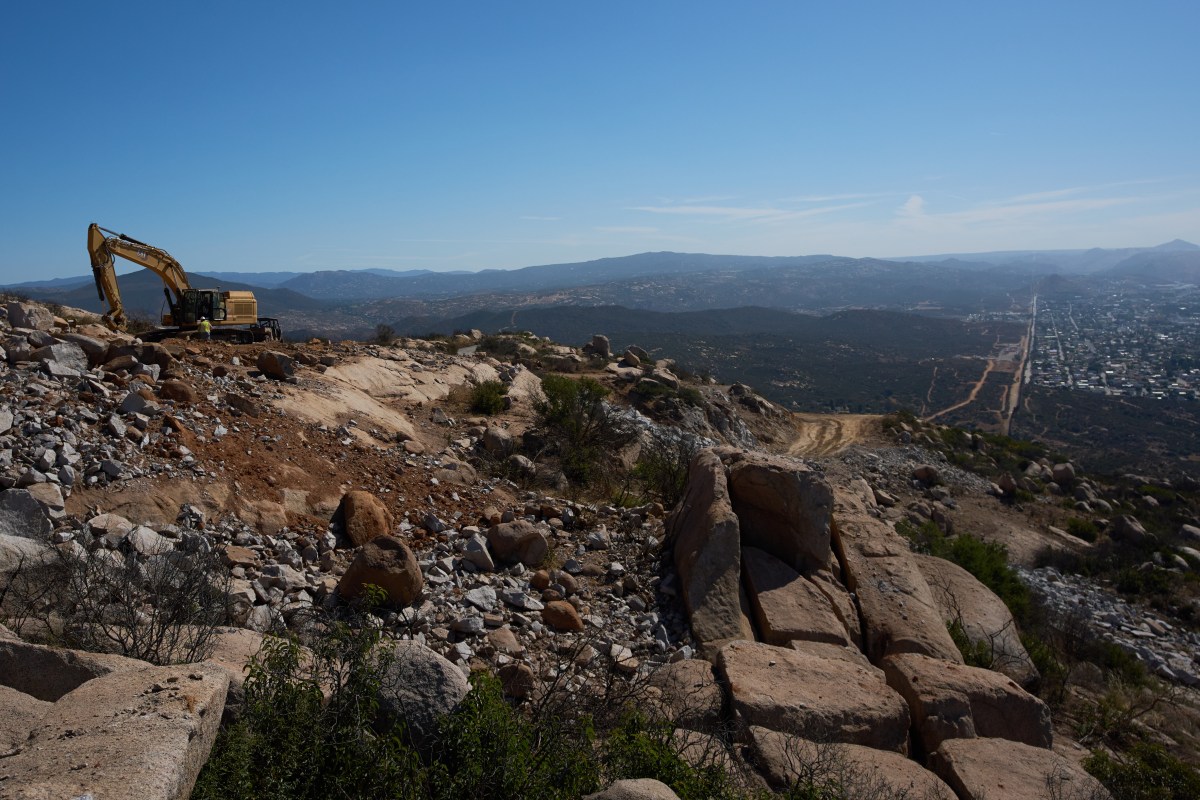
U.S. border wall construction along the southern border has prompted strong warnings from Indigenous leaders, who say the expansion is damaging sacred lands and threatening culturally significant heritage sites.
Religious groups’ and Indigenous leaders’ concerns center on sites such as Kuuchamaa Mountain, a peak that straddles California and Mexico, and holds deep spiritual significance for the Kumeyaay Nation.
Tribal leaders liken the mountain to a place of worship, but say that has been disturbed by blasting and bulldozing by federal contractors.
According to the Associated Press (AP), tribal leaders have met with Department of Homeland Security (DHS) officials to urge them to protect Kuuchamaa and are looking into legal action.
President Donald Trump’s promise to build a wall along the United States-Mexico border was a defining policy of his 2016 election campaign, and he vowed to continue the project on his return to the White House in 2025.
Officials argue expansion is key to tackling illegal crossings and drug trafficking, and the pace of construction has ramped up, even as illegal crossings have plummeted.
Newsweek contacted the U.S. Customs and Border Protection (CBP) and the DHS via email on Monday.
Concern Over Construction Near Sacred Sites
Emily Burgueno, a member of the Kumeyaay Nation, told AP that the Indigenous people feel the construction work “in our DNA”, adding that “body” and “land” are the same word in the Kumeyaay language.
“No one ever consented or supported the use of dynamite on the mountain,” she said.
She added that tribes along the border “are all experiencing the same tragic desecration of our cultural and sacred sites,” calling recent actions a “great example of the federal government not following federal laws.”
Desecrating a sacred Native American site on U.S. federal or tribal land is a felony, punishable by imprisonment and fines.
Elsewhere, in Arizona, contractors recently carved through a 1,000-year-old geoglyph known as the “Las Playas Intaglio,” a large fish-shaped figure etched into the desert floor. The Tohono O’odham Nation said it had previously flagged the site as culturally important, urging officials to avoid it.
CBP said in a statement to AP that a contractor “inadvertently disturbed” the site west of Ajo, Arizona, on April 23, but it vowed to protect the remaining portion. Commissioner Rodney Scott is talking to tribal leaders to determine next steps, it said..
Trump Admin Fights To Seize Catholic Land
Earlier this month, the Catholic Diocese of Las Cruces challenged plans by the Trump administration to seize more than 14 acres of land, including a religious pilgrimage site at Mount Cristo Rey in southern New Mexico.
The site marks the final unfenced stretch of the El Paso metropolitan area, making it a strategic gap in existing border infrastructure.
Kathryn Brack Morrow, an attorney representing the diocese, told National Catholic Reporter that church leaders plan to use “all legal tools at their disposal” to challenge the civil case filed at the request of Homeland Security Secretary Markwayne Mullin.
Border Wall Construction
Last month, DHS issued a waiver that allows the federal government to bypass environmental regulations and begin construction to add more barriers along the southern border.
DHS said it allowed them to “cut through bureaucratic delays”, but environmentalists warned the move could harm border communities and ecosystems.
Under the current administration, illegal crossings along the southwest border have dropped dramatically. Mullin said earlier this month that a primary southern border wall stretching from the Pacific Ocean to the Gulf of Mexico could be completed by next year.
This article includes reporting by The Associated Press.
Read the full article here
