

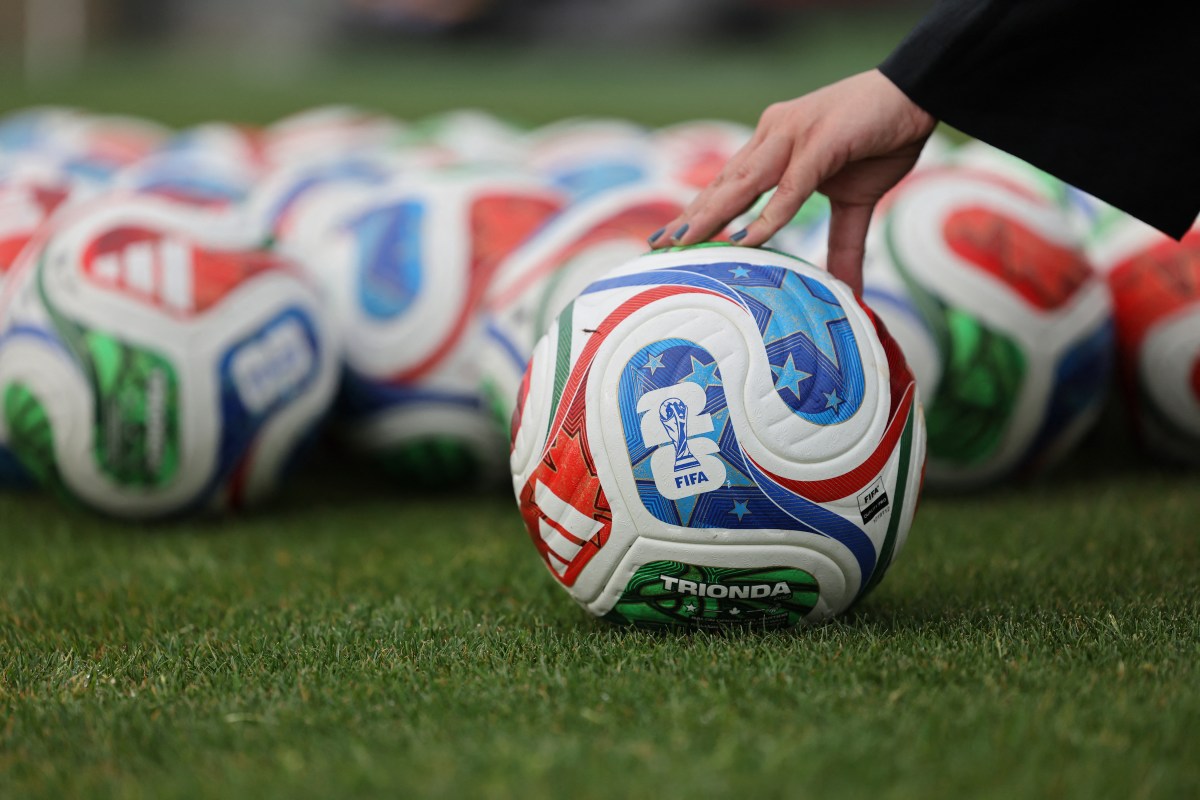
The 2026 World Cup ball is going high-tech in an attempt to make each match as fair as possible.
This year, the World Cup hosts—Mexico, Canada and the United States—will welcome fans from around the globe for a summer of nail-biting games. And while the hype is rising, there are still plenty of tickets left (if you can afford them, that is.)
It’s the first time the major tournament will take place across three countries at once. It will also feature a modern technological feat: an electronic ball that must be charged before each match. Adidas, which has created balls for the World Cup since 1970, last year unveiled the Trionda ball, which uses “Connected Ball Technology” to assist in officiating matches.
An Adidas spokesperson told Newsweek the ball will have to be recharged as “the sensor would not operate without the battery.”
“Each ball is charged on a specialised cradle in the match day venue prior to the game to ensure optimal function for the full game and beyond,” the spokesperson said, adding that the batteries are “of the highest standard, to allow them to last for several times the duration of a top-level game.”
According to a press release from Adidas, the ball contains a 500Hz inertial measurement unit motion sensor chip, held in place by a suspension system, which collects and sends data to the VAR system. Its sensors will track each touch and can help make decisions about potential off-sides, handballs, and other common incidents.
The Adidas spokesperson told Newsweek: “Throughout validation, and in the two FIFA World Cup competitions and UEFA EURO 2024 & 2025 we serviced so far, in no scenario did we have to replace the ball due to a low battery.”
The last World Cup also featured a rechargeable, high-tech ball, with Adidas working with tech company Kinexon to create “connected ball technology” with VAR assistance, used throughout the tournament’s 64 matches.
Kinexon told Newsweek that the high-tech balls are wirelessly charged via customized charging stations and take about 90 minutes to reach a full capacity of about 6 hours during active match use. The balls detect when they are off the field of play and switch to hibernation mode to extend battery life for several days.
Unlike the 2022 World Cup ball, the 2026 series has a sensor embedded into the side of the ball, rather than in its center. In a press release ahead of the previous World Cup, Adidas said the sensor in that year’s World Cup was “powered by a rechargeable battery, which can be charged by induction.”
The 2026 ball has been carefully designed to pay homage to the three host countries with a red, green and blue color scheme and iconography including the maple leaf, eagle and star.
Read the full article here
