

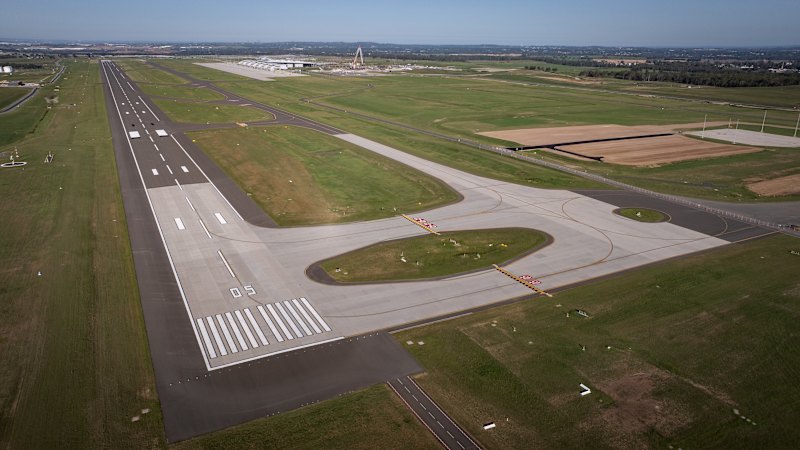
Sydney’s new $6 billion international airport will open to passengers on October 25 after Jetstar locked in the date for its first flights to the Gold Coast, Brisbane and Melbourne.
After prolonged negotiations with Western Sydney Airport, Qantas’ budget offshoot confirmed it will operate up to 14 flights a week between the new curfew-free hub and Melbourne, four to the Gold Coast and three to Brisbane.
The airline’s first flight from the airport will take off at 11am on Sunday, October 25, bound for the Gold Coast using an A320 aircraft.
Qantas and Jetstar are the last of Western Sydney Airport’s launch airlines to reveal the start of their flights to the new hub after Air New Zealand and Singapore Airlines set the beginning of their international flights for October 26 and November 23 respectively.
Qantas will not begin flying from the new airport until March 28, 2027, deploying smaller planes. The premium airline will run four flights a week between Melbourne and Brisbane, using the QantasLink Embraer E190. The Embraer has a seat capacity of 94 compared to the A320s, which carry up to 186 passengers.
These flights will “grow the overall number of flights to the Sydney basin”, according to Qantas. They are in addition to existing services to Kingsford Smith Airport.
Qantas Group chief executive Vanessa Hudson said the airline was “excited by the potential” of the new airport to spur local tourism and make aviation more accessible for millions of people in western Sydney.
“Jetstar has an incredible history of growing new markets, and being the first airline to launch will give one of the country’s fastest growing regions better access to low fares,” she said.
The Jetstar flights will have a one-way economy launch fare of between $59 and $75. One-way flights between Western Sydney and Melbourne will be launched for $69. Qantas launch fares will be from $99 one way, economy, and $299 business.
Western Sydney Airport chief executive Simon Hickey said the domestic fare offering was “another vote of confidence” in the new competitor despite global conflict challenging the aviation industry.
Jetstar’s move will open a new front of competition with Virgin Australia, which serves value-conscious flyers across the East Coast capitals. Virgin has yet to commit to operating out of the new airport.
After eight years of construction and commissioning, the launch of flights to the new airport on the western outskirts of the city near Luddenham will end the privately operated Kingsford Smith Airport’s long-held monopoly.
Prime Minister Anthony Albanese paid tribute to the tens of thousands of people who planned, built and were now testing the new airport.
“In 2011, I commissioned a joint study with the NSW government into how we’d deliver a second airport. I said at the time, it wasn’t ‘a matter of if Sydney needed a new airport, but when’,” he said. “Fifteen years later, this new airport is almost ready to open.”
In 2023, Qantas and Jetstar committed to basing 15 domestic aircraft at the federal government-owned Western Sydney Airport within a year of its opening, complementing its operations at Kingsford-Smith.
The chance for Emirates, Qatar Airways or Etihad to fly to the new airport has also been eased following changes last month to Australia’s air-rights agreement with the United Arab Emirates. Gulf carriers can now seek up to seven flights a week to Western Sydney Airport from the UAE.
Before air rights were eased, the new airport’s status as a primary gateway had severely limited Gulf carriers’ prospects of flying there upon opening if they had already reached the maximum number of flights they could make to Sydney.
Cargo aircraft will start flying in and out of the new airport on July 26, and Qantas freighters will begin regular flights a day later. Qantas and two other freight handlers – Menzies Aviation and Dubai-owned dnata – are setting up facilities in a new cargo precinct near the southern end of the 3.7-kilometre runway.
Western Sydney Airport expects 8.4 million passengers a year by 2030, and 19.3 million by 2045. In comparison, the privately owned Sydney Airport forecasts a 75 per cent increase in passengers to 72 million annually by the mid-2040s, from 41.4 million in 2024.
Committee for Sydney chief executive Eamon Waterford said the new airport would be a game-changer for boosting economic value.
“This will be a brand-new front door for the world to our city. In the short term, it’s going to be less busy than people expect. In the long term, I think it’ll be much busier than people expect,” he said.
Built on a 1780-hectare site, the new airport will be able to operate around the clock, whereas Sydney Airport has a flight curfew from 11pm to 6am.
Start the day with a summary of the day’s most important and interesting stories, analysis and insights. Sign up for our Morning Edition newsletter.
 Matt O’Sullivan is transport and infrastructure editor at The Sydney Morning Herald.Connect via X or email.
 Chris Zappone is a senior reporter covering aviation and business. He is former digital foreign editor.Connect via X, Facebook or email.
From our partners
Read the full article here
