

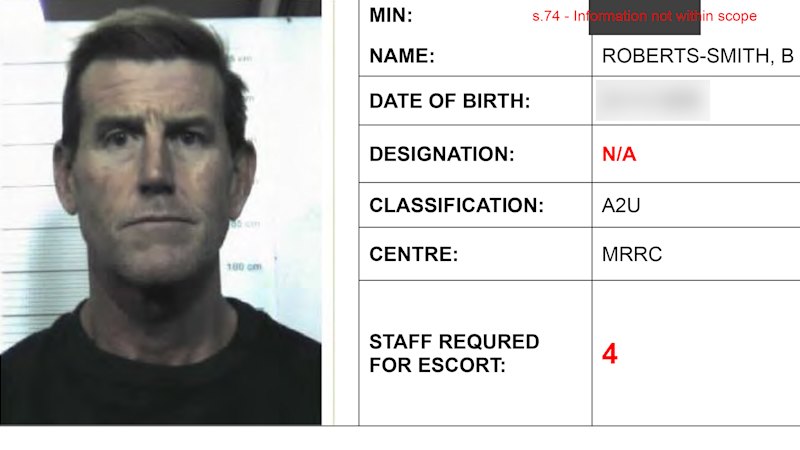
Corrective Services NSW staff devised a plan to sneak accused war criminal Ben Roberts-Smith out the back exit of a Sydney prison to avoid a waiting media pack after being granted bail, documents obtained under freedom of information laws reveal.
NSW Corrections considered the former Special Air Service soldier the most prominent high-profile protection inmate they had ever encountered, triggering a series of rare interventions, including a personal escort for Roberts-Smith and his partner, the use of a rear exit, and the intervention of one of its managers to ensure he received his daily exercise.
The cache of documents, obtained by this masthead using freedom of information laws, reveal that Metropolitan Remand and Reception Centre governor Patrick Aboud personally escorted Roberts-Smith from Silverwater Correctional Complex on April 17, joining a convoy of cars that later tried to block media from photographing the disgraced former soldier.
Officers had initially planned to escort Roberts-Smith and his partner, Sarah Matulin, to the rear gate of the facility before Aboud directed them to travel in convoy with him along a public road. In a briefing note sent four days after Roberts-Smith was bailed, Aboud said senior staff had undertaken a “dynamic operational risk assessment” on the day to determine the “safest and most appropriate method of release”.
But internal department communications reveal Aboud, who also personally escorted Roberts-Smith into his cell after he was remanded in custody on five counts of war crime – murder over the alleged killing of unarmed Afghan detainees, approved a plan allowing the former Special Air Service corporal to leave via a back exit more than 24 hours before he was granted bail.
“Media obviously won’t be told that he’s leaving via the back entrance,” a senior member of Corrective Services NSW’s media unit wrote in an email to Aboud on April 16.
Roberts-Smith’s prison exit sparked chaotic scenes as Corrective Services NSW officers tried to block media outlets from photographing the 47-year-old. As Roberts-Smith’s vehicle travelled along a public road bordering the prison, a black ute that had exited Silverwater behind him veered into the path of the Herald’s moving vehicle, blocking it.
Two female Security Operations Group officers “temporarily exited their vehicles to impede media access and prevent interaction with the release inmate”, a review into the officers’ actions found. Aboud was in one of several vehicles that escorted Roberts-Smith from the prison, having personally seen him into the Audi being driven by Matulin.
“The decision taken was reasonable, proportionate, defensible, and appropriate in the circumstances. It enabled the safe and orderly management of a uniquely high‑risk release event while minimising foreseeable risks to staff, the individual, media representatives, and the public,” Aboud wrote in his briefing note on April 21.
None of the officers, who said in statements provided as part of the review that they had intervened because they feared for Roberts-Smith’s safety, activated their body-worn cameras.
“Just a reminder that we are limited with our powers to deal with these types of situation (sic) on public roads. No further action required,” the general manager of the Security Operations Group wrote to the officers on April 20.
Corrective Services NSW maintained that Roberts-Smith was not given preferential treatment in being escorted out of a rear exit. The documents, however, reveal the department’s scramble to contain the fallout as pressure mounted over its handling of his release.
The documents offer an insight into Roberts-Smith’s time at Silverwater, revealing the strict policy in place to manage him in custody.
“Emotions are running high both internally and externally, but professionalism must remain our standard. He is to be managed like any other inmate, respectfully and without unnecessary attention,” the prison’s security manager emailed colleagues three days after Australian Federal Police officers arrested Roberts-Smith at Sydney Airport.
More to come
 Eryk Bagshaw is an investigative reporter for The Sydney Morning Herald and The Age.
He was previously North Asia correspondent. Reach him securely on Signal @bagshawe.01Connect via X or email.
From our partners
Read the full article here
