

Chris Tonkin spent years studying Toxoplasma gondii, a cunning and brain-invading parasite. But when he had to receive treatment for a suspected infection, the drugs he was prescribed were horribly harsh.
“It gave me a rash all over my body, and I couldn’t take the full treatment,” said the assistant professor at the WEHI research institute. “I had to stop taking it because it was so toxic.”
Tonkin experienced first-hand what is an urgent problem concerning the Toxoplasmosis parasite, which about 30 per cent of us carry: we have no good vaccine, drugs or treatment to combat its infection.
Further, once the parasite enters its “latent” stage, forming cysts within brain neurons and muscle cells, there is nothing we can do to rid it from the body.
That’s why experts have called on the World Health Organisation to recognise Toxoplasmosis as a neglected tropical disease, in the hopes of sparking greater action on treating and studying the parasite.
Infection wreaks its worst effects in underdeveloped tropical nations, but the parasite causes health problems in Australia too, Professor Justine Smith from Flinders University said.
“Toxoplasmosis is getting left behind,” said Smith, co-author of the new paper calling for more attention from WHO. “But it’s common, and it’s a problem.”
Most people are asymptomatic, but the parasite can flare up and attack the body when the immune system wanes with age, or if an infected patient undergoes chemotherapy.
Infection during birth can cause rare but severe birth defects. A study by Smith of 5000 eye scans also found high levels of ocular damage caused by the parasite.
“We estimate that 1 in 150 Australians has a scar in their eye related to infection with Toxoplasma gondii parasite,” Smith said.
There is correlative evidence that infection is linked to greater chances of developing schizophrenia and bipolar disorder.
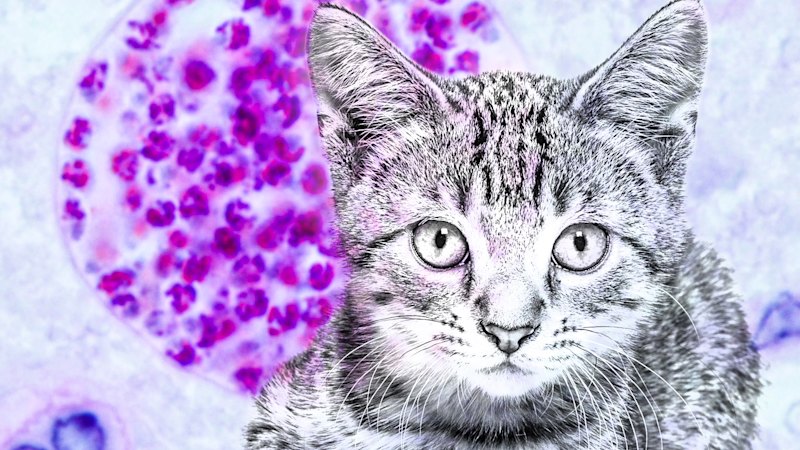
The parasite can infect any warm-blooded animal but it can sexually reproduce only in cats.
Toxo makes rodents lose their fear of predators and open spaces, making them easier targets for cats, which eat the infected mice and complete the parasite’s life cycle.
Exposure to cat faeces is one way humans become infected. But for people, the more common route of exposure is eating undercooked meat. Smith said livestock grazing on paddocks frequented by feral cats had led to high contamination levels in livestock.
“For a whole six months, we went to a supermarket three times a week, picked up a parcel of lamb mince, took it back to the laboratory and tested it with molecular testing for Toxoplasma gondii,” Smith said of a study published in 2020.
Conservatively, 40 per cent of the mince packets carried the parasite. Smith urged people to cook meat properly, or freeze it before cooking for rare dishes.
“Freezing meat to sub-zero temperature kills the parasite,” she said.
Researchers are now focusing on the latent stage of infection to see if the parasite’s stubborn cysts can be targeted with treatment.
Tonkin and his team revealed the parasite exports proteins into its host cell that silence immune signals, keeping the invaders cloaked within brain and muscle cells.
Professor Malcolm McConville, a toxo researcher at the University of Melbourne, has shown the parasite can steal a range of nutrients from its host cells, too, one of the reasons behind its extraordinary ability to infect an enormous range of organisms.
“It’s probably one of the most promiscuous pathogens to humanity. Essentially any animal is susceptible to toxo,” he said. “You get them in polar bears up in the Arctic, you get them in birds, feral cats, stray cats.”
The parasite is related to malaria, which could feasibly be eradicated if transmission can be disrupted. But while malaria has a restricted array of hosts, and affects only liver and red blood cells, toxo can hack into the cells of any warm-blooded creature.
That makes it essentially impossible to eradicate, unless we fully remove cats.
“We’ll probably never get rid of toxo, regardless of how good the drugs or vaccines are,” McConville said.
Tonkin and McConville, who weren’t involved in Smith’s paper, backed the global call for more attention on toxo.
The management of stray and feral cats is one of the measures discussed in the paper, alongside better pre-natal screening, strengthened food safety measures, fortified biosecurity for farms and more research.
Smith said action on other diseases designated by WHO as neglected tropical diseases had made rapid progress.
“Research funding bodies – which includes government but also philanthropic groups – will provide grants for research on neglected tropical diseases,” Smith said.
“If toxoplasmosis was eligible for that research funding, that would be funding to work on vaccines, better diagnostics, curative drugs. Today, we’ve got no human vaccine for toxoplasmosis and there are no drugs that can cure it.”
The Examine newsletter explains and analyses science with a rigorous focus on the evidence. Sign up to get it each week.
 Angus Dalton is the science reporter for The Sydney Morning Herald.Connect via X or email.
From our partners
Read the full article here
