

Essentials, including medical supplies and power, were said to be unavailable in a northern Manitoba First Nation battling wildfires.
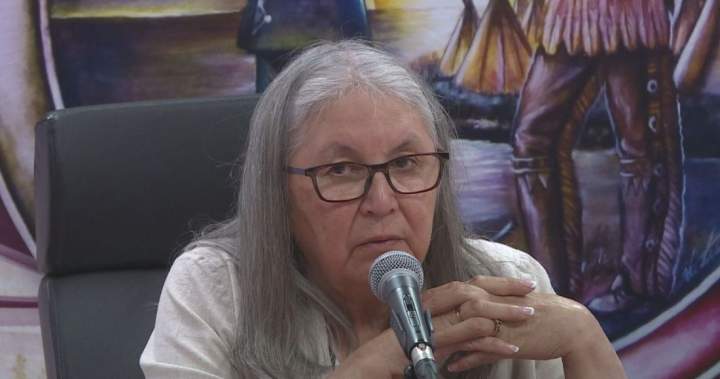
The wildfires surrounding the community are now under control, allowing Manitoba Hydro crews to begin assessing damage and restoring power in O-Pipon-Na-Piwin Cree Nation, Chief Shirley Ducharme told reporters at a news conference Monday.
Seventy-one members remain in the mostly evacuated nation, the chief said. Hundreds left after Priority 1 and Priority 2 residents were advised to evacuate because of the fire, which has burned 12,000 hectares.
Ducharme said she believes that had medical aid been more accessible in the community, a “tragic” ATV fatality may have been avoidable.
Last Thursday, the RCMP responded to a fatal single-vehicle collision in the community in which a 59-year-old woman died at the scene, according to a news release.
Mounties said officers responded to reports of an ATV in a ditch and found the injured woman. Wildfire service paramedics flew in from Leaf Rapids while crews waited for a trauma helicopter to travel more than 300 km from Thompson.
“We didn’t have medical staff,” Ducharme said. “Emergency support did not arrive in time, resulting in the loss of a beloved community member.”
The woman stayed in town to help during the evacuations. She was a front-line worker, according to the chief.
“We felt very helpless at the time,” Ducharme recalled. “There is a need for emergency response, and that wasn’t there at the time.”

Get daily National news
Get daily Canada news delivered to your inbox so you’ll never miss the day’s top stories.
When asked whether she believed the outcome would have been different if paramedics had been closer, the chief declined to comment.
In a statement for Global News, a spokesperson for the Manitoba government said it is working with the community to address its concerns.
“We helped support the evacuation of the O-Pipon-Na-Piwin Cree Nation and continue to work with Indigenous leadership, the federal government, Red Cross and others on supports and assistance during this difficult time. We continue to have daily communication to ensure the coordination of resources to the community,” the statement from the province reads.
Global News reached out to Indigenous Services Canada for comment. The department acknowledged the request. No statement was received before publication.
The outlet also reached out to the Crown-Indigenous Relations and Northern Affairs Canada. No response was received prior to publication.
The chief also said Manitoba Hydro must better prepare for wildfire season.
Mitigation measures, such as vegetation management, power-pole wrapping and infrastructure protection, must be used to ensure rural communities can maintain power in emergencies, Ducharme said, adding the current approach feels reactive rather than preventative.
“We stress (that) we should learn from this,” Ducharme said.
The community is in a similar situation as last year, when it faced a wildfire that burned more than 150 power poles, knocking out power for months. Power was fully restored in September 2025 after the community lost service that summer.
“We continue to struggle. We need clear communication amongst all departments and agencies,” she said, calling on “immediate action to address the emergency response gaps that are very noticeable at a time like this.”
In a statement to Global News, Manitoba Hydro said about 240 customers in the area remain without power after about 30 poles were damaged by the blaze.
“Some of the line passes through difficult terrain, requiring specialized equipment to access the area and do detailed inspections,” Peter Chura, a media relations officer with Manitoba Hydro wrote in an emailed statement.
“We are mobilizing staff and equipment to do this but currently, the wildfires and shifting winds are making the area unsafe.”
In terms of mitigation, hydro crews wrapped thousands of poles in fire-resistant mesh and cleared vegetation near power lines, he said. At O-Pipon-Na-Piwin Cree Nation, specifically, more than 150 poles were wrapped and community members assisted with vegetation-clearing efforts.
“We realize there’s more to be done, and plans are (in) place to complete this work in and around the community as soon as possible,” Chura’s statement says.
Manitoba Hydro could not estimate when power will be fully restored in the northern First Nation.
Read the full article here
