

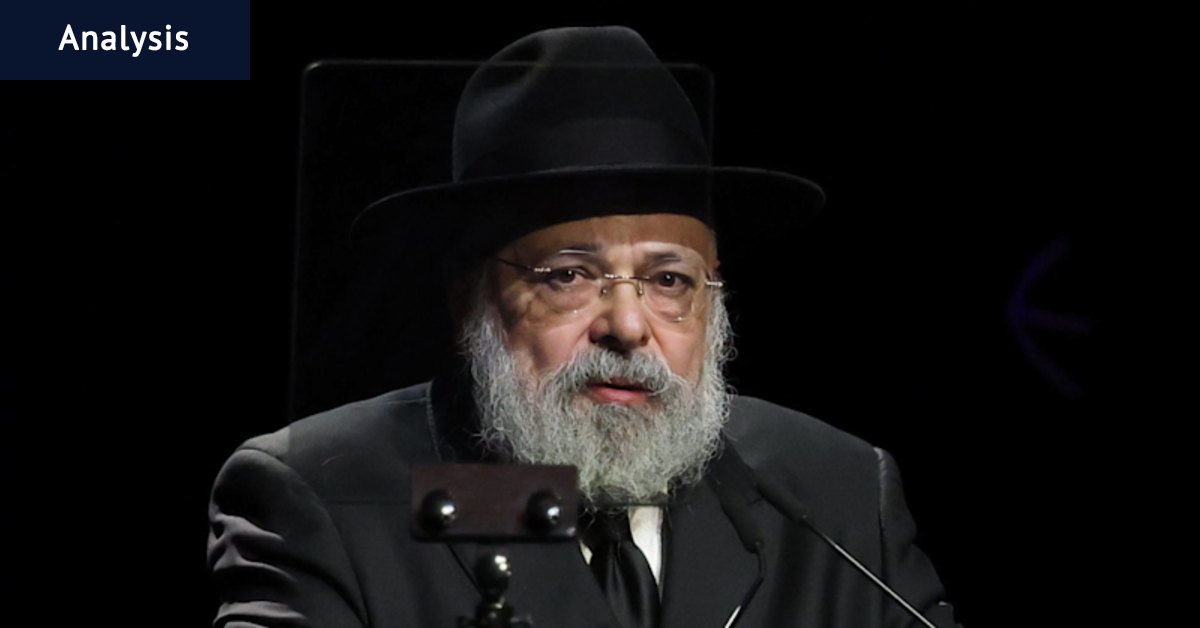
Rabbi Yehoram Ulman was given the final say as the powerful probe established after his son-in-law’s brutal killing concluded its public hearings. “Australia is at a crossroads,” Ulman told the Royal Commission on Antisemitism and Social Cohesion on Wednesday as former High Court judge Virginia Bell adjourned to finalise a seminal report that will shape how Australia deals with hate.
Ulman lost his son-in-law and fellow rabbi Eli Schlanger on the first night of Hanukkah last year when two gunmen opened fire at Bondi Beach. Schlanger’s youngest child was only two months old when the rabbi and 14 other mostly Jewish people were killed on that golden summer evening.
“One day he will be old enough to understand what happened on December 14, 2025,” Ulman told the commission, in reference to his grandson. “I wonder what Australia he will know by then.
“Will he learn that the warning signs were there, that hatred was allowed to grow, and that even after Bondi, Australia failed to change course? Or will he learn that Bondi became a moment when Australia understood where unchecked hatred can lead, found the courage to confront it, and chose another path?”
The royal commission’s public hearings ended as they began – with harrowing testimonies. Ulman, from Chabad Bondi, was one of 340 witnesses called to give evidence across 62 days, with more than 130 of those personal accounts from Jewish people. The commission has received 20,000 written submissions.
The mainstream Jewish groups on Wednesday put out a lengthy joint statement supporting the work of the commission. “Our community has put its head, heart and soul into this commission, providing the most detailed account of Jewish life in Australia ever put before a public inquiry,” Peter Wertheim, co-chief executive officer of the Executive Council of Australian Jewry, said.
“Australia is the only country in the world which has turned the spotlight on itself to examine its own record of antisemitism, and to do so with the seriousness of purpose that the issue clearly warrants. This is a cause for hope.”
Other Jewish groups offered similar optimism. None called for the extension of the commission.
Their stance, however, was in stark contrast to several high-profile Liberals, including federal MP Julian Leeser and former federal treasurer Josh Frydenberg, both Jews. Leeser and Frydenberg wanted the commission to continue in order for government ministers, including Prime Minister Anthony Albanese, to be called to give evidence.
Opposition Leader Angus Taylor weighed in too, insisting that a failure to extend the commission would be a “betrayal of the Jewish community”. Thirty national security and defence chiefs, including former governor-general David Hurley, also called for the royal commission to be extended, arguing that the “speed with which the royal commission has been forced to conduct its public hearings” has not allowed it to fully investigate the rise of antisemitism.
In response, counsel assisting the royal commission Richard Lancaster, SC, delivered a clear rebuke in his closing address on the final day of hearings, saying there were “many commentators upon, and indeed occasional critics of, the work of the commission”.
“However, the nature and scope of the royal commission’s investigations are such that the public record is not a complete picture of the work of the commission at the moment,” Lancaster said. “Such commentary is necessarily made without an appreciation of the full scope of evidence and material that is before [the commission].”
Chris Taylor, a senior fellow at the Australian Strategic Policy Institute, was one of the first experts to call for a royal commission into the December 14 terror attack. He had hoped that a key aspect of such a royal commission would be to probe any possible national security or police failings that led to the Bondi shootings.
One day after the attack, Taylor argued that a royal commission “should be empowered to minutely examine what led to the attack”, with a focus on the alleged gunmen, Sajid Akram and his son Naveed Akram, but that there should also be an investigation of the “knowledge and actions of security agencies and the police, before and during the attack”.
However, Taylor acknowledges that the commission was restricted by the looming criminal trial of the surviving alleged attacker Naveed Akram, as well as its terms of reference. He says judgment cannot be fairly passed until Bell releases her final report on December 18, four days later than initially anticipated.
“I very much felt that we had to have a royal commission,” Taylor says, “but I also acknowledge the need not to prejudice the criminal case.”
NSW Police, ASIO and the Australian Federal Police were called as part of the commission’s second hearing block, which looked at, among other issues, the “terrorism threat level and security environment in the lead-up to the attack”.
Much of that block, however, was done in closed and classified hearings.
Lancaster said this was to “avoid prejudice to the criminal proceedings, or to avoid the public revelation of security arrangements that could compromise the work of law enforcement agencies, or be used against Jewish community organisations”.
Bell, who will see out her lengthy and impressive legal career as commissioner, also addressed the concerns around the commission’s approach to probing national security.
“I am conscious that many members of the community, and particularly members of the Jewish community, must find it frustrating that a royal commission established in the aftermath of the Bondi Hanukkah attack has not been seen publicly to be investigating what led to the attack and whether it might have been prevented,” Bell said.
“After the conclusion of the criminal proceedings I propose that substantial parts of the confidential volumes of the interim and final reports should be made public.”
As for Rabbi Ulman, he wants the commission to be a true turning point in Australia’s history. He thanked his fellow Jews for their courage in sharing painful experiences, and the commission for listening.
“My prayer is that when my grandson is old enough to understand what happened to his father, he will also be able to understand what Australia chose to do about it,” Ulman told the commission in his closing words. “And that he will be proud of the choice we made.”
Be the first to know when major news happens. Sign up for breaking news alerts on email or turn on notifications in the app.
 Alexandra Smith is a senior writer and former state political editor of The Sydney Morning Herald.Connect via X or email.
From our partners
Read the full article here
