

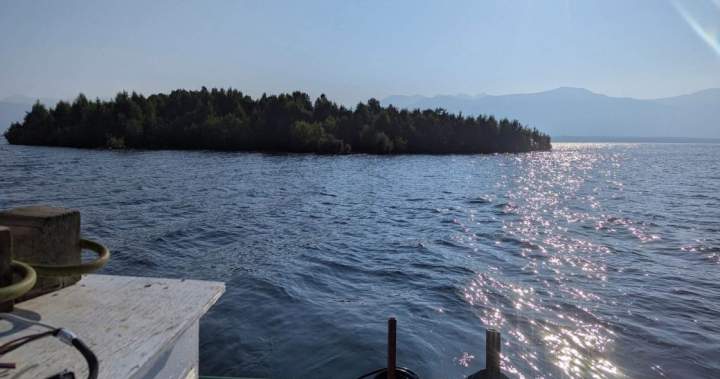
A bizarre phenomenon is drawing international attention to the shores of British Columbia’s largest body of water: a floating island of densely woven vegetation keeps appearing, disappearing, and then showing up elsewhere in the water.
The floating forest, which is 70 metres wide and 140 metres long, about the size of a soccer field, was initially spotted in July near Finlay Bay in the middle of Williston Reservoir in the northern interior of B.C.
Satellite imagery first confirmed its position, but by August it had vanished.
B.C. Hydro spokesperson Bob Gammer told Global News that his staff were alerted to the island in a Facebook post, but that because of its size and movement, it was tricky to follow and was likely “flimsy” and “dangerous.”
Williston Reservoir is the world’s seventh-largest artificial reservoir, measuring 250 km north to south and 125 km east to west. Gammer described tracking the nomadic island as like looking for “a needle in a haystack.”
But weeks after it was first seen bobbing along the shore, the travelling bulk of trees showed up again, this time resting on the banks of the reservoir, pushed northwards by blustering winds.
The government agency believes the island began as a collection of decaying logs that, over time, became tethered by tree roots and broke free from land as water levels rose, which are at their highest in 14 years. Gammer said the man-made lake was effectively “full,” creating the perfect conditions for the island to be lifted off the land.

Get daily National news
Get daily Canada news delivered to your inbox so you’ll never miss the day’s top stories.
John Clague, an earth sciences professor at Simon Fraser University, likened the appearance of the woven mass of trees to a “fairytale,” explaining that islands supporting forests aren’t supposed to “float around in a lake” and noting that visitors are safest admiring it from afar, advising them not to set foot on the self-supporting structure.
Rocky Avery, a lifelong McKenzie, B.C., resident living near the reservoir who posted a video of the island on social media last month, told Global News he had never seen anything like the floating island before, but planned to fly over it for a better view.
“It’s remarkable to see it sitting there floating around; who knows how long it’ll be out there,” Avery said.
The island is moving north, away from the W.A.C. Bennett Dam, the largest in British Columbia. B.C. Hydro does not believe it’s a threat to the dam, Gammer assured, and is confident it would never be a problem, even if it ended up nearby.
Gammer said the island would have taken many years to form and told The Guardian it likely hosted diverse species of fish, birds, trees and small animals, all living among a web of branches that keep the structure afloat.
These types of islands are studied and have been spotted before in other lakes across the globe, including Forty Acre Bog in Wisconsin, a large drifting island on Lake Chippewa bound together by mud roots and trees. It appeared more than 100 years ago when the area was flooded to create the Chippewa Flowage.
Read the full article here
