

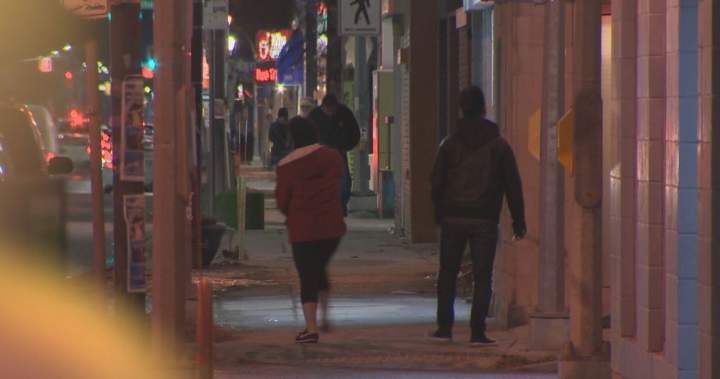
Winnipeg is perceived as the least safe major city in Canada, recent polling has found.
The Liaison Strategies poll asked respondents how they perceived the net safety score of 15 different Canadian cities. Their options included very safe, somewhat safe, somewhat unsafe or very unsafe, as well as one in case they did not know enough to answer.
Toronto, Edmonton and Moncton were also among the cities ranked. They were chosen to match those used in a previous study from 2017 that David Valentin, principal at Liaison Strategies, worked on, he told Global News in an interview.
Winnipeg also placed at the bottom of that list, and this year, its reputation backslid, he said.
Of the 1,500 people who responded to the recent edition of the poll, more than half said they consider Winnipeg to be somewhat or very unsafe, Liaison Strategies found. Thirty-eight per cent consider it somewhat unsafe, and 21 per cent perceived the city as very unsafe.
“Winnipeg was always doing badly in this ranking, but now it’s doing even worse – just objectively,” Valentin said.
“Obviously, there are some real challenges in terms of the amount of crime that’s taking place there, and we’re seeing that not from this survey, but from Statistics Canada. There really is a need to get that under control.”
Get breaking National news
Get breaking Canada news delivered to your inbox as it happens so you won’t miss a trending story.
Toronto, Saskatoon, Edmonton and Vancouver joined Winnipeg as the five least safe Canadian cities based on perception, the survey found.
People’s understanding of safety in areas they do not live is determined by various factors, including the news, personal experiences and stories from loved ones, according to the poll. It said 28 per cent said they are informed from news coverage.
“If you’re hearing about high profile robberies or high-profile crime, that can really colour your view of what is going on out there,” Valentin said.
“You can watch one robbery in one mall from 10 different angles. TikTok will show you all 10 angles, and you might get them all in sequence, but you might also see them over a span of three or five weeks. At which case, you might say to yourself, ‘wow lots of people in Mississauga right now are robbing jewelry stores,’ but it might just be the one incident.”
As a contrast to those negative assumptions based on media portrayal, he pointed to Ottawa, the safest city, according to the survey. Valentin said it is typically seen only as a backdrop to parliamentary discussions.
Quebec City was seen as the second safest city and was one per cent behind Ottawa, with 74 per cent of those surveyed saying they believe it is very or somewhat safe.
“I think so much of the news we absorb from Ottawa is about the government. I can’t recall the last time I saw news about Quebec City, but when I see it, it’s always about the winter events,” Valentin said.
Two-thirds of respondents found Charlottetown to be the safest city, putting it in third place. Victoria, B.C. was fourth, and Moncton came in fifth.
The two other Maritime cities included in the survey, Halifax and St. John’s placed sixth and eighth, respectively.
“We get a lot less news out of Atlantic Canada,” he said. “There’s very, very few high-profile incidents that we hear about from out East.”
Though, perception is not always reality, Valentin noted. Twelve per cent of people said their opinions were based on crime statistics.
He pointed to cities like Toronto, where per capita, crime is not as severe as non-Torontonians may assume.
“Toronto, for example, its net safety is second worst, but really, it belongs towards the higher end of the list when it comes to safety. There’s a lot of things that go wrong in Toronto, but you also have to account for the large population,” Valentin said.
“As a result, it’s not actually that unsafe to be in Toronto, despite what most Canadians believe.”
The Liaison Strategies survey interviewed 1,500 Canadian adults by telephone on Aug. 30-31, it said. Results were said to be weighted to demographic and geographic targets, with a national margin of error of ±2.53 percentage points, 19 times out of 20.
Read the full article here
