

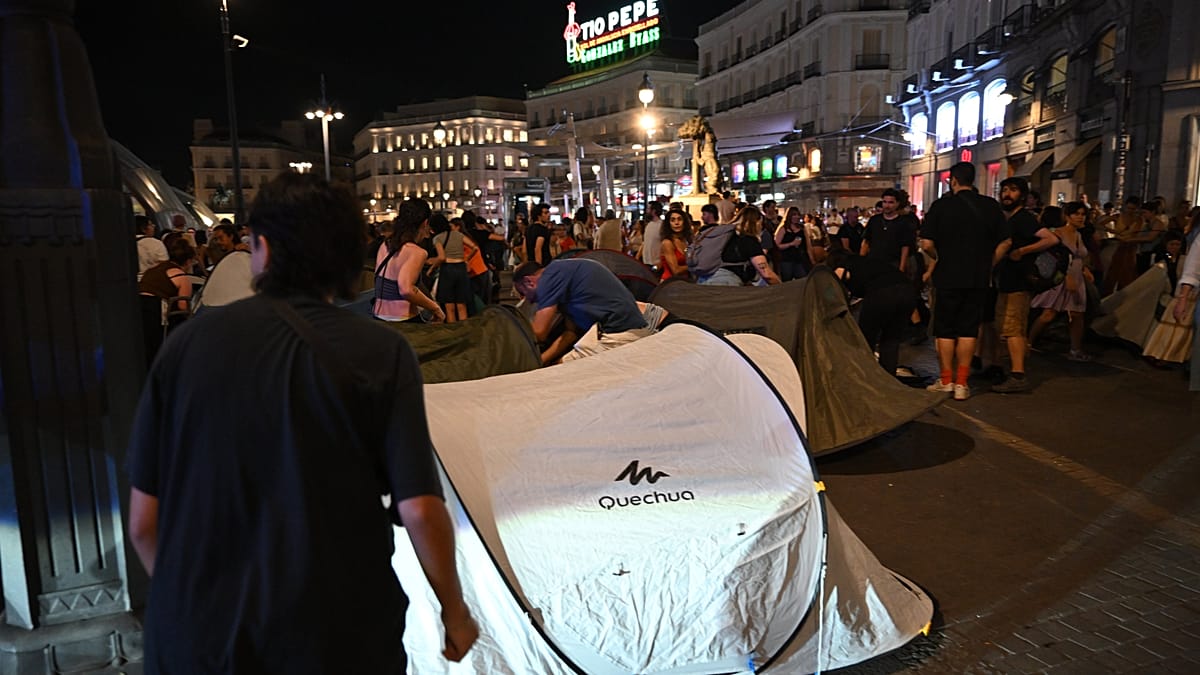
Puerta del Sol woke on Sunday to around 150 tents pitched across the square, as the encampment grew following a demonstration over Spain’s housing crisis that ended in the early hours of Saturday.
According to figures collected overnight, the camp began with around 100 tents and continued to grow, with further structures counted after 8am.
Those gathered spent the night on yoga mats, in sleeping bags and, in some cases, directly on the ground, while small groups stayed up talking into the early hours.
While the Civil Guard and National Police kept a constant watch over the square, although no incidents have been reported. The campers themselves have described a calm atmosphere, with stocks of food and water to sustain the protest over the coming days.
The initiative answers the call of the Madrid Tenants’ Union, which urged people to camp out in Sol once Saturday’s march was over. In its call, the organisation invited those unable to stay the night to bring sleeping bags, mats, food or water. One protester summed up the reason for the mobilisation in a line repeated in different groups: “all this is for Maricarmen”.
The camp is strongly reminiscent of the one that began in Madrid on 15 March 2011 and led to the 15-M movement. Its slogan, “Sí se puede” — “Yes, we can” — became a symbol for people frustrated with Spain’s two main parties, the PSOE and PP.
The movement called for a political alternative that would put ordinary people first.
Maricarmen’s eviction, the origin of the protest
The camp follows the eviction of Maricarmen Abascal, an 87-year-old woman who was forced to leave her rented flat in Madrid’s Retiro neighbourhood last Wednesday, after living there for 70 years. The case, now known as the “Maricarmen effect”, has become the trigger for a day of protests called in 40 cities under the slogan “Not one more Maricarmen”.
Saturday’s demonstration, which started at 6.30 p.m. in Puerta del Sol and ended at the Congress of Deputies, brought together around 25,000 people according to the Government Delegation, although the Tenants’ Union puts the figure at as many as 300,000 participants. Along the route there was a notable intergenerational presence, with families, young people and elderly groups chanting slogans such as “Where is the progressive Government?” and “We want to see Maricarmen come back”.
The spokesperson for the Tenants’ Union, Gonzalo Álvarez, who spent the night at the camp, explained in a live interview that the protest is seeking “structural changes” so that housing “is treated as a basic necessity and not as a financial asset”. Álvarez also pointed out that Maricarmen’s case has acted as a catalyst because of “the injustice, the harshness of what happened and the police response”.
The core demand: Tuesday’s housing decree
The main demand of the protest is for the Government to approve a decree on Tuesday that would include, among other measures, a freeze on rents. The union has called it the “Maricarmen decree”.
Álvarez warned that if the decree is not approved, the Government’s left-wing partners, including Sumar, should consider withdrawing their support and bringing down the Government.
Echoing this position, the Tenants’ Union spokesperson Alicia del Río described Maricarmen’s case as a “point of no return” in Spain’s housing struggle and warned that if the decree does not go through on Tuesday, the Executive “makes no sense at all” and should rethink whether it can continue.
Pablo Iglesias, founder of Podemos and one of the initiators of the 15-M movement in Spain, said that Maricarmen could become Spain’s Rosa Parks and that he hopes this movement will spread across the country.
The debate is also complicated by divisions within the left-wing bloc. Podemos MEP Irene Montero has rejected the Government negotiating the decree with Junts, accusing the party of trying to force an agreement on the people who took to the streets on Saturday.
Montero called for the expropriation of 650,000 homes owned by vulture funds so they can be turned into social rental housing. Meanwhile, Podemos secretary-general Ione Belarra said her party would keep “piling on the pressure” to secure the strongest possible decree. But she warned that no single measure would solve the housing crisis without continued protests and pressure from the streets.
Read the full article here
