

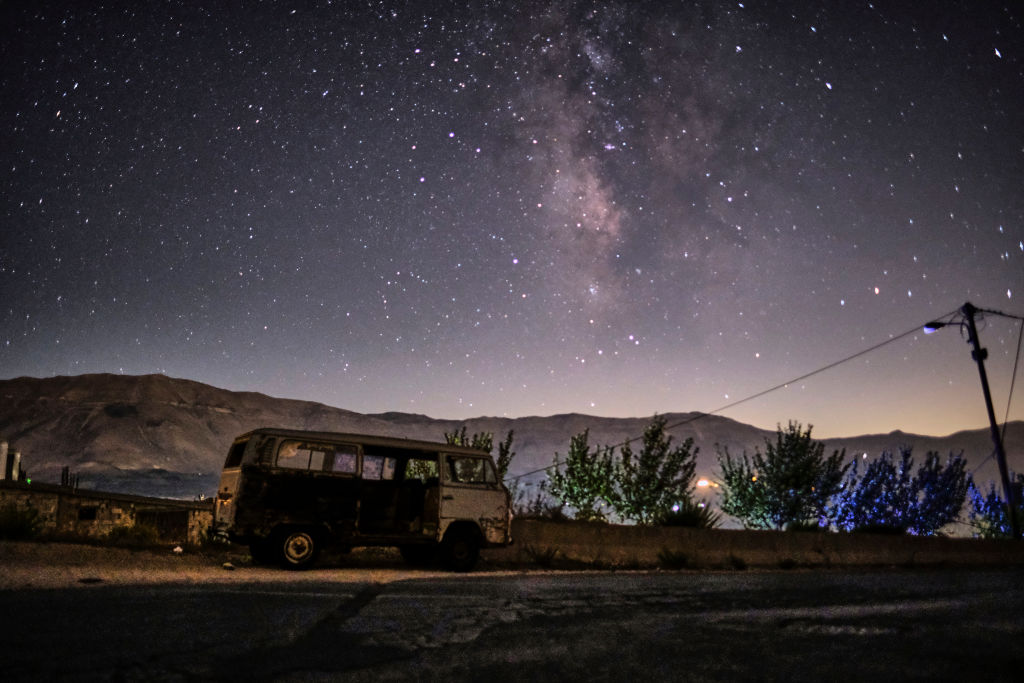
As autumn paints the leaves, the universe is putting on its own seasonal spectacular. October features an action-packed lineup of meteor showers and celestial showcases.
All eight planets are visible at some point in October
Every planet in the solar system is easily seen at some point this month, with Mercury being the most difficult. That’s not unusual, thanks to its proximity to the sun. Here’s a quick rundown on the best times to view each planet in October.
Mercury: Mercury is in elongation (the furthest it can get from the sun) on Oct. 12, making that day and the two or so days before and after the best possible time to view Mercury.
Venus: Venus spends most of the month being right next to the sun, making it virtually impossible to see. However, by the end of the month, it begins to separate from the sun, making it visible just after sunset. The best view is on Oct. 31, and the view is only set to get better going into November.
Mars: Mars will be visible in the night sky every night in October. It rises from the eastern horizon right around 2 a.m. and stays there until the sun comes up.
Jupiter: Jupiter and Mars are going to be pretty close together all month, so most of the same rules apply, except that Jupiter rises about two hours later than Mars on most nights in October.
Saturn: Saturn is living its best life in October. It’s visible almost right at sunset ET and stays visible in the night sky until sunrise.
Neptune: Neptune is also visible every day in October and follows a very similar path to Saturn. It rises in the east, streaks across the sky, and sets in the west right around sunrise. They’re actually pretty close together in the night sky every night during the month, so if you can find Saturn, Neptune isn’t far off, but you’ll definitely need magnification to see it.
Uranus: Uranus is visible the entire month and follows a very similar path through the sky as Saturn and Neptune, but its trek happens later at night. It rises on the eastern horizon about 2 hours after Saturn and follows it across the sky, but never really catches up, ending up in the high western sky when sunrise comes.
Oct. 3-4: Saturn is at opposition
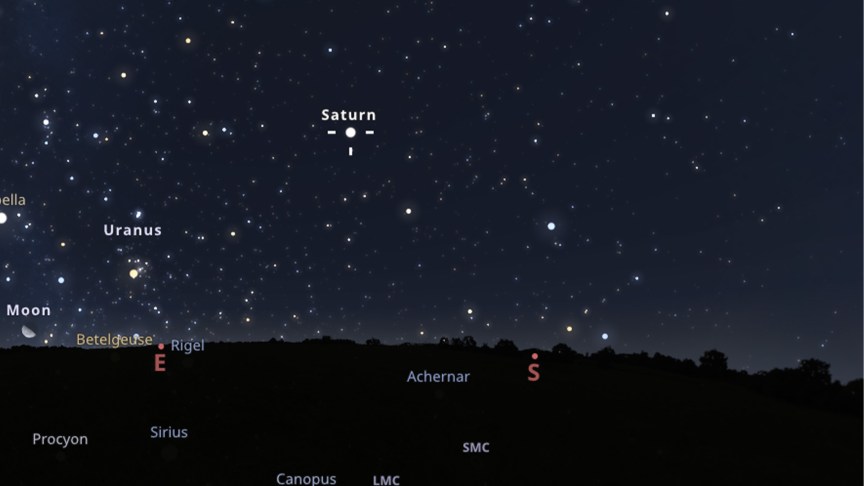
Skygazers hoping to get the best possible view of Saturn can do so in the first week of October. The planet is at opposition — the point at which it’s closest to the Earth — meaning it’s as big and bright in the night sky as it’s going to get for the next year. This is prime time to pull out the telescope or high-powered binoculars and get a look at Saturn, along with its fabulous rings.
The planet reaches opposition at around 8 a.m. ET on Oct. 4. The best time to view is the night before, Oct. 3, or the evening after, Oct. 4. For both nights, Saturn rises out of the eastern horizon just before sunset and streaks up into the southern sky as the night goes on. The moon may cause some light pollution, but the planet is bright enough that it shouldn’t be hard to spot with the naked eye.
Oct. 5: The moon and Mars hang out
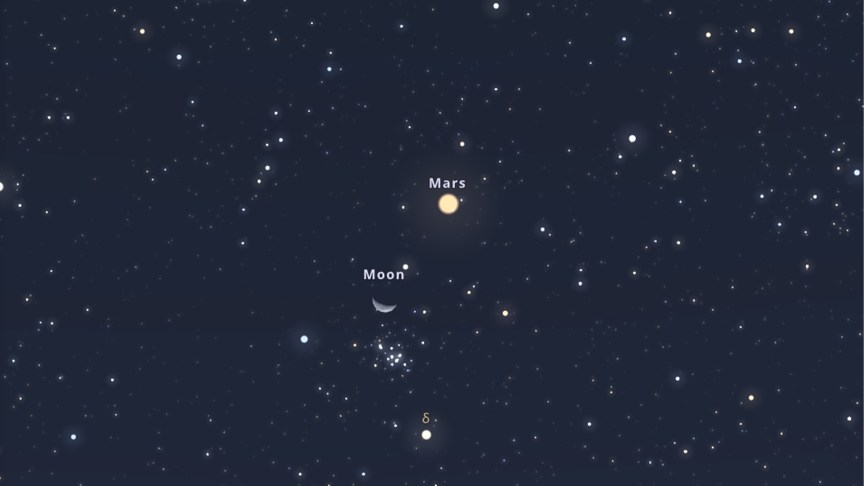
The various objects in the sky are always having a dance party, at least from the perspective of viewing them here on Earth. Mars and the moon are due for a dance on the evening of Oct. 5. In the days leading up to it, Mars appears further up in the night sky but drifts closer to the moon. After Oct. 5, the moon will move rapidly away from Mars. The two will be almost right on top of one another, so if you can find the moon, Mars should be nearby.
Oct. 6: The moon covers Jupiter entirely
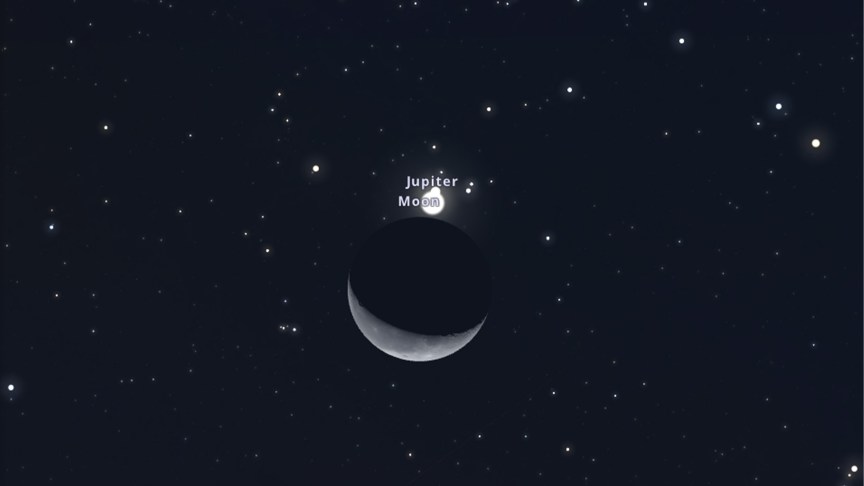
Just one day later, the moon is meeting up with another dance partner, Jupiter. The moon will completely cover Jupiter, hiding it from view for much of the night, a phenomenon known as a lunar occultation. This is a pretty rare event. Per The Old Farmer’s Almanac, New York City saw a Jupiter occultation in 2004. The prior one visible to New Yorkers was in 1889.
This one is pretty easy to see. The moon and Jupiter will be right on top of one another all night, but depending on where you live, you’ll see Jupiter dip behind the moon at some point and pop back out again. The times vary wildly depending on where you are, so we recommend checking out The Old Farmer’s Almanac, which has a table of times this will happen in major cities.
Oct. 7: Draconids Meteor Shower
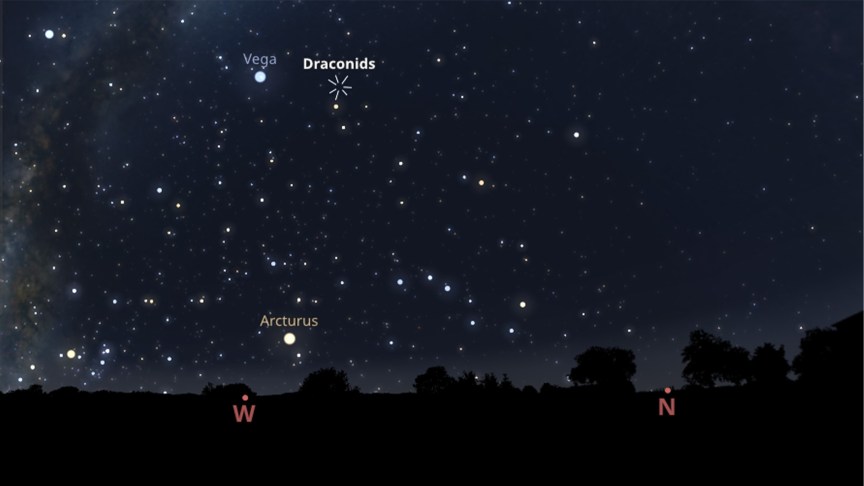
The Draconids meteor shower is a minor meteor shower that occurs every year around the first week of October. It officially starts on Oct. 6 and runs until Oct. 10, making it one of the shortest meteor showers of the season. It peaks on the evening of Oct. 7 and continues into the middle of the night. It’s fed by the 21P/Giacobini-Zinner comet, which is part of the Jupiter family of comets.
Draconids meteors appear to originate from the Draco constellation. It sits high in the western sky in the northern hemisphere this time of year, with a slight lean to the north. If you’re using a sky map app, all you need to do is find Vega, and you’re already in the right neighborhood to catch Draconids.
The peak is a little tame, at around 10 meteors per hour most years, but it has a history of surprising astronomers. In 1933 and 1946, Draconids spat out thousands of meteors an hour in what were two of the most intense meteor showers of the 20th century. On the plus side, the moon is below the horizon for this meteor shower, so you won’t need to worry about light pollution from the moon.
Oct. 10: The last good chance to see the Milky Way
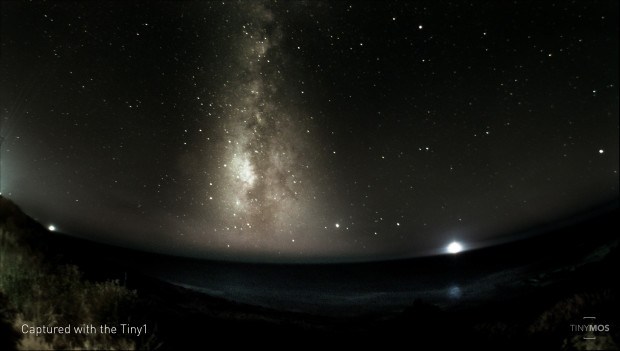
The Milky Way captured with the Tiny1 camera.
TinyMOS
The very best time to view the Milky Way is at a new moon in the warm months of the year, from May to August. This is when the Milky Way is high in the sky all night, giving night owls great views and plenty of time to photograph it. The problem is that it’s best viewed on nights with a new moon between midnight and 4 a.m. local time, which can be a bit late for some folks.
September and October are great for this because the Milky Way is at its highest point between 8 p.m. and 10 p.m. local time, giving the early birds a chance to snap some sweet photographs of the Milky Way. After October, the Milky Way is too low on the horizon to allow really good pictures of it until the following May. So, if you have a camera and are some place that’s dark, the new moon on Oct. 10 is probably your last chance to capture a striking photo before next spring.
Oct. 21: Orionids meteor shower
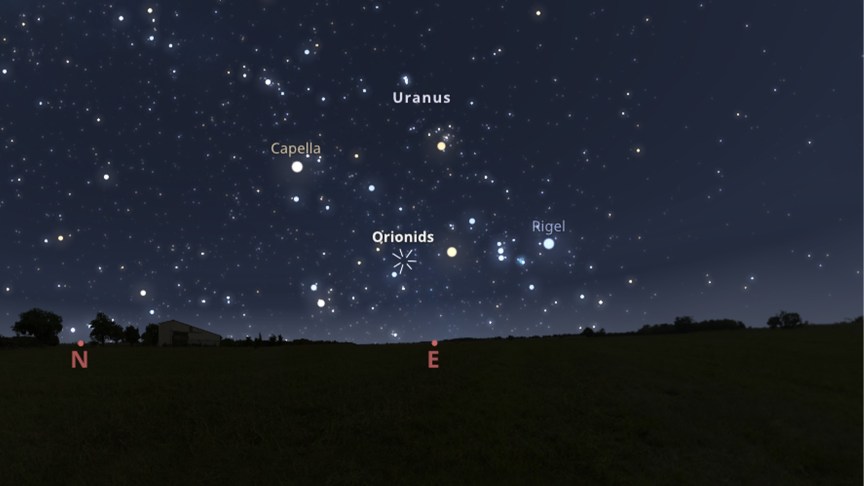
Orionids is the better-known of the two October meteor showers. This one officially starts on Oct. 2 and runs until Nov. 7. It’s possible to spot a meteor from Orionids any night during the month, but the shower reaches its peak on the evening of Oct. 21. Meteors for this shower come from the 1P/Halley comet, which also feeds the Eta Aquariids meteor shower that happens every year in May.
This is a slightly more active meteor shower than the Draconids, and you can expect about 10 to 20 meteors per hour. The moon is set to be about 76% full that night, so you can probably expect to see fewer meteors thanks to lunar light pollution. The Orion constellation, where the meteor shower will appear to originate, doesn’t pop up over the eastern horizon until after midnight, so make sure to pack some coffee if you’re staying up late for this one. If you can find the stars Betelgeuse, Capella and Rigel, then you should be able to find Orion easily. They’re in the same general area.
The Orionids meteor shower is best known for its bright, fast-moving meteors, which leave long trails that can last for over a minute and sometimes result in fireballs. Their brightness will be a boon, with the three-quarters-full moon in the sky hindering viewing.
Oct. 26: The Hunter Moon
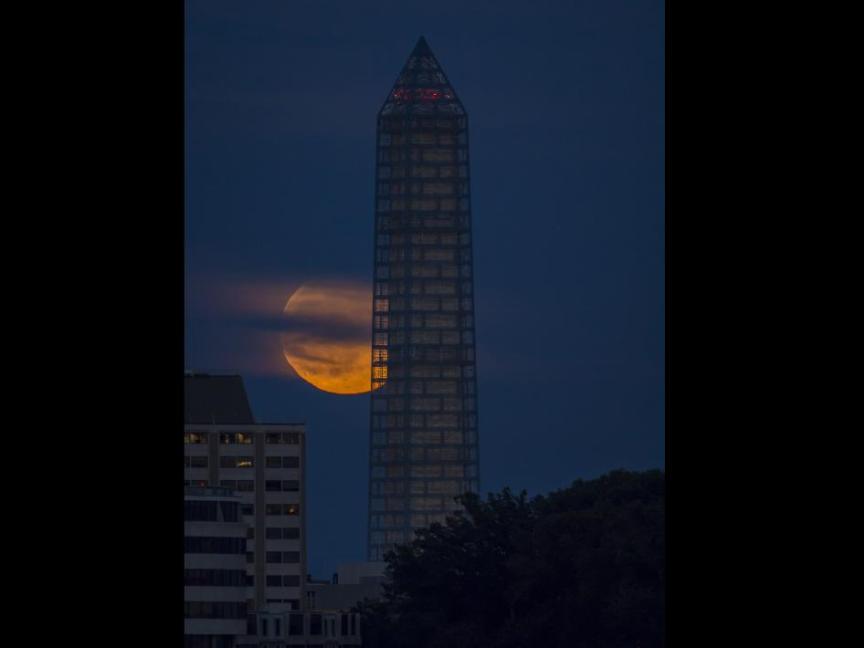
October’s full moon falls close to Halloween this year, perfect for spooky views. According to The Old Farmer’s Almanac, October’s full moon reaches its peak on Oct. 26 at 12:12 a.m. ET. It’ll also be over 90% full for a couple of days before and after, giving you a solid five days to check it out.
October’s full moon isn’t quite a supermoon. A full moon is only classified as a supermoon when the moon is in perigee and full at roughly the same time, and October’s full moon misses the mark by a couple of days. October’s full moon is the last normal full moon of the year. November and December close out 2026 with supermoons before January opens with the final supermoon of this cycle.
Oct. 27: The moon eclipses the Pleiades
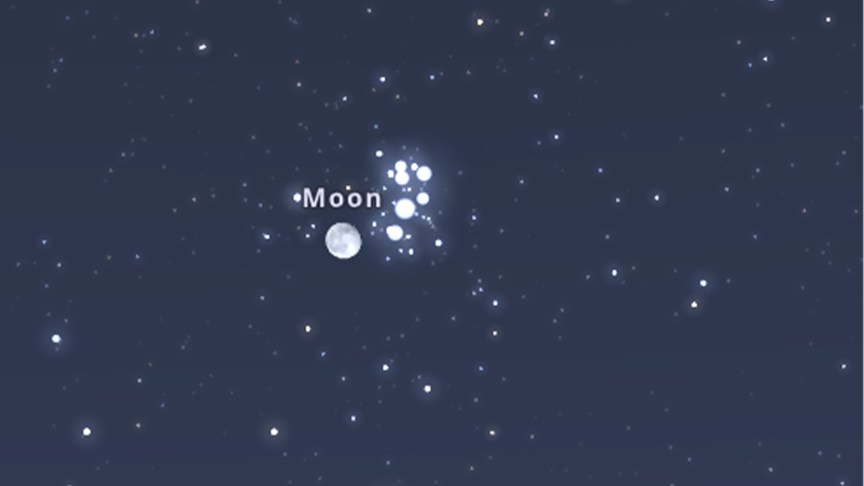
Pleiades is one of the best star clusters to view in the night sky. They’re known as the Seven Sisters, and in terms of clusters of stars, it’s one of the easiest to see. The exception is on Oct. 27, when the moon will cross in front of them, blocking them almost entirely from view. When this happens depends on where you’re located.
The moon begins passing in front of them before sunset in eastern time, and moves out of the way around midnight. Those on the East Coast will start the night in the middle of this little eclipse, while those on the West Coast will glimpse it at the very end. Finding it should be simple enough since the moon is the easiest thing to see in the night sky.
All month: Constellations and asterisms
The sky is continuing its rearrangement from summer into autumn, and there are tons of constellations to gaze at over the course of the month. Many of September’s constellations appear again, including both Dippers, Aquarius, Pegasus, Pisces and many others. October plays host to a few new ones in the night sky cycle, including Taurus, Cetus, Auriga and Orion, which will appear low on the horizon as they begin their months-long ascent into the sky for the winter.
There are some smaller asterisms to observe as well, including the Coffin of Delphinus, the Circlet of Pisces and the Northern Cross. We recommend using a sky map to find them all, as there are quite a lot. That’s good news, because even if you don’t go out during one of the big events in October, you’ll still have plenty of objects to look for in the night sky.

See full bio
Read the full article here
