

The signal of the chemical itself is relatively low, requiring some level of interpretation. But, even more importantly, just because we don’t know a way to produce this chemical through, say, geological or atmospheric processes, doesn’t mean it can’t be.
This discovery is very controversial, but Duffy says it has got many people thinking about the conditions for alien life and how to be sure we are seeing something that is really caused by life rather than other, less sensational, causes.
AI-crafted antibodies – Professor Merlin Crossley, molecular biologist and deputy vice-chancellor of academic quality at the University of NSW.
In 2025, biotech companies massively ramped up their efforts to enlist AI models in science.
“It is uncertain whether all strategies will deliver, but the careful datasets in protein databases led to AlphaFold,” says Crossley.
AlphaFold is an AI model built by Google and designed to solve a central, and very challenging, biological problem.
Proteins are the building blocks of our bodies; their function depends on their complex shape. We can read the 20-letter amino acid code that makes them, but it’s very difficult to know their structure without expensive and arduous experiments.
Antibodies, in red, binding to a virus in green.Credit: Dr Drew Berry/WEHI
AlphaFold is transformationally-good at predicting the structure from the code alone; the model’s designers won the 2024 Nobel Prize. “This is not garbage in, garbage out,” says Crossley. “This is diamonds in, and diamonds out. It is now possible to not only predict how proteins fold but also to begin designing them.”
Antibodies are proteins that rely on their unique shape to bind with and help destroy viruses and bacteria. This year, US-based biotech Absci dosed the first patients with an AI-designed antibody targeting inflammatory bowel disease.
“It is still early days, but the promise of designer proteins is huge,” says Crossley. “This is not vague AI hype.”
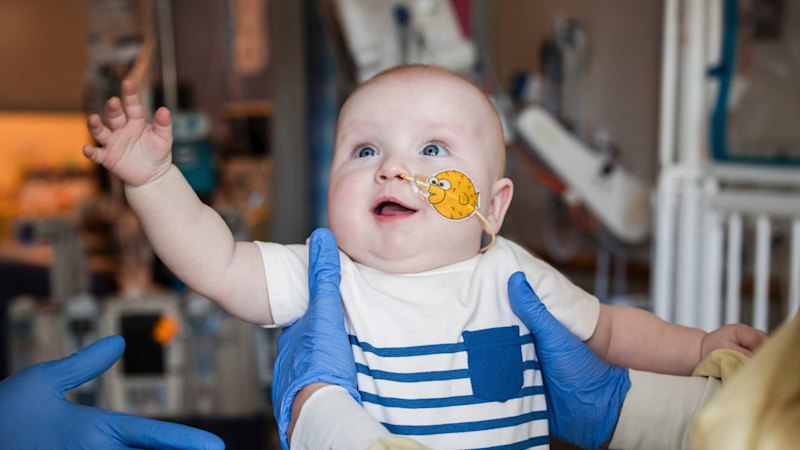
Baby KJ, the miracle child
Baby KJ was born with mutations disrupting the function of a key enzyme, which meant toxic products would gradually build up in his body.
“The baby’s prospects were grim,” says Crossley.
A liver transplant could cure the disease but instead, KJ, from Pennsylvania, was given genetic surgery, the first human to ever receive such a treatment.
Within six months of KJ’s birth, a team of scientists manufactured a custom gene editor and packaged it in lipid nanoparticles. The editor, known as CRISPR, was given instructions to crawl along KJ’s genome until it found the exact DNA that needed to be edited.
“It seems to have worked,” says Crossley. In a study published in May, the US researchers behind the treatment said KJ’s condition appeared to be improving, and there had been no serious adverse effects.

KJ was the first human to receive genetic surgery.Credit: AP
“Millions of people suffer from genetic diseases, and some people whose family members get their genomes sequenced are discovering they will inherit late-onset conditions. Universal cures are not yet available, but gene editing technology and RNA delivery strategies keep improving. Baby KJ is just the start.”
Quantum Encryption Breakdown – Professor Nalini Joshi, chair of applied mathematics at the University of Sydney
In May, Google Quantum researcher Craig Gidney uploaded a preprint paper with a title that is difficult to parse: How to factor 2048 bit RSA integers with less than a million noisy qubits.
It sent a shockwave through the encryption field, says Joshi. RSA is the most commonly used encryption algorithm for everything from your smartphone to government secrets; it relies on 2048-bit-long prime numbers. At that size, it’s essentially impossible for conventional computers to crack.
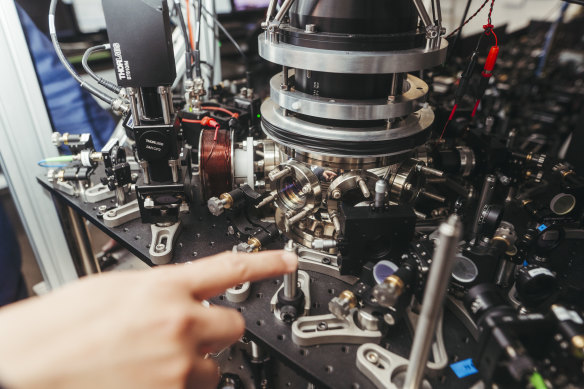
A trapped ion quantum computer in a lab at the University of Sydney.Credit: Dion Georgopoulos
Quantum computers, in theory, can do it much faster. Gidney’s original estimate in 2019 was that you might need 20 million qubits (the key measure of quantum computing power) to break encryption. In his 2025 paper, he cut that estimate to just one million.
“This paper shows that the looming threat of the breakdown of widely-used cybersecurity protocols by quantum computers is closer than we realised,” says Joshi. “Many have suggested that quantum computers capable of factoring currently used large numbers need to be so big that they may well be science-fiction fantasies, never likely to be built in our lifetimes. What Gidney has shown is that it requires only a million “noisy” qubits – building blocks that are being built now by many companies.”
The rise of the dark metabolome – Oliver Jones, professor of chemistry at RMIT
In the same way genomics is the study of all the genes in an organism, metabolomics looks at all the small biological molecules (metabolites) in our cells, tissues and organs.
Loading
“We try to measure as many metabolites as possible and then look at how this metabolic fingerprint changes in response to things like disease,” Jones said. “The idea is to find small changes in metabolism that might enable us to predict potential harm before it happens.”
But accurate predictions rely on identifying all the compounds that can be detected, and, as analytical methods get more complex, there’s an increasing number of metabolites that can’t be fully identified.
This is the dark metabolome, and by one estimate, about 85 per cent of all the metabolites in the human body remain uncharacterised with unknown function. What secrets do they hold?
“There is a lot of debate in the community about how extensive the dark metabolome is – and even how exactly we define it. Solving this issue could lead to advances in understanding our biology, and that of other species, as well as greater knowledge of how biological systems are affected by things like climate change and, my personal interest, the low concentrations of pollutants like microplastics and PFAS we find in the environment. I think it’s really exciting; I’m really looking forward to seeing where it goes next.”
Read the full article here
