

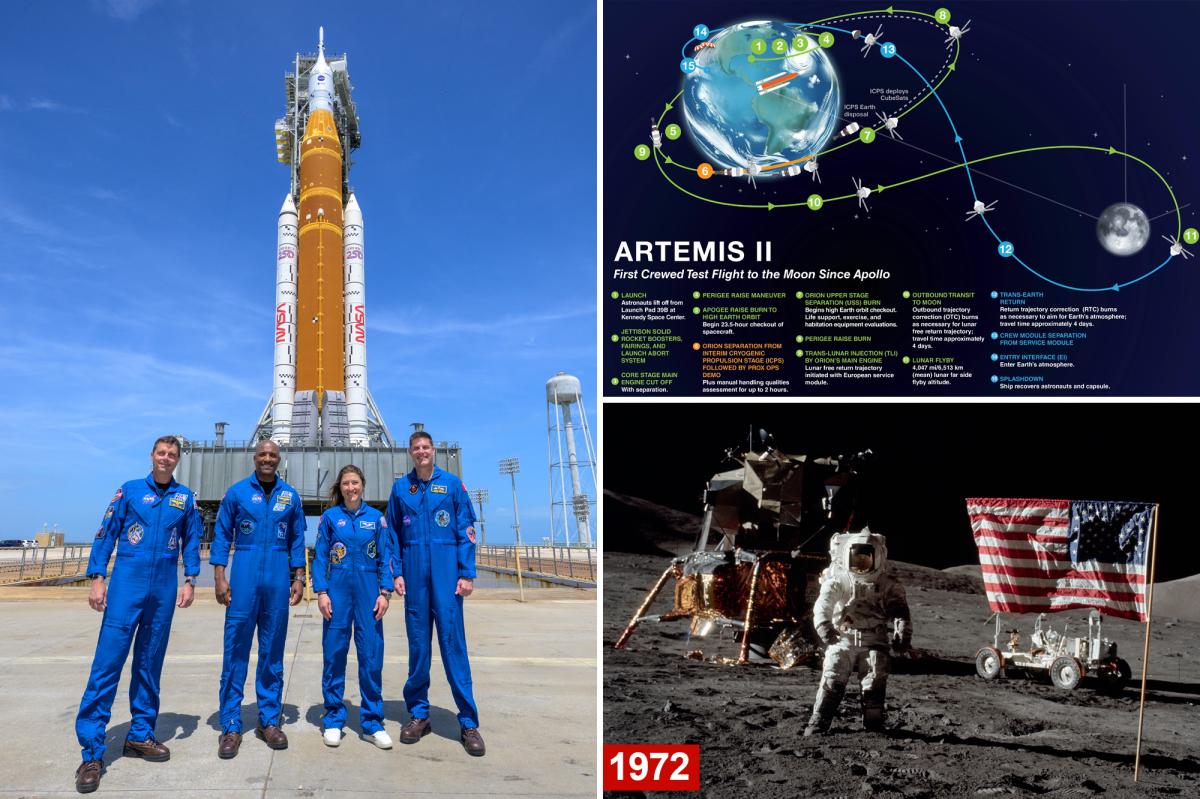
America is headed back to the moon for the first time in more than 50 years this week if all goes well on NASA’s Cape Canaveral launchpad.
But first, four astronauts have to go to the dark side of the moon on a perilous 10-day voyage.
Artemis II is scheduled to blast off from Florida as early as 6:24 p.m. EST Wednesday on an epic mission not seen since Apollo 17 left the moon in 1972.
The launch will send four astronauts — three Americans and one Canadian — loaded into a cramped spacecraft on a series of Earth orbits, before firing away for a loop around the moon and then heading home for a Pacific Ocean splashdown.
Artemis II’s flightpath will follow a figure-eight trajectory, which will utilize the moon’s gravitational field to slingshot the capsule back to Earth across the roughly 240,000 miles of space separating the two bodies.
It’s all a part of the ongoing plan to return humans to the surface of the moon — a feat which could happen as soon as 2028 if everything goes according to plan on Artemis II and the newly-scheduled 2027 Artemis III.
If the ship misses Wednesday’s launch window — either because of weather, or the kind of systems malfunction that delayed the mission in March — Artemis II will still have a window to fly until April 6, and then again on April 30 through early May.
Artemis II will test the life support systems and maneuvering capabilities of the Orion command module designed for upcoming moon-landings.
Then if all goes well, 2027’s Artemis III will stay in Earth’s orbit and give astronauts practice rendezvousing with the new lunar landers.
It’s a playbook that closely mirrors the missions that preceded Apollo 11’s historic first moon steps in 1969 — Apollo 7 and 9 tested systems in Earth orbit, while Apollo 8 flew its own figure-eight around the moon with a series of lunar orbits to test the Saturn V rocket’s ability to send a capsule across huge distances.
But Artemis II’s figure-eight will differ from Apollo 8’s and nearly every manned mission in history — it will skip the lunar orbits, but give humans the first extensive look at the far side of the moon through their own eyes.
All previous manned missions routinely flew around the far side of the moon — which perpetually faces away from Earth — but were planned so that the sun constantly shone on the nearside to allow for safe landings and productive moonwalks.
That meant the far side was almost entirely hidden in shadow throughout Apollo — and that most of it has only ever been seen through photographs from unmanned probes.
Artemis II will change that. The mission will pass over the far side in full sunlight and allow for direct observation of the moon’s hidden surface by the astronauts onboard.
The astronaut’s themselves will also become space history.
Mission specialist Christina Koch will be the first woman to go to the moon, and mission pilot Victor Glover will be the first black man to go.
Both have been astronauts since 2013, have backgrounds in engineering and science, and have already spent months onboard the International Space Station.
Artemis II’s commander Reid Weissman is a US Navy veteran and engineer, and has been an astronaut since 2009 with time served on the International Space Station.
And Jeremy Hanson will become the first Canadian to fly to the moon. He is a fighter pilot and scientist, and has spent time living in the underwater NEEMO science habitat in the Florida Keys.
The four of them will spend the entire 10-day mission living in the capsule’s cramped 330-cubic-foot space, which is about the size of two minivan interiors.
It’s not much of an improvement over the Apollo days, except for one major upgrade: the bathroom.
Apollo 11 command module Michael Collins once recalled that after “What was it like up there?” the second-most asked question he received throughout his life was “How did you go to the bathroom up there?”
The Apollo procedure was crude — astronauts had to strip naked and stick an adhesive plastic bag to their behinds to defecate, a procedure which sometimes left the crew chasing stray turds about the cabin.
Urination involved a tube and another bag, with the pee later being sprayed into space in a display the astronauts referred to as the “Constellation Urion.”
But the Artemis missions’ Orion capsule has not only a specialized toilet to take care of the messy business — but also a separate door to give the crew the kind of potty privacy never before seen in the history of deep space travel.
Read the full article here
