

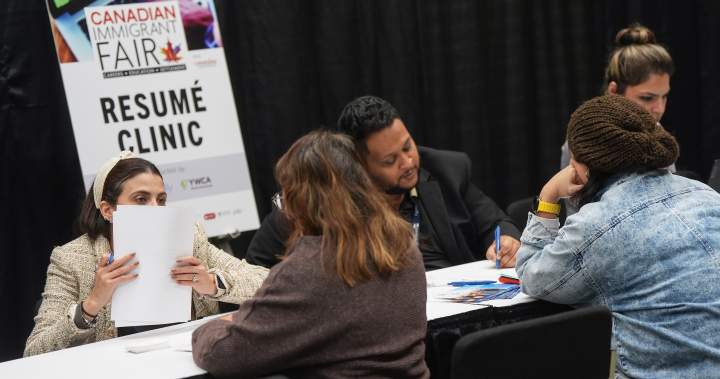
A newly released Statistics Canada report has found that in 2025, 71 per cent of women aged 25 to 64 had attained a college or university credential, up from 61 per cent in 2015.
Across the same age range, the number of men getting a college or university credential also rose from 49 per cent in 2015 to 57 per cent in 2025.
In total, nearly two-thirds (64 per cent) of Canadian adults aged 25 to 64 held a college or university credential, up from 55 per cent in 2015.
Ana Ferrer, a professor at the University of Waterloo and research fellow at the Institute of Labor Economics, says the value of education is only growing in a fluctuating economy.
The Statistics Canada data also found that across the next 10 years, “over 80 per cent of new job openings arising from economic growth are projected to be mainly in management positions and in those that usually require post-secondary education.”
“Women realize that the more education you have, the stronger your position is,” said Ferrer.
“Women have caught up to that really quickly and they have continued these trends which have pushed them into higher levels of education.”
According to the Canadian Occupational Projection System, out of 485 assessed occupations in 2023, there were 59 occupations where at least 80 per cent of workers were women. Out of those 59 occupations, 35 of them “are expected to have a job opening ratio above the average of all occupations.”
Of those 35 professions, 16 of them were health occupations and 12 were “business, finance and administrative occupations.”

Get breaking National news
Get breaking Canada news delivered to your inbox as it happens so you won’t miss a trending story.
In comparison, there were 161 occupations where at least 80 per cent of those workers were men and 63 of those professions were expected to have a high job opening ratio.
Thirty-one of those jobs were in “trades, transport and equipment operators,” 16 were in manufacturing and utilities, 10 in “natural and applied sciences” and four in “natural resources and agriculture.”
Ferrer also believes that increased technology will “play a big part” in closing gender disparities in different areas of the workforce.
“Looking at the technologies that are coming up, I think that this is likely to change because it’s less and less the case that there are occupations for women and occupations for men,” Ferrer said.
A separate Statistics Canada research study revealed that since 2024, 51.1 per cent of Canadian women aged 20 to 49 years were not mothers — roughly one in four, for women over 40 years old.
The report says, “increased educational levels, greater participation in the labor market, changing social norms and the widespread use of contraception have contributed to diversifying life patterns, notably in terms of childbearing.”
Statistics Canada also stated that in 2025, 64 per cent of Canadians aged 25 to 64 held a college or university credential, above the average of 41 per cent across member countries of the Organization for Economic Co-operation and Development (OECD).
OECD is an “international forum of 38 member countries that promotes economic growth, trade, and evidence-based policy standards.”
The study found that the gap is mostly driven by the Canadian college system, which found that in 2025, “25 per cent of Canadians aged 25 to 64 held a college credential—more than three times the OECD average of 7 per cent.”
From 2015 to 2025, the educational outline of Canadians aged 25 to 64 shifted towards higher levels of formal education. The proportion of those holding a bachelor’s degree rose from 20 per cent to 25 per cent.
The proportion with a master’s or doctoral degree increased from nine per cent to 14 per cent.
In addition, the number of Canadians without a high school diploma fell from 10 per cent to seven per cent, while the share with only a high school education decreased from 24 per cent to 20 per cent.
Read the full article here
