

Like the selkie of Celtic and Norse myth, the Moreton Bay mermaid swims in the water but walks on the land.
Her name is Warrajamba, and according to legend, she has walked upon the sands of North Stradbroke Island (Minjerribah) and Moreton Island (Mulgumpin).
Her blood was spilled on Cowan Cowan Beach on Mulgumpin, where the sand to this day has a red tinge.
From now until November you can find a life-size effigy of Warrajamba at the Museum of Brisbane, with quampie (pearl oyster) shells for fins and scales, yungaire (freshwater reed) for arms, and hair made from the fibres of the tawalpin, or beach hibiscus.
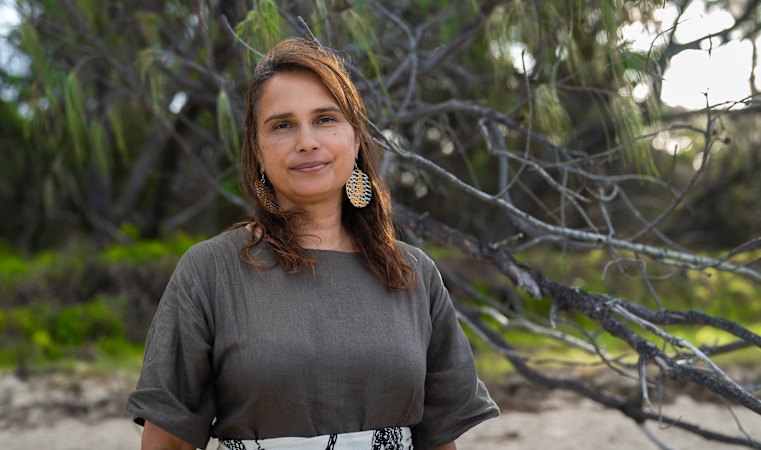
It’s by Quandamooka artist Delvene Cockatoo-Collins, who has been following the trail of Warrajamba for a decade.
The story was passed down through her grandmother, Bethel Delaney, and mother, Evelyn Parkin.
“My grandmother spoke to my mum about her, that she’s a mermaid in the bay, so that was enough for me to keep exploring,” Cockatoo-Collins said.
Her research turned up writings by Archibald Meston, who joined the Aborigines’ Protection Society of Queensland in 1890 and produced some of the first articles on local Indigenous culture in 1895.
“He came and visited the island, and recorded stories and language. He recorded the story about the mermaid, but wrote ‘it’s too long for this article’. So there’s more, somewhere.”
Cockatoo-Collins has taken over the Museum of Brisbane’s Creative Space as artist-in-residence.
Here, visitors are immersed in the mystery of Warrajamba, and provided with materials to make their own mermaid or dugong figures using cardboard, clothes pegs and printing stamps featuring the artist’s designs.
A printmaker and a fashion designer, Cockatoo-Collins also has a display of her couture on show at Brisbane Quarter, George Street.
The skirts, shifts and vests, featuring banksia-dyed fabrics, Stradbroke Island shells and fibres, are displayed along with three large-scale stylised dilly bags, inspired by her great-great-grandmother’s string bags that are held in several museums.
While in residence at the museum, she’ll design a fashion collection for a runway show to be held in September.
Cockatoo-Collins comes from an impressive matriarchal line. Her grandmother was one of several First Nations people who worked at the Dunwich Benevolent Asylum on North Stradbroke Island in the 1940s who were paid in rations.
“When they saw that other people were being paid in money, they protested, and were the first Aboriginal people to protest for equal wages and be successful,” she said.
Cockatoo-Collins spent her formative childhood years on the island, eating quampies in her mother’s curries. She returned to raise her own children, create art and clothing, and conduct cultural tours.
She said the message of Warrajamba is to ask the questions you can, while you can.
“That’s what my mum says about my grandmother. She wished she had asked more questions [about Warrajamba] than when she was told first up.
“This space is encouraging people to continue to ask questions to their families, to know your history.”
Warrajamba: Delvene Cockatoo Collins is at the Museum of Brisbane, City Hall, March 28- November 15. When Dilly Bags Catch the Light is at Brisbane Quarter until May 10. Entry to both is free.
Start the day with a summary of the day’s most important and interesting stories, analysis and insights. Sign up for our Morning Edition newsletter.
 Nick Dent is a Culture Reporter at Brisbane Times, covering arts and things to do in the city.Connect via email.
From our partners
Read the full article here
