

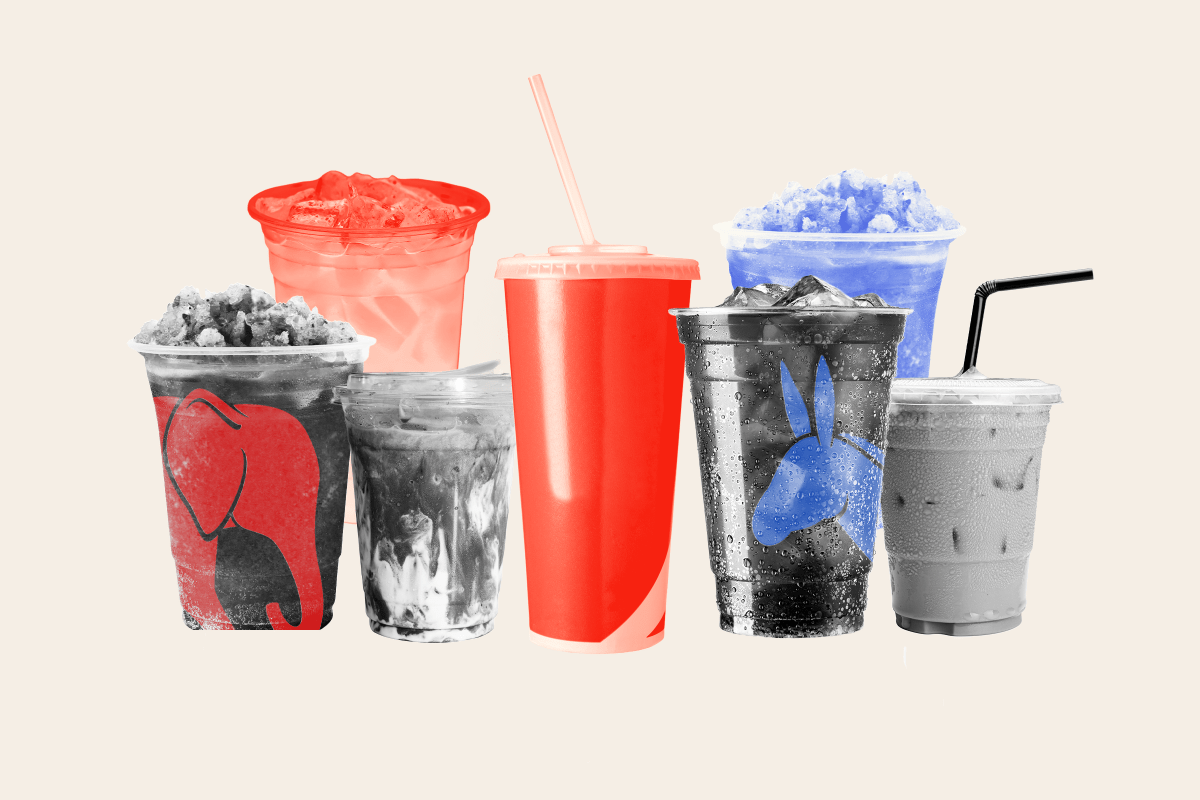
For decades, the debate over what Americans should drink was considered settled politics. Republicans defended personal choice. Democrats pushed public health. The sides appeared firmly entrenched.
In 2012, Democratic New York City Mayor Michael Bloomberg proposed banning restaurants from selling sodas larger than 16 ounces. The backlash to the move was immediate and fierce. A conservative group called the Center for Consumer Freedom took out a full-page ad in the New York Times depicting Bloomberg in a powder-blue dress and referring to the mayor as “The Nanny.”
In the following year, Republican former Governor of Alaska Sarah Palin walked to the podium at the Conservative Political Action Conference and pulled out an oversized soda cup. She took a long swig. “Oh, Bloomberg’s not around. Our Big Gulp’s safe,” she told the crowd.
The mayor’s proposal was eventually struck down in court. But the moment captured something real about the politics of food in America: Soda was a conservative cause, and anyone who came after it was going to be painted as a government overreach waiting to happen.
Twelve years later, however, it is Republicans pushing to restrict sugary drinks—and many Democrats who are objecting.
Health Secretary Robert F. Kennedy Jr. has made sugary drinks a central target of his “Make America Healthy Again” campaign, pressing states to block federal food assistance from being used to buy soda and candy. Indiana, Iowa, Nebraska, Utah and West Virginia were the first five states to enact those restrictions, affecting roughly 1.4 million SNAP recipients. At least 22 states now have approved waivers or have committed to seeking them.
“SNAP exists to nourish vulnerable Americans—not bankroll the products driving our chronic disease crisis,” Kennedy said in a statement on Thursday announcing the latest waivers. “Today we are putting nutrition back at the center of SNAP.”
The push has drawn broad support from Republican governors across the country. But many Democrats are now the ones objecting—and the arguments they are making sound remarkably like the ones Republicans used to make.
Food security proponents have long argued that the government should not police what low-income Americans buy with their benefits.
But, at the same time, drinks such as soda remain the leading source of added sugar in American diets. Kennedy and his allies say their moves are a common-sense step to reduce consumption.
“Show us the safety data showing that it’s OK for a teenage girl to drink an iced coffee with 115 grams of sugar in it,” Kennedy said at a political rally last week, targeting Starbucks and Dunkin’. “I don’t think they’re going to be able to do it.”
Round One
Dietitians and physicians had been sounding the alarm about sugary drinks for years before politicians caught up. By the late 2000s, the medical consensus was clear: Soda and other sweetened beverages were a primary driver of rising obesity and type 2 diabetes rates, particularly among children.
Democrats moved first. First lady Michelle Obama launched the Let’s Move campaign in 2010, promoting healthier school lunches and encouraging families to cut back on sugar. Congress passed the Healthy Hunger-Free Kids Act the same year, the most significant update to federal school nutrition standards in more than 30 years.
But Bloomberg’s 16-ounce soda cap became the flashpoint. Conservatives framed the move as severe government overreach, and Bloomberg himself did little to soften the argument.
“If you want to kill yourself, I guess you have a right to do it,” Bloomberg said at the time. “But we have a responsibility to tell you what is dangerous and to try to put things in place that will make you live longer.”
Congressional Republicans applied the same logic to Obama’s school lunch reforms. Representative Robert Aderholt of Alabama, the Republican author of a House bill to delay the new nutrition standards, argued that Washington was moving faster than schools could handle.
“As well-intended as the people in Washington believe themselves to be, the reality is that from a practical standpoint these regulations are just plain not working out in some individual school districts,” he said after a House panel approved the measure in 2014.
Michelle Obama was direct in her response. “The last thing that we can afford to do right now is play politics with our kids’ health,” she said at the White House. “Parents have a right to expect that kids will get decent food in our schools.”
The GOP Embraces Food Policy
After Kennedy joined the Trump administration in 2025, restricting SNAP use became a key point of the health agenda. Agriculture Secretary Brooke Rollins signed the first SNAP food restriction waivers in her early months in office.
“America’s governors have proudly answered the call to innovate by improving nutrition programs, ensuring better choices while respecting the generosity of the American taxpayer,” Rollins said.
The beverage industry has spent heavily to fight the moves. The American Beverage Association spent $790,000 on lobbying in the first quarter of 2025 alone—by far the most it had spent in a single quarter since 2010, according to federal lobbying disclosures. PepsiCo and Coca-Cola also disclosed lobbying specifically on SNAP purchasing restrictions.
The debate comes at a moment when the obesity crisis has become impossible to ignore. Two-thirds of Americans are overweight or obese, and the obesity rate has doubled over the past few decades, according to federal health data. Sugary drinks remain the leading source of added sugar in the American diet, according to the Centers for Disease Control and Prevention.
“There’s a very strong and solid link between sugary drinks and obesity and chronic diseases like hypertension,” Robert Klitzman, a professor of psychiatry and health policy at Columbia University, told Newsweek.
The evidence, he noted, extends well beyond American research. Countries including Chile, the United Kingdom and Australia have established taxes on sugary drinks that have lowered consumption and reduced obesity rates. “I think we could do this in the U.S. also,” Klitzman said, “but there has been political pushback because the industry opposes it.”
Klitzman, who has watched the politics of sugar policy shift for years, is frustrated that it took a partisan reversal to bring the issue back to the surface. “We need to think of other ways to reduce the obesity epidemic in America besides having everyone just take a shot or a pill,” he said, referring to the rise of weight-loss medications like Ozempic. Science, he added, was never the problem. “The evidence has been there for a long time.”
Pushback From Democrats
To many dietitians and policymakers, the argument feels straightforward: Soda drives obesity, taxpayers are funding it, stop funding it. But Democrats counter that the policy singles out the poorest Americans for dietary scrutiny that nobody applies to anyone else.
The opposition is not really about soda, Democrats say. What is driving the resistance is the context around it. Republicans in Congress have simultaneously proposed cutting $186 billion from SNAP over the next decade—the largest reduction in the program’s history. The Foundation for Government Accountability, a Florida-based conservative think tank that has helped draft and push SNAP soda-ban legislation in states across the country, has also lobbied aggressively to restrict who qualifies for public assistance altogether. Kennedy has publicly aligned himself with those efforts.
“If you want to buy sugary soda, you ought to be able to do that,” Kennedy said during a news conference in 2025. “The U.S. taxpayer should not pay for it.”
Some Democrats and food security advocates see the two efforts as part of the same argument—that a program with restrictions on what people can buy is easier to justify funding at lower levels.
“It’s very hard not to look at this as a cover for what the real motivation is, which is to cut SNAP,” Marion Nestle, the food policy scholar at NYU and author of Soda Politics, told The Atlantic. The Center for Budget and Policy Priorities, a left-leaning think tank, also warned that “cutting SNAP funding and policing people’s groceries does not improve the program or respect their dignity.”
“This administration is filled with millionaires and billionaires. They have no clue about what it is to struggle,” Representative Jim McGovern of Massachusetts, a senior Democrat on the House Agriculture Committee, told NOTUS. “If you want people to make better choices, then support increasing the SNAP benefit.”
Critics also question whether restricting purchases will actually improve diets. Representative Jill Tokuda of Hawaii, a Democrat on the House Agriculture Committee, said she supports efforts to help children eat healthier but argued Kennedy’s approach ignores the reality of food deserts, where families often rely on cheaper options to feed their children.
“Secretary Kennedy has to look at the availability and the scarcity of food,” Tokuda told NOTUS. “If we want people to eat more nutritious food, we should increase SNAP funding so kids can afford healthy meals.”
Kavelle Christie, a health policy and advocacy expert, echoed Tokuda’s concerns, and told Newsweek that many families who rely on SNAP live in areas where healthier food options are limited.
“The issue isn’t about individuals misusing their benefits, but their limited choices,” Christie said. “In many rural areas and food deserts, convenience stores and fast-food chains are often the only available options.”
When the Politics Get Messy
The policy is spreading quickly. Federal officials confirmed this week that Kansas, Ohio, Nevada and Wyoming have received approval to restrict certain sugary products purchased with SNAP benefits, leaving some Democrats in a genuinely difficult position.
Last year, Kansas Democratic Governor Laura Kelly vetoed a restriction bill in her state, pointing out that its definitions made little practical sense—banning protein bars and trail mix while leaving chocolate bars eligible. Arizona Democratic Governor Katie Hobbs vetoed a similar bill in her state, arguing the restrictions were “a solution in search of a problem.”
The confusion extended to institutions that have long advocated for healthier diets. The American Heart Association initially opposed the Texas SNAP soda ban, then reversed course days later, saying its position had been “miscommunicated.”
Klitzman said he understands why the politics are complicated—particularly with the debate unfolding under Kennedy whose long history of controversial views has shaped public conversation. But he warned that science cannot afford to get lost in the politics.
“This not about Bobby Kennedy or not. As we know that is no evidence that vaccines cause autism. Zero. That has been disproved multiple times,” he said. “So, for a political leader to say vaccines cause autism does not reflect the science. However, to say that sugary soda leads to obesity and diabetes does reflect science.”
The message, he said, should be simple regardless of which party is delivering it. “Political leaders who are developing public-health programs should follow legitimate scientific evidence. If they do that, that is good. If they don’t, it is very problematic and could potentially lead to harm.”
Read the full article here
