

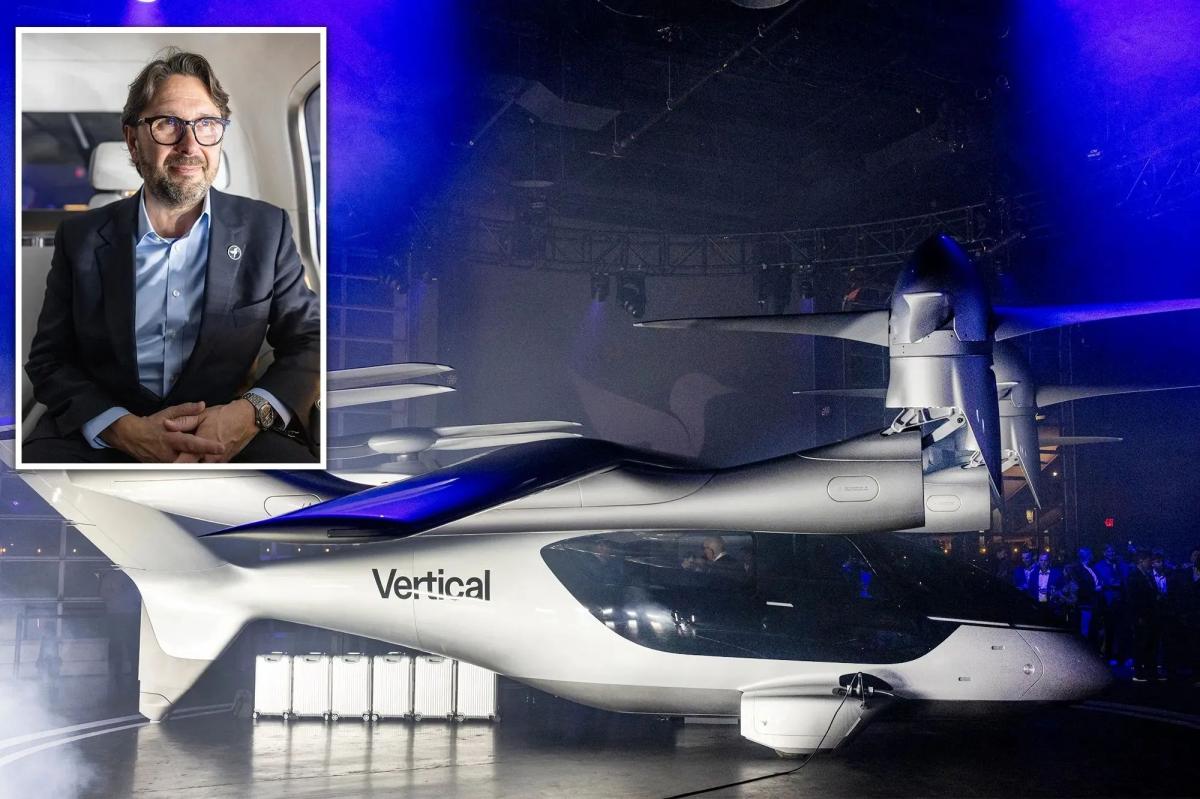
A “Jetsons”-style “air taxi” may be transporting New Yorkers before the end of the decade, its manufacturer says.
The UK-based tech company Vertical Aerospace touted its futuristic Valo aircraft, a four-seat electric vehicle designed to fly up to 100 miles at 150 mph, at an industry preview in Manhattan last week — calling the contraption a first because of its zero-emissions power source.
“If you think of mass transport … the infrastructure just doesn’t work anymore,” company CEO Stuart Simpson told The Post in unveiling the craft, which has a pilot and is roughly the same size as a chopper and as fast.
He said his firm — which dubbed the vehicle an “air taxi” akin to something out of the 1960s cartoon “The Jetsons” — is aiming for the e-aircraft to be certified to fly short trips such as from JFK Airport to downtown Manhattan by the Federal Aviation Administration and UK regulators by 2028.
“This low-altitude economy frees up billions of hours for people where you can be with your friends and family, rather than sat in a car, squashed up on a train trying to get home,” Simpson said.
The air taxi’s back-and-forth destinations — routes to be devised by tourism companies and other businesses purchasing the aircraft — are set to use green energy to cut multi-hour journeys to airports, stadiums and weekend-travel destinations to minutes, Simpson said.
For example, the hourlong train ride from JFK to downtown Manhattan is expected to be cut down to just 7 minutes while being emissions-free.
A “hybrid” version of the flying e-vehicle can sit up to six passengers and jet across up to 1,000 miles.
Aside from JFK and other major regional airports, Valo is considering routes between: downtown Manhattan and Metlife Stadium using Teterboro Airport in New Jersey, and on Long Island and heliports such as those at West 30th Street or East 40th Street in Manhattan.
Vertical is also exploring options for Valo to be used in luxury aerial sightseeing, as well as providing emergency services including medical air transfers within the New York area.
It’s unclear how much it will cost customers of the leather-interior rides.
The aircraft was first shown off in London, where it is expected to debut a few months before New York in 2028. Vertical aims to build 1,000 aircrafts a year by 2035, with fleets “in [each of] the great cities of the world as an option for transport.”
The tech company has already logged nearly 1,500 pre-orders of the aircraft – with major customers including American Airlines, Avolon, Bristow and Japan Airlines.
Simpson said the Valo model is quieter than traditional helicopters, an issue help fueling a push to ban nonessential flights over the region in recent years.
A City Council bill passed last year bans non-essential chopper, tourism and luxury flights from East 34th Street and Downtown Manhattan heliports, unless they meet strict FAA noise standards, by 2029.
The legislation, which also pushes for electric helicopters as an alternative, came just weeks after a fatal tourism helicopter crash claimed the lives of a tourist family of five and their pilot.
Short-distance air travel is already in use in the Big Apple with services such as Blade, which was just acquired by Joby Aviation ahead of its own anticipated electric air taxi deployment.
Blade already touts $95 “commuter” chopper rides for passholders, or $195 JFK-to-Manhattan transfers. Heli-commuting has become so popular, the company began offering 12-minute flights between Manhattan and Westchester County in November.
Joby is similarly working on FAA certification of its own electric vehicles, with FAA Type Inspection flight testing set to begin this year, Inc. reported.
The Valo model — with leather interiors, WiFi capabilities and ample leg room — was created to “address the challenges” of the “noisy, dirty and unsafe” helicopter counterparts, Simpson said.
The electric vehicle is also cheaper than traditional helicopters to maintain, with cost per seat per mile at $2 for the operator, and less than a minute of maintenance required for every flight hour, the exec said.
Vertical’s air taxi is set to operate with zero emissions and built to meet “airliner-level safety standards,” Simpson said.
“The regulations we’re certifying under, it’s a one-in-a-billion chance of failure at a system level,” Simpson said, adding that there will be limited human air-traffic control monitoring the vehicles on the ground as the products “have a transponder and stay apart.
“It’s very simple: there’s nothing up there” like it, the CEO said of the aircraft.
Read the full article here
