

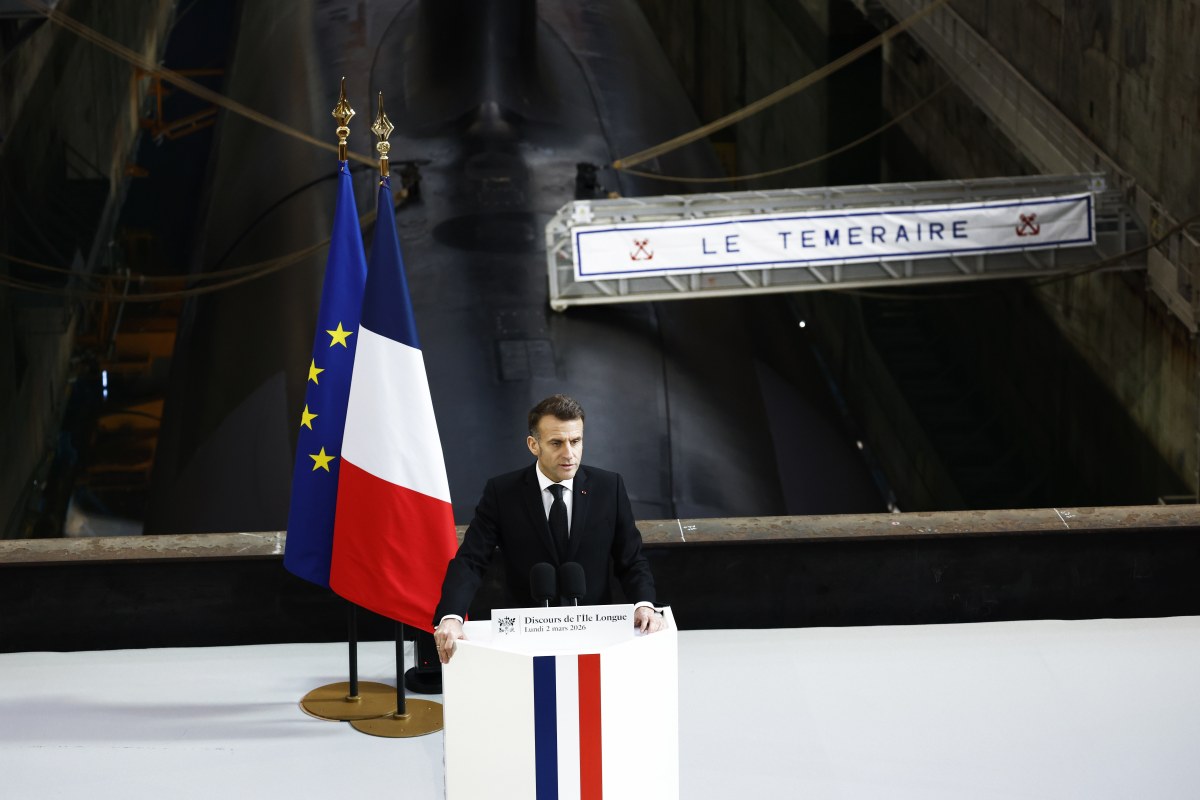
French President Emmanuel Macron announced Monday that France will expand its nuclear arsenal and, for the first time, allow the temporary deployment of its nuclear‑armed aircraft to allied countries, a shift he said is intended to strengthen Europe’s strategic independence amid growing global instability.
Speaking at a military base at L’Île Longue in northwestern France, which hosts the country’s ballistic missile submarines, Macron framed the decision as a response to long‑term security challenges rather than recent events. The speech had been planned well before the latest outbreak of war involving Iran, French officials said.
France has been the European Union’s only nuclear power since Britain formally exited the bloc in 2020, leaving Paris with a unique role in continental defense debates.
France’s Nuclear Weapons and European Security
Macron used the address to outline how France’s nuclear deterrent could play a broader role in Europe’s security architecture, as leaders across the continent express concern about renewed tensions with the United States under President Donald Trump and Russia’s ongoing full‑scale invasion of Ukraine.
“To be free, one needs to be feared,” Macron said, describing nuclear deterrence as a central pillar of national and European defense.
He said France’s updated posture could include “the temporary deployment of elements of our strategic air forces to allied countries,” a step never before taken by Paris. Macron emphasized, however, that France would not share decision‑making authority over the potential use of nuclear weapons with any other nation.
Under France’s constitution, the president alone serves as commander‑in‑chief and retains exclusive authority over the nuclear arsenal.
Talks With European Allies on Nuclear Deterrence
Macron said discussions on deterrence cooperation have already begun with Britain, Germany, Poland, the Netherlands, Belgium, Greece, Sweden and Denmark. Those talks include participation by partner nations in deterrence exercises and the involvement of allied conventional forces in France’s nuclear‑related activities.
He said such cooperation would stop short of nuclear sharing, a model used by the United States within NATO, and would not alter France’s sovereign control over its weapons.
European leaders welcomed the announcement, describing it as a step toward deeper defense coordination rather than a replacement for NATO.
In a joint statement, Macron and German Chancellor Friedrich Merz said France and Germany would begin deeper integration in deterrence efforts starting this year, including German participation in French nuclear exercises and joint visits to strategic military sites.
European Leaders React to Macron’s Strategy
The Netherlands also confirmed it is in talks with France. In a letter to Dutch lawmakers, Defense Minister Dilan Yesilgöz‑Zegerius and Foreign Minister Tom Berendsen said discussions were focused on nuclear deterrence “as a supplement to, and not a replacement for, NATO’s collective defense and nuclear deterrence capabilities.”
Polish Prime Minister Donald Tusk wrote on X that European nations were strengthening their defenses together “so that our enemies will never dare to attack us,” signaling support from countries closest to Russia’s borders.
Macron has previously argued that Europe must be capable of defending itself independently if global alliances weaken or shift.
France to Increase Number of Nuclear Warheads
Macron also announced that France will increase the number of nuclear warheads in its arsenal, marking the first such expansion since at least 1992. He did not specify how many warheads would be added, though France’s stockpile is widely believed to be below 300.
“I have decided to increase the numbers of warheads of our arsenal,” Macron said, adding that his responsibility is to ensure France’s deterrent maintains its “assured destructive power” now and in the future.
“If we had to use our arsenal, no state, however powerful, could shield itself from it, and no state, however vast, would recover from it,” he said.
The announcement comes as European leaders increasingly question the reliability of the so‑called U.S. nuclear umbrella, a longstanding policy intended to protect allies under America’s nuclear deterrence.
Doubts Over U.S. Commitments and NATO’s Role
Macron said recent shifts in U.S. defense strategy, alongside the emergence of new global threats, show that Washington is refocusing its priorities and expects Europe to assume greater responsibility for its own security.
He argued that Europeans must “take their destiny more firmly into their own hands,” a message he has repeatedly delivered since returning to office.
Some European countries accepted Macron’s offer last year to discuss France’s nuclear deterrence and to associate partner nations with certain exercises. Last month, Merz confirmed he had held initial talks with Macron and publicly speculated about whether German aircraft could one day carry French nuclear weapons.
Macron dismissed that idea on Monday, saying France would not place its nuclear bombs on foreign aircraft.
France and Britain Coordinate Nuclear Deterrence
France and Britain, the only two nuclear powers in Western Europe, adopted a joint declaration in July allowing their nuclear forces to be “coordinated” while remaining fully independent. Britain, though no longer a member of the EU, remains a key NATO ally.
Macron reiterated that any decision to use France’s nuclear weapons would remain solely in the hands of the French president, a position he has consistently maintained.
He said the evolution of adversaries’ missile defenses, the rise of new regional powers, the risk of coordination among hostile states and ongoing nuclear proliferation all led him to conclude that France must strengthen its arsenal.
Nuclear Disarmament Groups Condemn the Plan
Disarmament advocates sharply criticized Macron’s announcement, warning it could escalate global tensions and undermine international arms control efforts.
The International Campaign to Abolish Nuclear Weapons, which won the Nobel Peace Prize in 2017, said the plan could cost billions of dollars, jeopardize France’s international commitments and be interpreted by Russia as a major provocation.
“These are indiscriminate weapons that are banned under the Treaty on the Prohibition of Nuclear Weapons,” said the group’s executive director, Melissa Parke. “This announcement from French President Macron is a direct threat to the peace and security of the region, and the world.”
Parke said France spent about $6 billion on its nuclear weapons program in 2024 and warned that expanding the arsenal would add to that total. “This is not progress,” she said. “It’s a nuclear arms race that no one can afford.”
This article includes reporting by the Associated Press.
Read the full article here
