

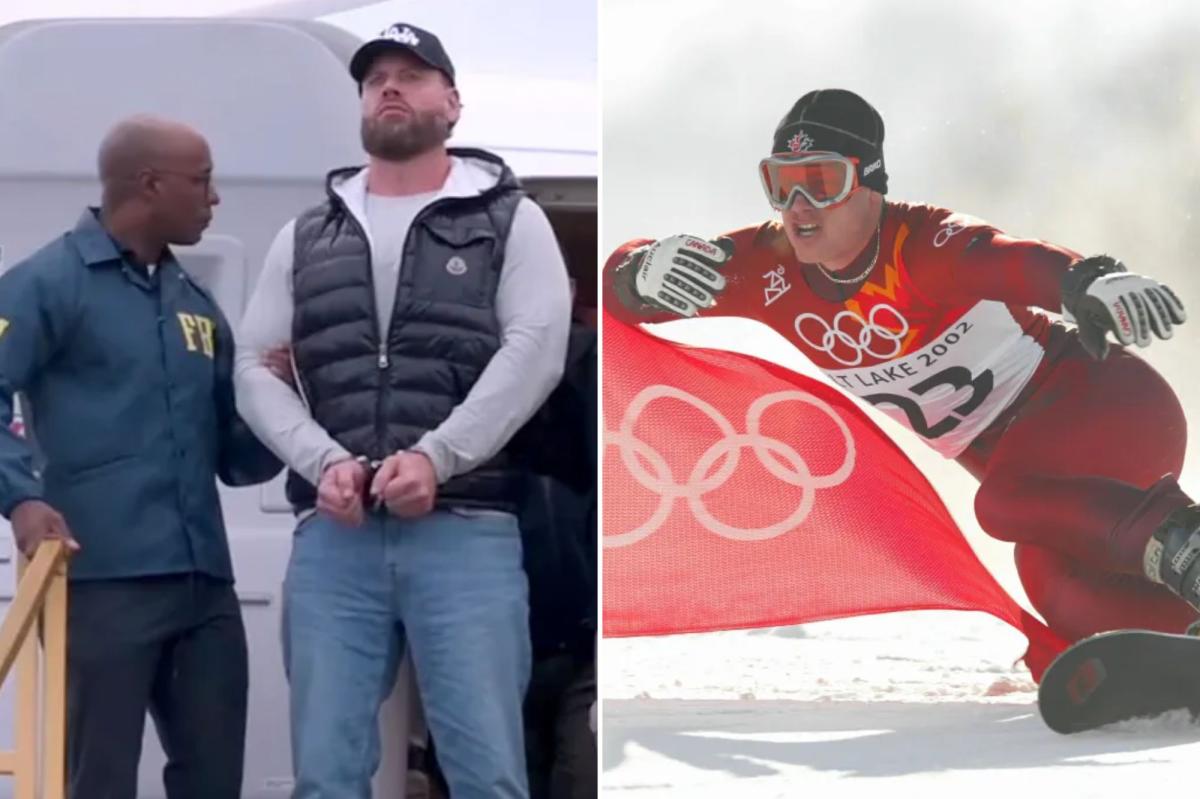
Olympic snowboarder Ryan Wedding was a “fearless” competitor who desperately wanted to become a household name — and when his dreams were crushed, “his quest for money and power got to him in a bad way,” according to a former teammate.
Wedding, who competed for Canada at the 2002 Winter Olympics in Salt Lake City, Utah, pleaded not guilty Monday to 17 federal felony charges including drug trafficking, witness tampering and conspiracy to commit murder.
The 44-year-old, whose alleged aliases include “El Jefe” and “Public Enemy,” was arrested in Mexico last week, 10 months after being added to the FBI’s Ten Most Wanted Fugitives List.
“He was such a promising talent with big ambitions — completely fearless. But maybe his quest for money and power got to him in a bad way,” a teammate who competed with Wedding in his snowboarding days told The Post. “He always wanted to be a big name, and wasn’t the type to let anything stop him from getting what he wanted.”
Wedding is now being held in Santa Ana without bond.
Authorities believe he is an associate of the Sinaloa cartel and imported millions of dollars’ worth of cocaine from Colombia through Mexico, storing it in southern California before sending it across the US and Canada.
He is also accused of having ordered “multiple murders of victims and government witnesses.”
Wedding was believed to be hiding out in Mexico for more than a decade.
Calling Wedding one of “the largest narco traffickers in modern times,” FBI Director Kash Patel added last week: “He’s a modern day El Chapo, he is a modern day Pablo Escobar, and he thought he could evade justice.”
It’s a far cry from the young boy who won his first snowboarding race at the age of 12 and who would reportedly go to bed cuddling his teddy bear while older teammates were out partying. But insiders say Wedding, whose grandparents owned a ski club, always had drive.
“A lot of kids, they say they want to go fast, but they don’t really want to go fast. They hold something back, because there’s a little bit of fear there of falling. Ryan had none of that,” Bobby Allison, a former national champion ski racer, told Rolling Stone.
Wedding’s was just 15 when he first made the Canadian national team and 20 when he made it to the Winter Olympics in Salt Lake City.
“He had a great family and life,” his teammate said.
But dreams of glory were ruined when Wedding finished in 24th place in the men’s parallel giant slalom, with the teammate saying extreme weather conditions threw him for a loop.
“He really started to change after that. He was not happy about his performance there,” the teammate said. “He always wanted to win.”
After blowing his big shot, Wedding seemingly gave up.
He enrolled at Simon Fraser University in Vancouver, BC, with his parents — an engineer and a nurse — pushing him to become a stockbroker or join his dad’s engineering firm.
But Wedding also worked as a bouncer in nightclubs frequented by gang members, according to a profile in Toronto Life.
It reportedly wasn’t long before he started imitating the gangsters’ style — wearing expensive watches, bulking up at the gym and developing a taste for flashy cars.
Wedding, sources said, was now playing a far riskier game than competing on the slopes.
By 2004, he had dropped out of college and local police started looking into his role in a massive marijuana grow operation in Maple Ridge, British Colombia,
In 2006, the operation was raided, turning up loaded guns, 6,800 marijuana plants and 86 pounds of dried weed — an estimated 10 million dollars’ worth. It was later linked to Wedding, though authorities said at the time they did not have enough evidence to charge him.
Two years later, Wedding was arrested by federal authorities in California after he traveled to San Diego with two men to buy cocaine from a source who turned out to be an undercover FBI agent, according to documents.
Serving time in prison, prosecutors say, Wedding used the time and new connections to concoct an even higher-stakes scheme.
“[The conviction] really did just turn him into a much better drug dealer than he ever was when he started … ,” Brett Kalina, a now-retired supervisory special agent, told CBC News.
After a judge reduced his sentence from 10 years to four, Wedding moved to Montreal and, allegedly, became very close with a dealer, Philipos Kollaros, who, according to court records, had ties to Mexican drug lord Joaquín “El Chapo” Guzmán of the Sinaloa cartel.
As The Post previously reported, Tony Wayne, a former ambassador to Mexico who is an expert in drug-trafficking between that country and the US, said it’s not unusual for non-Mexicans to be liaisons or point people within a larger Mexican-run cartel — but it’s rare one for one to be in charge of a huge enterprise themselves.
“I haven’t heard of many white men from Canada involved on this level, that’s for sure,” Wayne said.
Which made Wedding’s alleged operation all the more shocking.
Prosecutors say he oversaw a cross-border trafficking operation that moved cocaine from South America through Mexico and Southern California into Canada.
Around 2015, Wedding unwittingly met with an undercover operative from the Royal Canadian Mounted Police in Montreal to discuss a plan to traffic a “mega-import” of up to 5,000 kilograms of cocaine, worth hundreds of millions of dollars, according to the Montreal Gazette.
It was, authorities say, set up by Wedding’s old pal Kollaros.
When officers later arrived at Wedding’s Montreal condo with a warrant, they were too late. Something or someone had apparently tipped him off, and he disappeared.
Over the next decade in Mexico, investigators allege, Wedding built one a cocaine-smuggling operation as big as ones run by notorious cartels and generating more than $1 billion annually.
The man known as “El Jefe” also developed a reputation for intimidation and, allegedly, murder.
Shortly after Kollaros’ 2018 prison release, he was shot dead at a restaurant in Montreal. Investigators have not publicly identified a suspect.
In 2023, the FBI and RCMP joined forces to pursue Wedding in a sting dubbed Operation Giant Slalom.
A year later, Jonathan Acebedo-Garcia, whom Wedding had served time with in prison, reportedly turned on him and gave authorities key intel. The former athlete allegedly got wind of that, too, and placed a $5 million bounty on his former associate’s head, prosecutors say.
In 2024, the DOJ unsealed an indictment charging almost 20 defendants linked to Operation Giant Slalom.
Months later, Acebedo-Garcia was fatally shot five times in the head inside a Medellín, Colombia, restaurant.
In March 2025, the former athlete was added to the FBI’s Ten Most Wanted list — and a grand jury indictment later charged him in Acebedo-Garcia’s death.
Last week, Mexican officials said, Wedding surrendered at the US Embassy in Mexico City after weeks of negotiations with the FBI. However, his lawyer has called this report a “false narrative.”
Feds have busted 36 people for their role in Wedding’s alleged drug organization and seized more than 2,300 kilograms of cocaine, 44 kilograms of methamphetamine and 44 kilograms of fentanyl, as well as more than $55 million of illicit assets, according to the Los Angeles Police Department.
Wedding’s former teammate said it’s all senseless.
Even with his Olympic failure, “he was the last person who needed to go down this path.”
Read the full article here
