

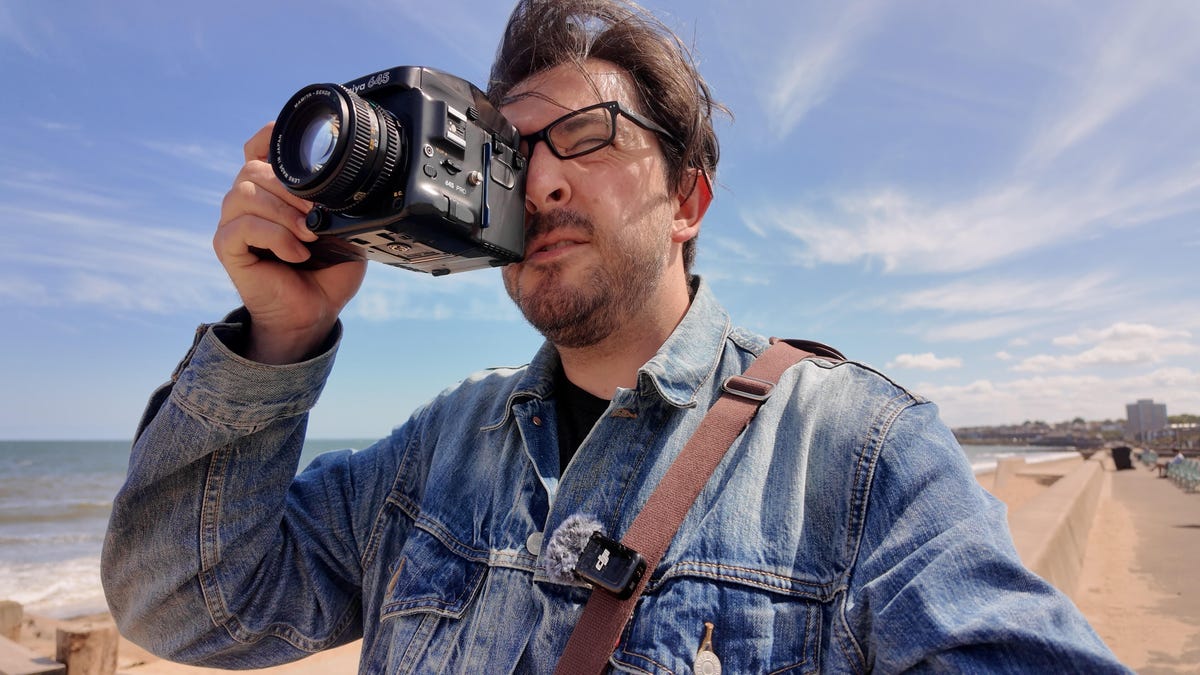
The rise of compact digital cameras and high-quality cameras built into your phone meant that traditional analog film photography faded almost into nonexistence. But the “film look” trend has soared on Instagram and TikTok, and there’s no better way to get an authentic analog photography look than to actually shoot on film.
I’ve already covered the best types of film cameras to choose, where to buy them, and what film to use, so here I’ll take you through the key things you need to know to actually capture your first images. I’ll also walk you through the process of getting your film developed and how to save a bundle by scanning your negatives at home using your digital camera.
Keep in mind that the topic of “how to take a photograph” is essentially infinite — not to mention highly subjective. So rather than produce a comprehensive guide, I’ve tried to keep this focused on the key elements you need to know: from how to analyze a scene’s light to what aperture to use. From there, it’s up to you to dive further into the world of photography and become the next Ansel Adams. Or, I guess, Brooklyn Beckham.
How to take photos on film
The first thing you’ll need to do is actually load the film into your camera, which isn’t always easy and varies a lot by the type of camera that you’re using. But the internet is an amazing resource, and there are plenty of how-to-load-film guides or YouTube videos for nearly every film camera ever made.
With your film loaded into your camera, the first thing you need to learn is how to adjust your exposure. If you’re experienced with digital photography, then much of this will be familiar, but even if you’re brand new to photography, it’s not that hard to get to grips with.
This scene was quite challenging as it has extremely dark areas within the tunnel and bright areas outside. However, I knew I wanted to silhouette the runners, so I exposed for the bright area, allowing everything else to fall into shadow.
There are three elements that control your exposure: the ISO speed of your film, the aperture of your lens (which means how wide open it is and therefore how much light it can let in) and the shutter speed (which means how long your shutter stays open for, exposing your film to light). The more light that gets in, the brighter your images will look and vice versa.
The ISO speed is set by your choice of film, whether it is the relatively low ISO 200 of Kodak Gold or the more sensitive ISO 3200 of Ilford’s Delta 3200. Some cameras will read this information automatically from the film canisters, while others require you to manually set the number on the camera. That just leaves you to consider your aperture and shutter speed, both of which will be determined simply by the type of photo you want to take and the conditions you’re in.
If you want that dreamy shallow depth of field where the background is blurred around your subject, you’ll need a wide aperture of f/1.8 or faster if your lens allows. That lets in more light, so you’ll need a faster shutter speed to compensate. Remember, the smaller the f-stop number, the wider the aperture and the less of your image depth will be in focus.
Want more of your landscape in focus? Great, you’ll need a narrow aperture of f/8 or f/11. This smaller hole means less light is let in, so you’ll also need a longer shutter speed to give your film time to expose properly. But a longer shutter speed means you might have a blurry shot, especially if you’re shooting handheld.
I was able to keep more of the scene in focus by using a narrow aperture. As it was a bright day, I could still use a fast enough shutter speed to get a sharp image handheld.
Exposures of 1/15 of a second or longer are best achieved on a tripod to ensure your camera remains steady and you capture a sharp image. If you’re out and about shooting handheld in daylight, consider your shutter speed first — perhaps keep it at least 1/150 of a second and adjust your aperture accordingly. If you know you’re going to be shooting handheld in dim conditions, then select a more sensitive film stock like Kodak’s Portra 800 for color images or Ilford Delta 3200 for black and white.
Working out the settings you need for a correct exposure isn’t always straightforward, however, and requires you or your camera to essentially analyse the ambient light in your scene to decide on the settings. This is called “metering,” and some cameras, like the Mamiya 6 or Canon 1000F, have light meters built in — When you point them at the scene, a scale in the viewfinder will indicate whether you’re overexposing the scene or not. If you’re overexposing, close down the aperture by one or two stops or use a faster shutter speed. And if you’re underexposing the scene and need to brighten things up, open your aperture or reduce your shutter speed.
Metering light manually
Some cameras — especially older models like the beautiful Yashica A TLR from 1959 — don’t have light meters, so you need to work it out another way. Historically, photographers have used dedicated physical light meters. But now many photographers, including myself, have found that using a phone is sufficient. There are various light meter apps, such as the one I use, called Light Meter, which allows you to enter your camera settings and use your phone’s camera as a light meter to determine your exposure. I’ve used this for photos on 35mm and 120 film, and it’s never steered me wrong.
By using the Light Meter app (left) to analyse the scene in front of me I was able to choose the best settings to achieve my final shot (right).
Getting the perfect exposure isn’t always straightforward, though, and part of the fun of film photography is that sometimes you don’t always get a perfect image. It’s about trial and error and learning as you go. Exposing for a bright sky and dark, shadowy foreground is a nightmare for even the best of today’s digital cameras, as you’ll need wildly different camera settings depending on whether you want the bright or dark parts exposed correctly.
With film, it’s up to you, the photographer, to decide what you want to expose for. If you meter your scene correctly, then you can’t go too far wrong. Many film stocks, including Kodak Gold, benefit from being slightly overexposed. So, if you’re getting different readings for various parts of a scene, it’s often best to go with the one that will result in the brighter exposure.
If you’re not sure, then shoot two frames: one that is slightly overexposed and the other shot a little under, and then you can decide later which is best.
Using the Hasselblad 500C means metering your light manually. It’s not always easy, especially in darker sunset conditions like this.
Having a point-and-shoot camera or a more modern SLR with auto settings does take some of the guesswork out of it, as the camera will decide on the settings for itself. But it’s not always perfect, and some scenes will fool the light meters of even the best cameras.
So now you’ve taken your photos, it’s time to get them developed
The best way to develop and scan your film
Taking your film to a local camera shop is the easiest way to get it developed. You can also send it to a lab and have them develop and scan the negatives using their film scanner. You then get back analog photos and digital files. Easy.
While this eliminates the hassle of developing and scanning, the downside is that it becomes expensive. For example, my local lab will develop a roll of 35mm film for £6 ($8), but then it’s another £10 ($13) on top of that per film for high-resolution scans. Sure, $20 might not seem like a huge cost to process one roll of film, but when you start to do multiple rolls of film a week, that cost starts to add up. You can do more of the work yourself to lower that cost.
I don’t want to develop film myself, so I use a lab for that and then scan the negatives myself.
I’m not interested in home developing. While there are various kits that make home developing easier than setting up an entire darkroom, a lot of precision is involved to get it right. And I don’t want that much extra kit in my house, so I’m happy to pay a local lab to do the developing. However, what I will do at home is scan the negatives to obtain digital files.
While good labs use dedicated film scanners, if you already have a digital camera and a macro lens, it’s not that difficult to do it yourself. I use a kit from Valoi that attaches to my camera lens. It has a built-in backlight that shines through the negative, allowing me to take your photo of each frame and simply pull the strip through onto the next frame. It’s simple, and while the Easy 35mm and Easy 120 kits aren’t particularly cheap, if you go through a lot of film, it won’t take long for you to recoup the cost.
On the left is the negative as photographed by my digital camera and the Valoi kit. On the right is the finished image after conversion using Negative Lab Pro within Adobe Lightroom Classic.
What you’re then left with is a bunch of raw images of your negatives. Import those into Adobe Lightroom Classic and use a plugin called Negative Lab Pro to convert and adjust them to achieve the desired look. It’s up to you how far you want to take this, as some of you may want the closest look to natural film stock as possible, while others will want to achieve a more unique look from their shots. As with any art, though, there’s no right or wrong way to do anything, and it’s just down to your personal preference.
The Valoi scanning kits make it easy to scan your negatives at home.
Ultimately, you’ll be left with your film images, taken on your own film camera using your preferred film stock. Hooray! You made it through. Now rinse and repeat until your house is full of photos and your bank account is depressingly empty.
Extra pro tips for film photography beginners
I dropped my camera and the back sprung open, exposing the roll of film to light. Several images were destroyed, but I love the happy accident of this frame being burned at the edges, forming a natural frame for this couple as a result.
Start out cheap. Film could be an itch that just needs scratching, or you might just not get on board with it at all. It’s worth finding an affordable film camera — like the Canon EOS 1000F — and trying it out before splashing thousands on a fancy kit.
Don’t overshoot. It’s not like digital, where you can take hundreds of images in an afternoon and then decide to keep one or two of your favorites. Well, you can, but it’ll cost a fortune. I like to limit myself to one roll of film per event. Part of the charm for me is being more selective about the shots I want to take, resulting in fewer, more meaningful photos.
Don’t be afraid to mess up. It’s part of the process, even if you’re an experienced photographer. Mistakes will happen, whether that’s accidentally opening the camera’s film door halfway through a roll or simply getting the exposure completely wrong. Yes, it costs money to get a shot wrong or to spoil a whole roll, but you’ll also learn from those mistakes.
A photo isn’t good just because it’s on film. It still needs to have good composition, lighting, exposure, focus and subject matter. In short, it needs to be a good photo regardless of what it was taken on — film or digital. So keep on working on your skills as a photographer as you practice with film.
Read the full article here
