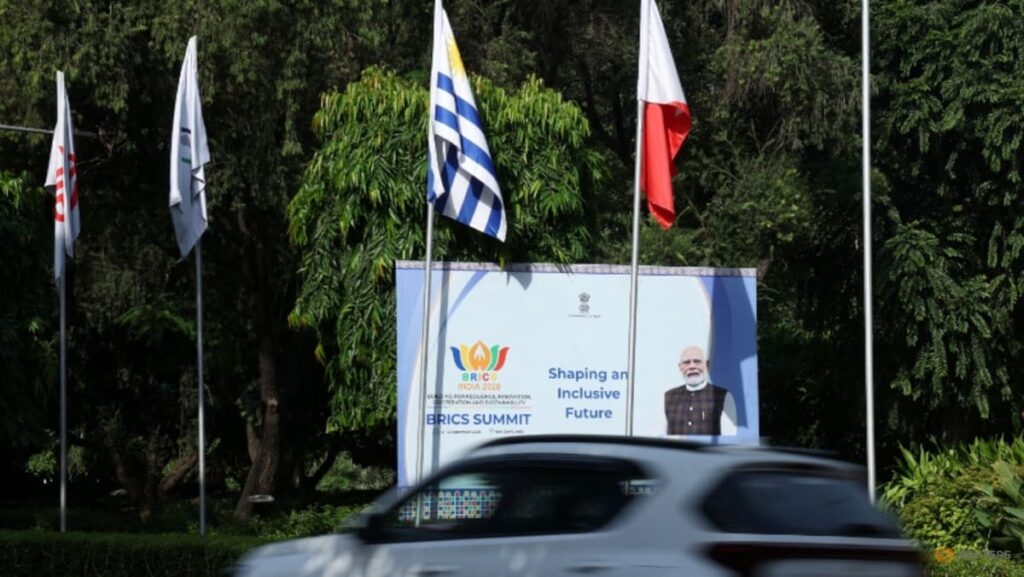
NEW DELHI: India will host the BRICS Leaders’ Summit this weekend, seeking to lift the bloc’s global profile even as the US-led war on Iran splits its membership, with Tehran and Abu Dhabi on opposing sides of the conflict.
The Sep 12-13 summit in New Delhi comes more than six months after the US and Israel launched attacks on Iran, a BRICS member since 2024. The conflict has led to a virtual shutdown of the Strait of Hormuz, one of the world’s key choke points in the oil trade, pushing crude prices to over US$100 a barrel.
BRICS member UAE, after being hit by Iranian missiles since the war began, suspended all trade and financial transactions with Iran in August.
Foreign policy experts said the key test for the bloc will be finding language on the Middle East crisis that both Abu Dhabi and Tehran can accept, clearing the way for a joint declaration.
Such a joint statement was unlikely to influence the current geopolitical landscape, but will demonstrate, for instance, that a forum of emerging countries could be united against economically debilitating policies like Western sanctions, they said.
Chinese President Xi Jinping will attend in his first visit to India in seven years, underscoring the importance Beijing attaches to BRICS and placing China alongside host India at the centre of efforts to hold the expanded bloc together.
Russian President Vladimir Putin, Iran’s Masoud Pezeshkian, South Africa’s Cyril Ramaphosa, Egypt’s Abdel Fattah al-Sisi and Indonesia’s Prabowo Subianto are also due, along with UN Secretary-General Antonio Guterres.
The UAE is expected to be represented by Abu Dhabi Crown Prince Sheikh Khaled bin Mohamed bin Zayed Al Nahyan.
IRAN WAR HAS NEGATIVE IMPACT ON BLOC
Kremlin spokesman Dmitry Peskov said on Tuesday that the differences between the UAE and Iran had a “negative impact” and get in the way of “drafting” a joint declaration, but hoped the leaders will be able to find a phrasing that will be acceptable to both countries.
Originally comprising Brazil, Russia, India, China and later South Africa, BRICS has expanded with the addition of Egypt, Ethiopia, Iran, the UAE and Indonesia, reflecting its ambition to represent a wider Global South.
Saudi Arabia’s role in the grouping remains ambiguous as it has not accepted full membership but participates with lower-level delegations. Foreign Minister Faisal bin Farhan Al Saud will attend the Delhi meeting.
“Some of (BRICS’) new members, Iran and the UAE, Egypt and Ethiopia are embroiled in tensions and don’t agree much. This is bad news for an entity that operates based on consensus,” said Michael Kugelman, a senior fellow at the Atlantic Council.
“There is an irony here: BRICS expansion reflects its growing appeal and prominence. But that very expansion, because of the divergent views of the new members, could make the group less effective.”
In May, foreign ministers of BRICS nations failed to issue a joint statement after a meeting in New Delhi due to differences between Iran and the UAE.
Read the full article here