

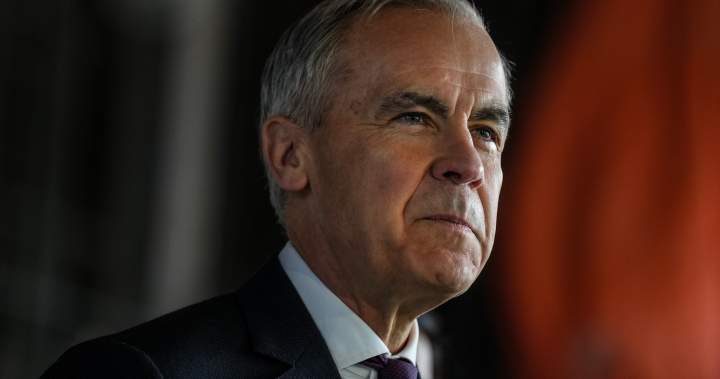
Prime Minister Mark Carney‘s government, keen to improve its standing in the public’s eyes when it comes to law and order issues, ordered up several taxpayer-funded polls late last year to take stock of how Canadians view their work on justice issues and identify their priorities when it comes to fighting crime.
The polls, taken in November and December, returned a clear conclusion: Canadians, at the time at least, did not think the government was doing much to combat everything from home invasions to cybercrime.
They also had a dim view of the justice system when it come to treating victims of crime fairly, and strongly favoured measures that would make bail harder to get for those accused of some crimes and would give harsher sentences to repeat offenders.
Prime Minister Mark Carney, ahead of visiting a law enforcement facility in Brampton, Ont., Tuesday, acknowledged his government was not meeting the expectations many Canadians have when it comes to fighting crime.
“This needs to be a relentless focus using all the powers of the federal government,” Carney told reporters. “We are starting to see results. We’re not satisfied and we’re going to keep at this.”
Pollsters believe the Liberals’ relatively poor reputation for being tough on crime contributed to poor election results last spring in Brampton, Ont., Surrey, B.C., and in parts of Calgary.
“It’s fair to say Liberals don’t always feel comfortable talking about crime because there’s a wing of the party that is much more about not getting tough on criminals but going to root causes and trying to rehabilitate criminals,” said pollster Dan Arnold of Pollara Strategies.

Get daily National news
Get daily Canada news delivered to your inbox so you’ll never miss the day’s top stories.
Arnold was the PMO pollster for most of Justin Trudeau’s time in office and served as pollster on Trudeau’s election campaigns.
“And while a wing of the Liberal Party feels that way, the broader public is very much in a view where they wanna get tough on criminal,” he added.
Carney, in contrast to Trudeau, has tried to take the party in a different direction on law-and-order perspective.
“It’s similar to a lot of what Carney’s doing on energy and environment where he is moving to what is seen to be more of a rightward position on crime,” Arnold said
That said, the the polling data Carney’s PMO had collected in November and December indicates there’s still work to do to change impressions the public has about the Liberals when it comes to crime.
Among the 2,000 polled during the weeks of Nov. 10-23, 87 per cent said they feel safe in their communities. And yet, more than 55 per cent said they believe crime in Canada is on the increase — in Alberta, Saskatchewan, and Manitoba, 65 per cent said it was increasing, while 39 per cent across the country thought it was about the same or decreasing.
“We come to it not from an electoral perspective … but from the perspective of serving and protecting the people of Brampton, the people of Peel region, the people of Ontario, and the people of Canada,” Carney said.
In February, Carney travelled to Surrey, B.C. to meet with RCMP and deliver a statement about what his government was doing to crack down on crime, especially how it was responding to a wave of extortion crimes that have been particularly prevalent in Canada’s South Asian communities.
On the same day, Finance Minister François-Philippe Champagne, the Secretary of State for Combatting Crime Ruby Sahota and other Liberal MPs were in Brampton to announce new measures to combat extortion rackets.
“I would say any level of crime is too high,” Carney said. What is happening in many municipalities is we’re starting to see a decline in the level of crime. But there is understandably always going to be a lag before, or that materializes, and it changes in view.”
The Carney government has moved on bail reform, strengthened border security, proposed a gun buyback scheme and was moving to provide money to hire more police officers. Little of that, though, seems to have registered in the minds of voters.
The PCO polling found that, as of November at least, just 17 per cent of respondents answered “yes” when asked, “Have you seen, read or heard anything recently that the federal government has done to reduce crime in Canada?” while 78 per cent answered “no.”
More than 40 per cent of respondents in every province but Quebec said the government was on the “wrong track” managing crime and less than 33 per cent in each region thought the government was on the right track. In Quebec, though, it was the reverse: 45 per cent said the government was on the right track; 26 per cent said it was on the “wrong track.”
The PCO polling also found that Canadians overwhelmingly believe the courts and the justice system are “too soft” on people who have broken the law, although Quebec again was an outlier. While nearly two-thirds in every other region believe the courts are too soft, just 49 per cent of Quebecers believed so.
And while most Canadians polled by the PCO believe accused persons are treated fairly by the courts, a majority — 54 per cent — believe victims of crime are treated unfairly.
From Nov. 1 to Dec. 14 last year, multiple polls were put into the field by the Privy Council Office (PCO), through the weekly PCO polling program that first began during the Trudeau years.
Every week, 1,000 Canadians are asked to participate in a live-agent telephone poll on a range of issues.
The prime minister’s director of research — a political appointee — decides on the questions asked and prepares the results for distribution to the prime minister, his senior aides, cabinet ministers and deputy ministers.
Read the full article here
