

Africa is breaking apart along a giant crack that will form a new ocean between two large masses of land millions of years from now, the latest research shows.
The split is taking place along the East African Rift (EAR), where the eastern portion of Africa, the Somalian plate, is tearing away from the larger Nubian plate, which forms the rest of the continent.
The breakage is incredibly slow, and it will take tens of millions of years for a full split to occur, with only a few millimeters of movement each year.
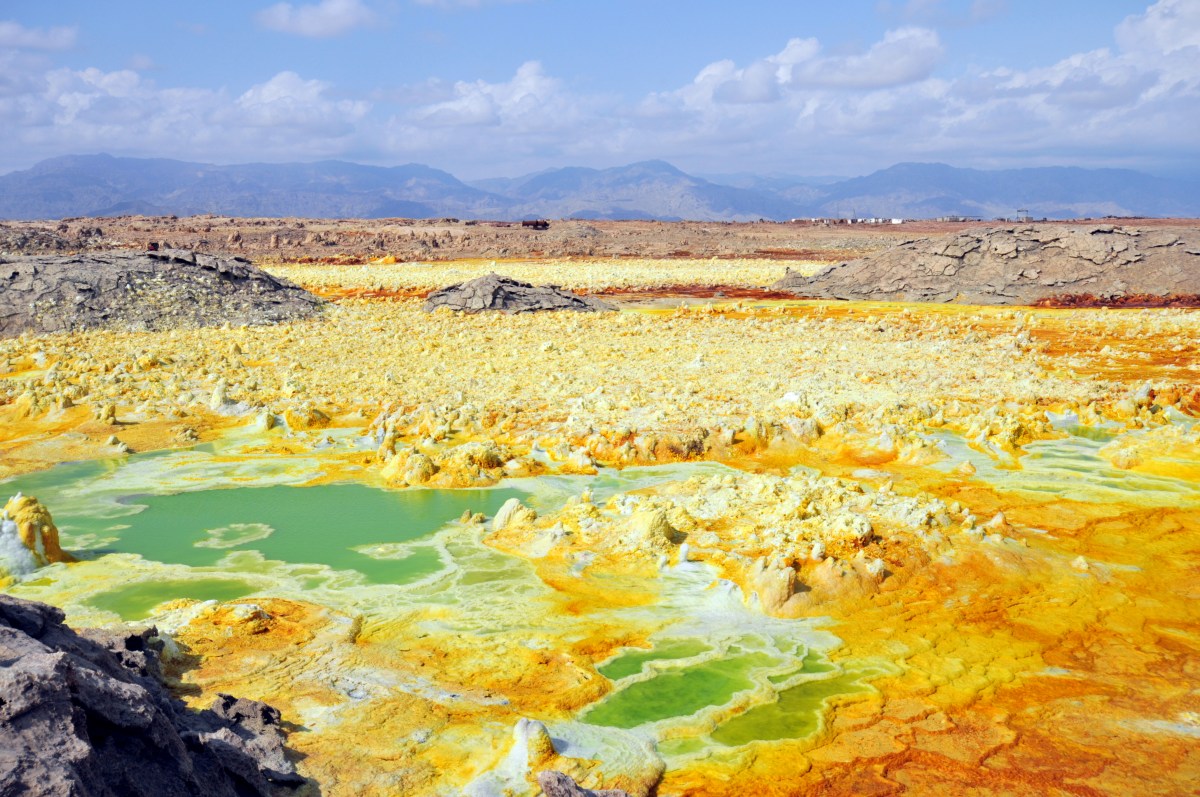
The Nubian and Somalian plates are also separating from the Arabian plate in the north, creating a Y-shaped rifting system. These plates intersect in the Afar region of Ethiopia, known as a “triple junction.” It is one of the rare places on Earth where three tectonic rifts—the Ethiopian, Red Sea and Gulf of Aden Rifts—meet.
Formed in the Miocene period around 25 million years ago, the EAR originates at the Afar triple junction and currently stretches for around 2,174 miles from the Red Sea to Mozambique. Its eastern rift passes through Ethiopia and Kenya, while its western rift runs in an arc from Uganda to Malawi.
The Earth’s crust is already very thin in the Afar region, and parts of the landscape are below sea level, with two arms of the rift already submerged in the Red Sea and the Gulf of Aden. According to scientists, once the valley connecting them dips low enough, seawater will begin rushing in to form a new ocean basin between the separating plates.
“The rate of extension is fastest in the north, so we’ll see new oceans forming there first,” Virginia Tech geophysicist D. Sarah Stamps told ECONews.
The plates are reported to be moving apart by around 0.28 inches each year, on average. So, a gap big enough for an entire ocean basin to fill would only be formed after many millions of years. However, this slow split can impact people’s lives sooner through through seismic and volcanic risks.
The Earth’s crust is formed of between 15 and 20 tectonic plates that gradually float above the molten magma mantle below. Geologists have long believed that the Afar area is underlain by a mantle plume, a pillar of upwelling hot material that is helping to tear apart the overlying crust of the Earth.
Research published this month in the Journal of African Earth Sciences revealed new insight about the magnetic crustal structure of the Afar region and how the African continent is splitting.
New analysis of magnetic data from the late 1960s suggested that Africa and Arabia pulled themselves apart first, following a single fracture after the Gulf of Aden and Red Sea rifts. The African rift followed, likely torn by a superplume upwelling, and remains active today.
A study published last June in Nature Geoscience suggested that the splitting process may be driven by heartbeat-like pulses of molten rock rising from the depths of the Earth.
“We found that the mantle beneath Afar is not uniform or stationary—it pulses—and these pulses carry distinct chemical signatures,” lead author and geologist Emma Watts said in a statement.
“These ascending pulses of partially molten mantle are channeled by the rifting plates above. That’s important for how we think about the interaction between Earth’s interior and its surface.”
Do you have a tip on a science story that Newsweek should be covering? Do you have a question about geology? Let us know via [email protected].
References
Purcell, P. G., De Ritis, R., & Styles, P. (2026). A review of the 1968 Afar Magnetic Survey data and integration with vintage Red Sea and Gulf of Aden data. Journal of African Earth Sciences, 233. https://doi.org/10.1016/j.jafrearsci.2025.105881
Watts, E. J., Rees, R., Jonathan, P., Keir, D., Taylor, R. N., Siegburg, M., Chambers, E. L., Pagli, C., Cooper, M. J., Michalik, A., Milton, J. A., Hincks, T. K., Gebru, E. F., Ayele, A., Abebe, B., & Gernon, T. M. (2025). Mantle upwelling at Afar triple junction shaped by overriding plate dynamics. Nature Geoscience, 18(7), 661–669. https://doi.org/10.1038/s41561-025-01717-0
Read the full article here
