

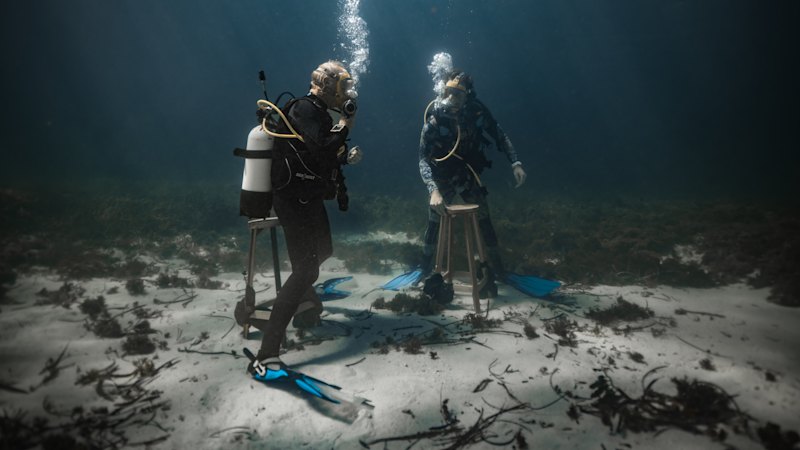
Kurt Krispyn may not be able to walk on water, but he sure can talk under it.
Seated on a stool on the sea bed just off Rottnest Island, the marine biologist did what he believes is a world first – hosted a live podcast on the ocean floor.
With the help of Murdoch University associate professor and seagrass specialist Mike van Keulen, the duo floated in the water for almost an hour, live-streaming to the world.
“I knew it wasn’t going to be relatively easy, but something that I thought was going to take a bit of work ended up taking nearly every day, of every week, for the last three to four months,” Krispyn said.
“It seemed to be the world’s first live underwater podcast out there … and I wanted it to turn into one of the most educational pieces possible because the whole idea of what we’re doing is to raise awareness, to educate, to inspire, especially that younger generation.”
As the founder of Paramount Importance – a science communication platform – Krispyn is used to sharing knowledge about the marine world, but this time his team almost didn’t make it to air.
“One week before we were going to do it, the boat that we originally planned to do it on cancelled on us,” he said.
“Because we have to power four computers, two Starlinks, four monitors, four 5G networks, there’s a fair bit of power that is required, so you’ve got to have a boat that is one, big enough to hold everybody and everything, and then two, has enough power. So it kind of limits the amount of boat options that you have.”
Luckily, a family friend had a boat that fit the list of requirements needed to get the podcast up and running.
Except that was only the beginning of their hurdles.
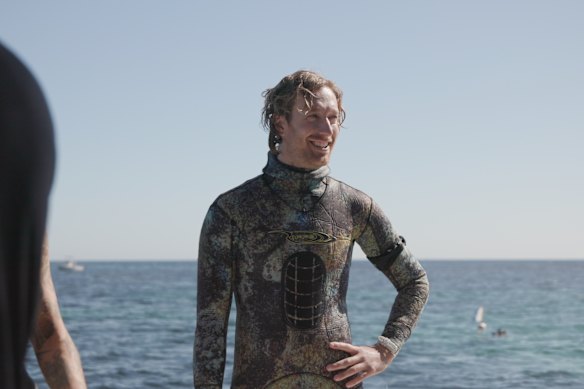
“On the day that we were going out, three hours before we meant to go live, we could see Rottnest in our sights, we were probably about two kilometres from the island … and both motors failed,” Krispyn said.
Krispyn and his team spent two hours racing against the clock, trying to get the fuel system back up and running.
“As time was ticking by, my stress was just sky-high. Knowing everything that we’ve organised, everything that I’ve worked towards for the last four months [might not happen],” he said.
“We were calling people to try to tow us in, but no one could get to us on time … but with one hour to go before we meant to go live, we cranked the engine over and it started.
“I don’t think I’ve ever felt so much relief, I actually teared up.”
They anchored the boat, got the equipment ready and jumped in the water with mere moments to spare, but the podcast went live to Australia and the world at 10am on February 27.
How to talk underwater
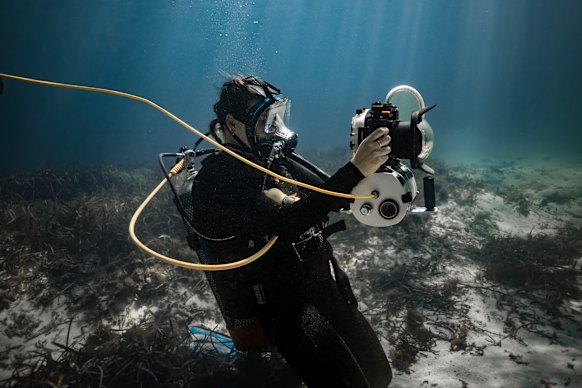
With the help of a fibre-optic cable, a camera, and some fancy technology, Krispyn and van Keulen made broadcasting and talking underwater look easy.
By pressing a button on the mask, a sound wave was sent via sonar to a transducer beneath the boat. This technology transmitted their voices to a computer on the surface using the same principles a boat’s sounder uses to detect fish.
The camera was attached to the boat by a fibre-optic cable, which fed the footage straight to the computer and out to the world to be streamed in 1080p.
And thanks to some nifty technology, marine biologist and podcast host from the surface Dr. James Tweedley was able to take questions from the public straight to the duo underwater.
“So when someone sent in a question, he’d read it out and could speak to us while we were in the water. So that added another element of something that was really cool, that while we’re underwater, people that could be anywhere in the world, could be speaking to us,” he said.
Krispyn said they also ensured there was a delayed telecast, just on the off chance something bad happened.
“We had a delayed telecast so that just in case we got eaten by a shark or something like that, it didn’t go out live,” he said with a laugh.
At least 12 different schools took part in the broadcast Q&A with the Western Australian Marine Science Institution hosting an event with 60 participants that also tuned in.
“We wanted to do something very unique to change the classroom from looking at a few pictures or someone standing at the front talking about so-and-so, to something completely new,” he said.
“Something different to be able to give them access to something really cool and to show what marine science is really about.”
The event also coincided with World Seagrass Day.
“Seagrass ecosystems are found all over the world, and they’re a critically important ecosystem, whether that’s from storing carbon, such as sequestration of carbon from the atmosphere to combat climate change, nursery habitats for fish and invertebrates to mitigate coastal erosion,” Krispyn said.
“It is one of the most amazing and important ecosystems that we have … so hopefully [the podcast] inspired and educated a whole other generation of future scientists maybe, or even just people that want to make a better decision.
“I always had the philosophy that change doesn’t happen from instruction, change happens from inspiration.”
Krispyn said while the podcast was aimed at high school students, there was information in there for people of all ages.
And it wasn’t just a once off event, Paramount Importance has two more underwater podcasts lined up for later this year.
“I can guarantee these next two that we have lined up will be incredible. We’re just trying to find funding for them, so we’re trying to go bigger and better,” Krispyn said.
The podcast can be streamed on the Paramount Importance platform, Youtube, Facebook and Spotify.
Read the full article here
