

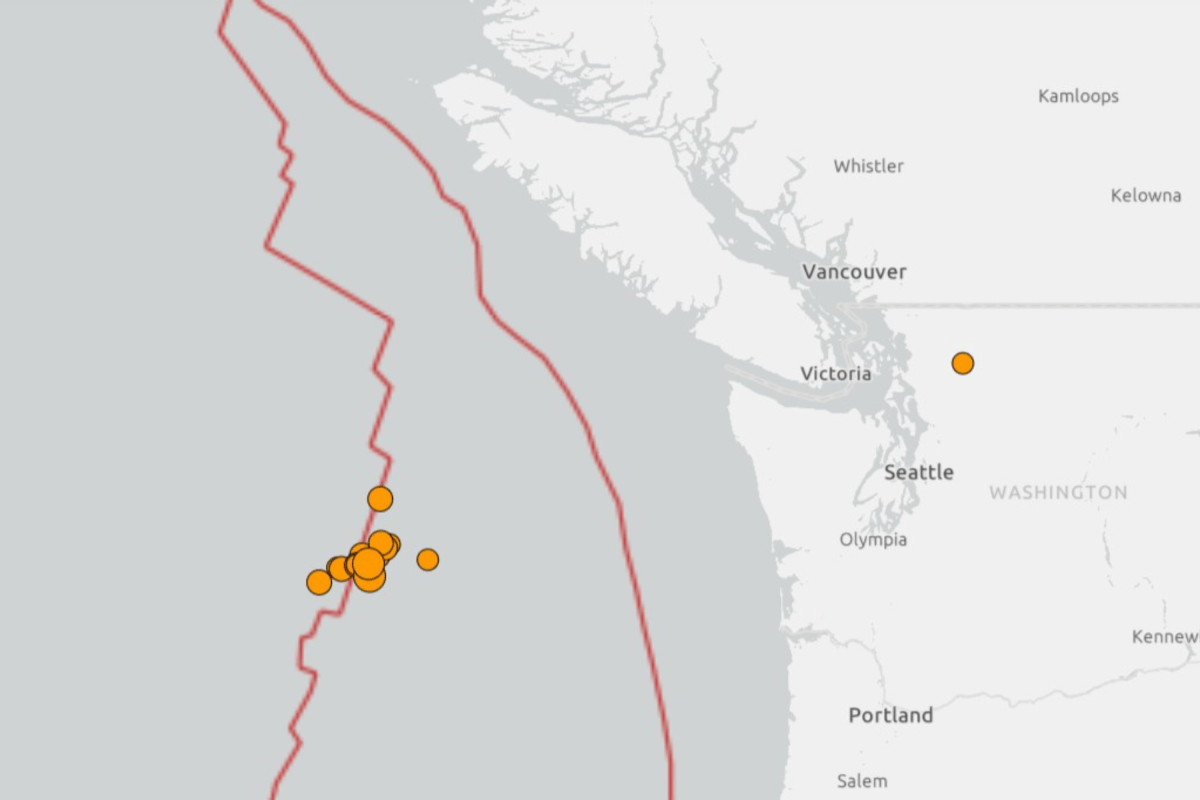
An offshore swarm of at least 18 earthquakes struck far off the coast of Washington state early Sunday, with magnitudes up to 4.2, according to regional and federal seismic networks.
The Pacific Northwest Seismic Network (PNSN) said the activity began around midnight at an offshore spreading center roughly 250 miles from the coastline, while the U.S. Geological Survey (USGS) said the events occurred between midnight and 9 a.m., and were not strong enough to generate a tsunami.
PNSN emphasized the earthquakes were far from the Cascadia Subduction Zone and not at the Axial Seamount undersea volcano, and said the swarm did not pose a hazard to onshore communities in the Pacific Northwest.
Why It Matters
Offshore earthquake swarms can prompt public concern in the Pacific Northwest, where residents are familiar with risks posed by the Cascadia Subduction Zone and undersea volcanoes along the Juan de Fuca plate.
Understanding where these earthquakes occurred and what they mean for coastal hazards helps residents and emergency managers calibrate risk.
What To Know
PNSN reported “quite an active swarm” at the Juan de Fuca Ridge about 250 miles offshore of Washington that began around midnight on Sunday with at least 18 events recorded by noon and a maximum magnitude of 4.2, based on network detections and USGS locations.
The earthquakes took place along the Blanco Fracture Zone, a transform fault system off the Pacific Northwest coast, with the strongest event occurrring about 254 miles west of Aberdeen, Washington, at 4:48 a.m. local time.
USGS defines earthquake swarms as clusters of small-to-moderate earthquakes occurring in a local area over a period of time that do not follow the typical mainshock–aftershock pattern, and the largest event may occur in the middle of the sequence rather than first.
Scientists located the swarm well offshore and away from Cascadia, and experts said the sequence did not threaten coastal communities or trigger tsunami concerns.
PNSN also said the swarm did not occur at Axial Seamount, an undersea volcano that scientists have monitored for signs of possible eruptive activity.
The offshore earthquakes were not strong enough to trigger a tsunami, according to USGS data.
What People Are Saying
U.S. Geological Survey (USGS) said on its website: “There is no precise definition of when a mainshock-aftershock sequence becomes a swarm. In reality, the distinction is not sharp. Earthquake sequences follow a whole range of behaviors from ‘very mainshock-aftershock’ to ‘very unlike mainshock-aftershock.’ The ‘swarm’ designation is typically applied when we observe relatively many earthquakes within a relatively small area, which just don’t fit the pattern of a mainshock-aftershock sequence.”
What Happens Next
PNSN and USGS typically continue to monitor offshore seismicity and update public catalogs as new data arrive, including refined locations and magnitudes for individual events.
Officials have not currently indicated any onshore hazard from this sequence. Residents can review preparedness guidance from state and federal agencies and follow updates from seismic networks for any changes in offshore activity.
Read the full article here
