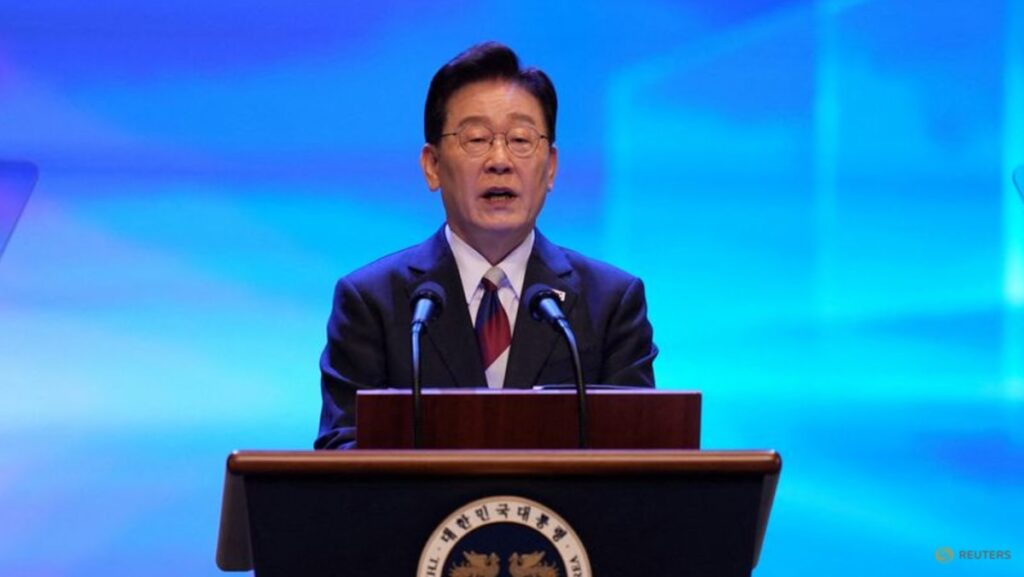
SEOUL: South Korea’s president has ruled out even considering an extension of his constitutionally-capped one term in office, a spokesman said on Thursday (Sep 10), after the leader and some allies had floated a reform.
President Lee Jae Myung’s critics noted a second term would extend the suspension of five criminal trials against him, including on bribery charges linked to a firm’s alleged illicit transfer of US$8 million to North Korea.
South Korea adopted its current single five-year presidential term in 1987 as the country transitioned from decades of authoritarian rule, in part to prevent the prolonged concentration of presidential power.
Lee said on social media in August that he favoured a four-year presidency allowing for more than one term, while shifting some presidential powers to parliament.
National Assembly Speaker Cho Jeong-sik, formerly affiliated with Lee’s Democratic Party, said in July that voters should decide whether an incumbent president could seek another term under a revised constitution.
Speaking to South Koreans in Paris on Wednesday during a state visit to France, Lee noted he has just one term.
“My term is clearly limited under the constitution, so the earlier we start, the longer we can enjoy the benefits,” Lee said, explaining why he had scheduled many overseas visits.
Seong Ghi-hong, senior presidential secretary for public relations and communication, said Lee’s remarks should be understood as ruling out any attempt to seek re-election through a constitutional amendment.
“I interpret his remarks to mean that the idea of a consecutive term – which is being discussed in some quarters – is completely impossible and not even a matter for consideration,” he told a radio programme in South Korea.
Since Cho’s remarks, the opposition People Power Party has accused Lee and his allies of considering an amendment that could allow him to remain in office.
Proposals to allow presidents to serve more than one term have repeatedly emerged since the 1987 revision of the constitution, but those attempts have failed amid political opposition.
Lee’s remarks come as his approval rating has fallen to its lowest level since he took office, with a Gallup Korea poll released last week putting it at 40 per cent.
Read the full article here