

Football has been America’s game for decades, and Super Bowl Sunday is America’s biggest gameday. Last year, 127 million of us gathered around our TV sets to watch the AFC and NFC champs vie for the Lombardi Trophy, the highest number on record. While doing so, we devoured 1.4 billion chicken wings, 12.5 million pizzas and 32 million pounds of potato chips. And washed it all down with 325 million gallons of beer and 187,000 gallons of soda.
But how did the Super Bowl turn into America’s largest national televised event? The story began quite humbly.
“Back in 1958, during the booming postwar years, a young man named Lamar Hunt, only 26, decided to put an expansion team in Dallas,” Dennis Deninger, author of The Football Game That Changed America. “There was no professional sports team of any kind in Texas, and he had lots of money. H. L. Hunt was his father, and he was a multibillion-dollar oil tycoon.”
Hunt approached the NFL with the idea of expanding the league with a team in Dallas but was rejected.
“The NFL owners liked the fact that there were only 12 of them and were splitting all of the dollars the NFL made,” Deninger explained. “They didn’t want to cut the pie into smaller pieces.”
That rejection would lead to even more rejection.
“The commissioner at the time, Bert Bell, told Hunt: ‘If you can get Walter Wolfner, the owner of the Chicago Cardinals, to sell his team, we’ll let you move it to Dallas.’ The Chicago Cardinals were the poor stepsister to the Bears. They didn’t win very many games, and they didn’t make a lot of money,” Deninger explained.
“But Walter Wolfner liked being an NFL owner. He said, ‘Listen, sonny, I’m not selling my team to you or to any of these other rich guys who keep trying to buy my team.’ And he made the mistake of naming the names of the other rich people,” Deninger added.
On the plane back to Dallas, Hunt had an epiphany: If all those rich guys wanted to start teams in cities that didn’t have NFL franchises, why not start a second league? Two years later, the “Foolish Club”—a term the owners of the eight original AFL teams called themselves—was born.
What seemed foolish at the time soon seemed quite brilliant.
“They AFL owners quickly got a television contract with ABC and started with a 14-game season, while the NFL only had 12,” Deninger explained. “Which meant the AFL controlled two weekends in the fall when the NFL didn’t have games. That was a winning combination.”
A mere five years later, NFL owners were facing strong competition—especially for players. The tipping point was the 1965 contract that brought Bear Byrant’s star quarterback at the University of Alabama, Joe Namath, to the New York Jets. Namath signed for what was then the most lucrative rookie contract in football history—$427,000 over three years.
“The NFL owners couldn’t keep this up,” Deninger noted. “They wanted to go back to the good-old days when they could pay players a lot less, so talks about a merger began.”
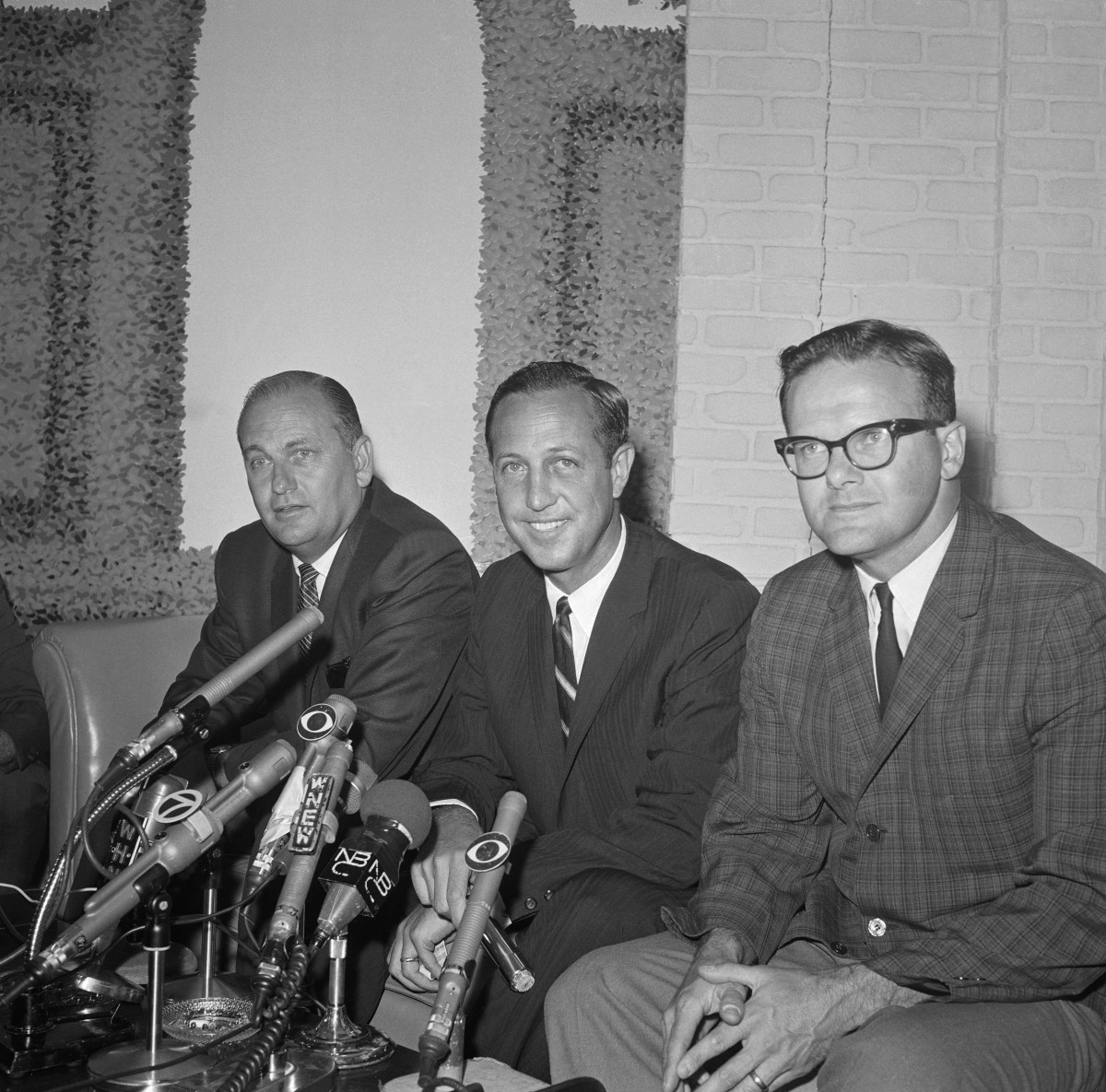
Those merger talks didn’t take place in a fancy boardroom or executive suites. With the blessing of the latest NFL commissioner, Pete Rozelle, Tex Schramm (president and GM of the NFL’s Dallas Cowboys) met with Lamarr Hunt (who had founded the first AFL team in Dallas and moved it to Kansas City) planned to meet at the airport in Dallas near the old Texas Ranger statue.
“Since it was a public place, Schramm suggested they talk in a nearby parked car,” Deninger explained. “So they had their merger talk in an Oldsmobile in the parking lot of Love Field,” Deninger laughed, “and in 45 minutes sketched out what it would look like.”
In June of 1966, Rozelle announced the two leagues would merge, and there’d be a game at season’s end between the league champions.
“The first Super Bowl wasn’t actually called the Super Bowl,” Deninger explained. “Rozelle didn’t like the word ‘super,’ so the official name was the AFL-NFL World Championship.”
But that didn’t stop the media from calling it the Super Bowl. The name quickly stuck.
“Rozelle was a man of vision,” Deninger explained. “He saw the Super Bowl as the biggest sporting event of the year, alongside the Kentucky Derby and the World Series. Because it was held in January, he wanted it in warm-weather cities where people could plan their travels in advance.”
Rozelle also wanted more time to promote the season finale. He wanted a two-week break, which gave rise to Super Bowl week. And time to gin up excitement and revenue.
The first Super Bowl was held on January 15, 1967, featuring the Green Bay Packers and Kansas City Chiefs.
“Tickets cost $6, $10 and $12, and it wasn’t a sellout,” Deninger noted. “There were 30,000 empty seats in the [Los Angeles] Coliseum.”
But the game turned out to be a hit with television viewers.
“NBC carried AFL games and CBS carried NFL games, and each network paid the league a million dollars to televise the game,” Deninger said. “Two of the three major networks heavily promoted it.”
There was a great deal of pressure on Packers head coach Vince Lombardi to win the game and defend NFL’s reputation against the upstart AFL team. The Packers won handily, 35-10, and the first Super Bowl became the most-watched sporting event in American history (as) more than 51 million viewers tuned in. Only two years later, “Broadway Joe” Namath led his Jets to the AFL’s first Super Bowl win.
The game’s significance grew quickly along with the league and as the two leagues achieved parity. So too did the NFL’s halftime show.
“Early halftime shows were meant simply to fill the field with college bands, floats and variety acts,” Deninger explained. “They were very G-rated and middle-of-the-road.”
That changed after 1992.
“Fox had just debuted and was trying to attract viewers,” Deninger explained. “They promoted a special episode of their hit comedy-sketch show In Living Color during Super Bowl halftime, featuring Jim Carrey and Jamie Foxx. Twenty-five million viewers switched over.”
Alarmed, the NFL decided they needed the biggest act possible for the next year, and in 1993 booked Michael Jackson.
“That ended the era of viewers tuning away from the halftime shows,” Deninger added. “Since 2012, the halftime show has been the highest-rated portion of the broadcast.”
Much has changed since that first Super Bowl.
“The fact is, there’s a sense of communal bonding around the game that you don’t get with almost any other national event,” Deninger said. “The Super Bowl has become America’s secular holiday.”
In a polarized era, the center is dismissed as bland. At Newsweek, ours is different: The Courageous Center—it’s not “both sides,” it’s sharp, challenging and alive with ideas. We follow facts, not factions. If that sounds like the kind of journalism you want to see thrive, we need you.
When you become a Newsweek Member, you support a mission to keep the center strong and vibrant. Members enjoy: Ad-free browsing, exclusive content and editor conversations. Help keep the center courageous. Join today.
Read the full article here
