

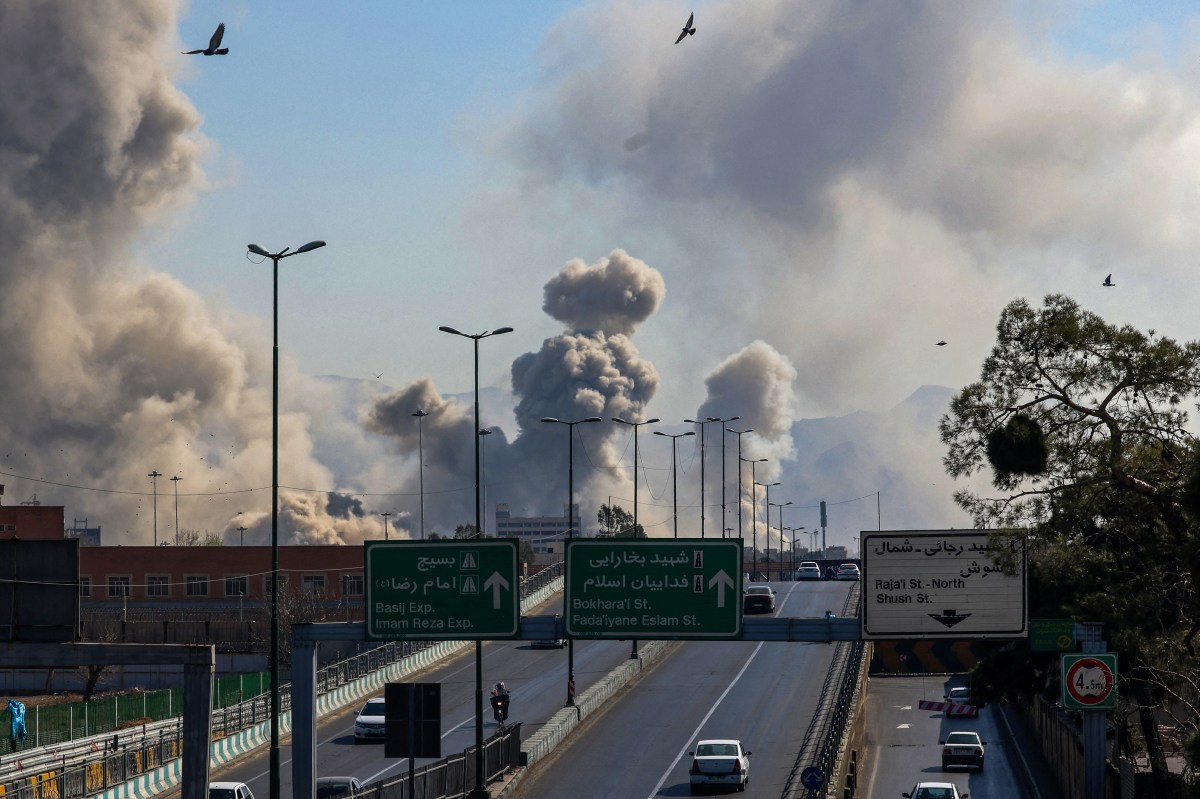
Most of the world’s attention in the confrontation with Iran has focused on the obvious places: Israel, Iran and the Arab states across the Persian Gulf within reach of Tehran’s missiles and drones.
But wars rarely respect the neat geography of news coverage. Their consequences ripple outward, often reaching places that initially seem far from the battlefield.
One way to see it is to open a live map of global air traffic.
The picture looks different from only a few years ago. Flights moving between Europe and Asia once crossed broad swaths of Russian airspace or the Middle East. Today many of those routes are closed, restricted or simply considered too risky. Russian skies have largely been off limits since the invasion of Ukraine. Parts of the Middle East now carry new security concerns as tensions around Iran escalate.
So airlines have begun funneling through a narrow band of sky over three countries that rarely occupy the center of American strategic thinking: Armenia, Georgia and Azerbaijan.
What was once a relatively quiet stretch of airspace has become one of the busiest corridors between Europe and Asia. Aviation planners increasingly refer to it as the “Caucasus corridor.” Air traffic data shows the shift clearly.
For the countries beneath it, the sudden congestion overhead is less a commercial opportunity than a reminder of geography. When great powers collide, smaller states nearby tend to absorb the pressure.
For the South Caucasus, the timing could hardly be more delicate.
After decades of hostility between Armenia and Azerbaijan, the region had been edging toward what many diplomats hoped might become a fragile normalization. Washington and European governments have spent the past two years encouraging a framework built around economic integration and regional transit—trade routes that could link the South Caucasus more tightly with markets in Europe and Asia.
The logic held that if the region became a reliable bridge for commerce and infrastructure, the incentives for renewed war would shrink. The confrontation with Iran now introduces new uncertainty.
Across the Middle East, governments are watching how the crisis unfolds and drawing their own conclusions about the durability of external security guarantees. Gulf states that host American bases have still faced missile and drone attacks in recent years. Fairly or not, a perception circulates in regional political circles that outside protection has limits and that prudent governments must hedge.
Perceptions like that travel quickly. In the South Caucasus, where rivalries have long been shaped by shifting alliances among larger powers, even subtle changes in outside credibility can ripple through local calculations.
None of it is new, in a way. History tells us that major wars rarely stay contained. Trade routes shift as insurers raise risk premiums and cargos reroute. Border crossings grow tense as governments prepare for possible refugee movements. In rugged terrain, smuggling networks and illicit arms flows can expand quickly.
Then there are the accidents. Missiles misfiring, drones stray, ships sunk and planes downed by mistake, miscommunication—the list goes on and on. In volatile conflicts, geography can turn nearby countries into unwilling spectators to events they cannot control.
Consider the ways in which the war could reshape the strategic balance for my country, Armenia, which I served as ambassador to the United States (and Mexico) and deputy foreign minister.
For Armenia, Iran has long been an awkward but important neighbor. Despite ideological differences, Tehran has served as a counterweight to the increasingly close strategic partnership between Turkey and Azerbaijan. Its presence has helped ensure that no single bloc dominates the region’s political landscape.
At the same time, Iran has been one of Russia’s closest partners in the broader geopolitical contest with the West. If the current conflict significantly weakens Tehran, the consequences could cut in multiple directions. A diminished Iran might remove a balancing factor valued by Armenia while also limiting Russia’s ability to project influence southward.
What the region ultimately needs is not a victory by the Islamic Republic regime. It needs an Iranian state stable enough to police its borders and function as a normal neighbor.
Several futures are possible. Iran’s leadership could survive the confrontation but emerge weakened, producing a period of uncertainty along its frontiers. A longer-term political transition might eventually open to broader economic integration with its neighbors, though such transitions are rarely tidy.
The most destabilizing outcome would resemble the fragmentation seen in Iraq or Syria after the collapse of state authority. Militias, proxy forces and criminal networks tend to spill outward in those circumstances, and mountainous borders are difficult to control. This week’s news of Kurdish fighters and arms streaming into Iran is, from that perspective, disconcerting.
Ironically, the least dramatic outcome may also be the most stabilizing: a battered but functioning Iranian state capable of policing its frontiers and participating in regional trade, no longer menacing anyone.
Geography ensures that Iran will always seek influence in the South Caucasus. Armenia offers potential access routes toward Europe and Russia that bypass dependence on Turkey. Any government in Tehran—revolutionary or pragmatic—will have incentives to maintain a presence there.
For Armenia and its neighbors, the immediate challenge is navigating uncertainty without losing the fragile momentum toward regional cooperation.
That means protecting the sovereignty principles behind emerging transit routes, ensuring that connectivity does not come at the cost of jurisdiction or legal control. It means quietly preparing for possible refugee movements and strengthening border security across difficult terrain.
It also means continued engagement by outside sponsors. If Washington hopes to stabilize the South Caucasus, the emerging framework for regional connectivity cannot be treated as a one-time diplomatic initiative. Moments of geopolitical shock tend to test commitments.
The unfinished peace between Armenia and Azerbaijan still requires careful work as well. Issues such as Armenian detainees held in Baku, displaced communities from Nagorno-Karabakh, and legal guarantees may sound technical—but they form the scaffolding of any settlement capable of withstanding outside pressure.
Eventually, the confrontation with Iran will end. If Iran emerges battered but stable and eventually becomes part of the region’s trade networks, the South Caucasus could evolve into something strategically valuable: a bridge linking Europe and Asia through predictable rules and shared economic interests.
If instability spreads northward instead, the region may find itself bordering a prolonged zone of turbulence. That will matter to the West too, and it would undermine last August’s TRIPP agreement (establishing a trade corridor through Armenia that is also valuable to Azerbaijan, and that U.S. President Donald Trump rightly hails as a major achievement).
For now, the crowded skies above Armenia, Georgia and Azerbaijan offer a quiet reminder of how quickly distant wars can reshape the strategic map. A region that once seemed peripheral now sits along one of the world’s most important transit routes—and beside a conflict whose consequences may travel farther than anyone expects.
Grigor Hovhannisyan is the former Armenian ambassador to the U.S. and Mexico and Armenia’s former deputy foreign minister.
The views expressed in this article are the writer’s own.
Read the full article here
