

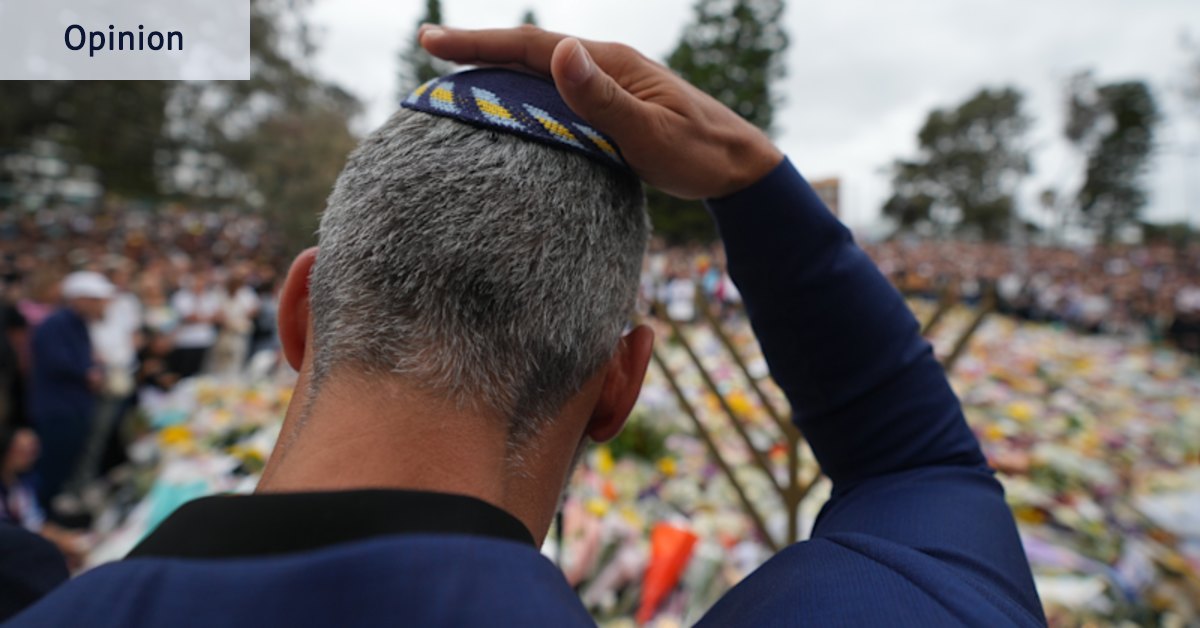
On the morning after the massacre, I happened to be standing alongside the Liberal leader at Bondi Pavilion as she first started to hear from those affected. Arms rigid, hands clasped tight together, face almost blank, she, like all of us, seemed shell-shocked. Now, in voicing her fury so volubly, she may have strengthened her hold on the party – conservative politics has become so untethered recently, it is hard to tell – but has such a personalised attack undercut her claim for national leadership?
Loading
Something she said on television the next day is also worthy of note. After speaking to the prime minister on the night of the attack, she had not had a conversation with him thereafter. It’s another marker of broken bipartisanship, and how the political dialogue is being conducted in front of a thicket of microphones. In the past 25 years, I cannot recall an angrier fortnight in Australian politics. Likewise, in a quarter-century of covering terrorist strikes in North America, Europe and South Asia, I’ve not seen a more vilifying political response.
Here, there are contrasts to be drawn with the bipartisanship in America immediately after 9/11 in 2001, before the Bush administration’s invasion of Iraq had such a polarising effect. As dusk faded into night that awful day, Republican and Democratic lawmakers assembled on the steps of Capitol Hill to sing God Bless America. George W. Bush, after addressing a joint session of Congress on September 20, 2021, was hugged by the then Senate Democratic leader Tom Daschle, another gesture of patriotic unity.
The attacks are not strictly analogous. Al-Qaeda targeted an entire country rather than a specific community. Nonetheless, the cessation of political hostilities in a city that by the turn of the century was already becoming a cesspit of hyper-partisanship was impressive. John Howard, who on 9/11 watched smoke rise over the Pentagon, experienced it firsthand.
To watch Anthony Albanese is to be reminded of George W. Bush’s response to the destruction of the Twin Towers. The then-US president struggled to find apposite words. Often, he appeared ashen-faced and overwhelmed by the immensity of the crisis. Because of his halting, almost syncopated delivery, questions were raised about his communication skills. Only when he stood atop the rubble of Ground Zero, bullhorn in hand, did Bush finally find his voice.
Loading
By contrast, when Albanese returned to Bondi last Sunday for the Day of Reflection vigil, he was heckled by some in the crowd and not invited to utter a single word. For him, it must have felt like a day of retribution. Rather than wrapping his arms around community members – something he has done privately with victims’ families – he had to be enwrapped by his security detail. Because of his enforced absence from the stage, Governor-General Sam Mostyn – whose carefully weighed words and gestures have widely been judged to have met the moment – spoke on behalf of the nation.
Watching a prime minister struggle to take command raises a broader question: whether the office itself has been weakened and degraded by the here-today-gone-tomorrow turmoil of the past 20 years. Over that period, there have been eight different prime ministerships, compared with just three between 1985 and 2005. During the COVID crisis, Scott Morrison was outshone by popular state premiers, such as Mark McGowan in Western Australia and Gladys Berejiklian in NSW. So much so that when The Australian Financial Review published its 2021 power index, state premiers usurped the prime minister. In this moment, too, NSW Premier Chris Minns, who was cheered at the Bondi vigil, has been lionised. For the right-wing press, praising Minns has become a means of denigrating Albanese.
Unfortunately, politics has entered the shouting phase when it still pays to be listening.
Hopefully, the holiday season will be defusing. A partisan ceasefire would be welcome. Noticeable, though, is how January, traditionally a rest period, has recently become a political fighting season, with each party determined to strike early to set the tone for the year ahead. Then come the culture war tensions of Australia Day.
That beachside vigil at Bondi culminated with the singing of “I am, you are, we are Australians”. Alas, this week will be remembered more for a cacophony of partisan rage.
Nick Bryant, a regular columnist, is a former BBC correspondent and author of The Rise and Fall of Australia: How a Great Nation Lost its Way.
Read the full article here
