

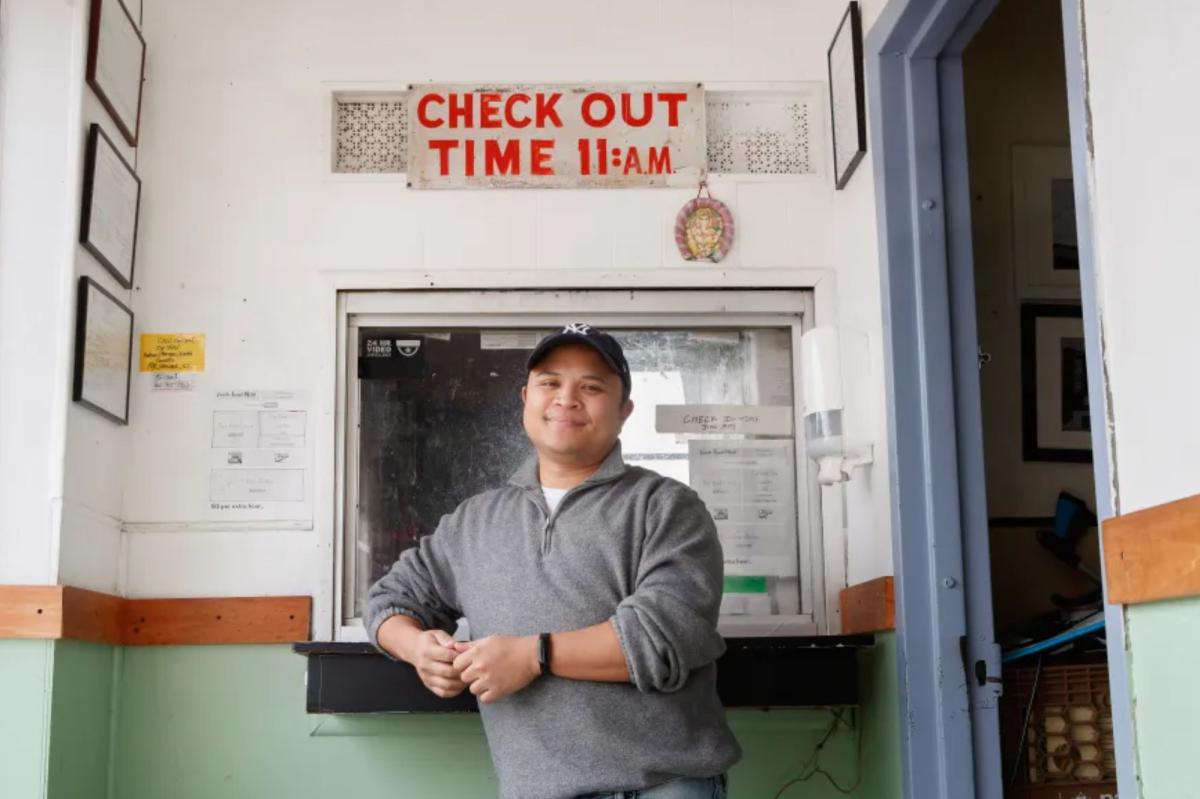
We hear so often about family businesses closing because the children who would have inherited them see their parents’ trade as being beneath them. But Brian Acosta Arya isn’t your typical millennial.
He was just 22 when he took over his father’s business, the Lincoln Tunnel Motel, situated on the side of a highway in North Bergen, New Jersey.
“Not a lot of millennials decide, okay, I’ll take the family business,” the 38-year-old told The Post.
Nothing about his lifestyle is glamorous. He works night shifts behind a glass divider and has to deal with guests’ fights, domestic violence, overdoses and even suicides. But Arya has found purpose in serving those who can barely afford the $90 nightly rate.
Often, he will take in guests who have been turned away from other places in their darkest moments. Sometimes he’ll give rooms for free to those who can’t pay the fee, or let them take a quick hot shower.
“Maybe they just need a shower, there’s no risk there,” he said. “Well, they can break the showers, and they might, but it’s only 30 minutes or less to wash up. Or they need to take a nap — what are they going to do, steal the bed? There’s no reason to even think about turning anybody down.”
In fact, he sees purpose in it.
“It’s beautiful, just helping people in their worst times, to their end times, to their best time,” he said. “You just see the gamut of the human condition.”
Arya’s philosophy, and his cinematic eye, have earned him a whopping 1.1 million followers on TikTok, where he shares his business’s day-to-day happenings.
His father, an immigrant from India with a background in engineering, first bought the roadside motel in the 1980s and eventually acquired nine others. The family lived in one, and Arya recalls being a kid and running up and down the halls of the motel he now runs. That experience gives him empathy for his customers now, he said.
“It was this weird dichotomy. I was the manager’s kid, but at the same time living amongst everybody too,” he remembered. “I witnessed my dad helping people. I would just be hanging out behind the front desk, helping the desk clerks, seeing both sides.”
He recalls his father’s unusual compassion: “From the other side of the window, I saw the kinds of people that would come in, and, if they couldn’t afford the night, my dad would be like, ‘OK, that’s alright, just pay me tomorrow, pay me next week, maybe when the next check comes in.’”
But the reality of running an affordable motel is a lot tougher than he realized as a child.
“I’m here for the hours that people don’t see,” he said. “I work the night shift, when people are under extreme stresses sometimes.”
He plays peacemaker in domestic violence situations and fights that break out in common areas.
“I can defuse even the testiest, most aggressive people,” he said. “It’s akin to working a night shift at a bar or a late night club. You just have to be more grounded.”
He also dealt with a suicide in room 123, a memory that will stick with him forever.
“I had a guest who checked in, and he didn’t necessarily check out. You obviously clean it up and just have respect for the whole situation,” he said. “I know how to deal with it, because I grew up in a generation where I have friends who have unalived themselves.”
Drugs are always a looming threat — he’s dealt with three overdoses onsite — but Arya prides himself on the fact that maids find paraphernalia far less frequently now than they did when he first took over.
“I’ve had to really tell people that it’s not gonna happen here anymore,” he said. “I love literally chasing people away who are selling something.”
Arya recently set up a donation table for food and clothes which often clears out in hours. “You try to make people comfortable, but then again we don’t have a lot of amenities to give them. We don’t have hot tubs,” he said.
The $90 nightly rate is much cheaper than the average $150 in the area, and Arya doesn’t require a credit card. Visitors can stay for as little as three hours. Some without other options take advantage of longer weekly rates.
More recently, he’s seen a spate of people displaced from homes because they can’t afford rising rents.
“They don’t have the ability to get an apartment deposit, first month’s rent, brokers’ fees, or whatever,” he said.
Every day brings a new challenge, but Arya is proud that he stuck with his family business when many in his generation might have turned their backs on the trade.
Read the full article here
